
The Full-Size Luxury Sedan That Delivers Mercedes S-Class Vibes At A Discount
Full-size luxury sedans have always occupied a special place in the automotive hierarchy — they’re the proving grounds where automakers push comfort, technology, and craftsmanship to their absolute limits. If you want to understand where the industry is headed, you watch what happens in this segment first. And for decades, one nameplate has defined the benchmark against which every rival is measured: the Mercedes-Benz S-Class.

The Mercedes-Benz S-Class has debuted some of the most useful — and occasionally most gimmicky — technology known to the automotive world. Electronic stability control (called Electronic Stability Program in Mercedes-Benz’s parlance), now a mandatory safety feature in new cars, made its debut in the W140 S-Class. So did CAN Bus, the communication architecture that underpins modern vehicle diagnostics and connects to your OBD2 port. Comfort innovations from that era included jam protection for power windows, a self-closing trunk lid, and double-pane window glazing, among others.
The Mercedes-Benz S-Class remains the segment benchmark — and its pricing reflects that. The S-Class starts well into six-figure territory, while the BMW 7 Series and Audi A8 follow closely behind. While the Germans have long dominated the full-size luxury sedan genre, challengers have emerged from other regions — most notably Japan. And the Japanese contender also happens to be among the segment’s most accessible in terms of price. But does a lower sticker mean you’re sacrificing prestige?
The Lexus LS Offers Flagship Luxury For Less

When Mercedes-Benz was engineering the near-perfect W140 S-Class, Toyota decided to challenge the status quo with its own vision of the full-size luxury sedan. The Lexus LS — which simply stood for “Luxury Sedan” — debuted in 1989 for the 1990 model year, and it was the pivotal moment that put Japan on the radar of luxury car buyers. It cost less than the S-Class while offering qualities that matched, and sometimes exceeded, the W140 of that era. The question is whether that value proposition still holds today.
The Affordable Full-Size Luxury Sedan
The Lexus LS carried a base price that, while far from cheap, makes it the most accessible entry point in the full-size luxury sedan segment — undercutting even the Genesis G90 when it was available new, which has disrupted this class in its own right. The final Heritage Edition came with a starting price of $99,280, but if pick a model from a couple of years back, you can have it between ~$70,000 and ~
$90,000.
The fifth-generation Lexus LS rides on the TNGA-L platform designed for grand tourers and full-size luxury sedan applications. It underpins the Lexus LC and even the Japanese-exclusive Toyota Crown full-size luxury sedan, which is mechanically unrelated to the TNGA-K-based Crown crossover sedan sold in the United States. Introduced for the 2018 model year, the LS lasted until 2025, when the automaker decided to draw the curtains by launching a farewell edition called the “Heritage Edition”, limited to 250 examples.
V-6 Engines In Two Flavors

When the LS originally debuted in 1989, it made waves with its refinement and legendary Toyota reliability. Who could forget the iconic Lexus commercial in which wine glasses were stacked on the hood of the LS to demonstrate the smoothness of its then-new V-8? In the last LS, however, that V-8 was replaced by two V-6 options. The LS 500 is powered by a 3.4-liter twin-turbocharged V-6 producing 415 horsepower and 440 pound-feet of torque, driving either the rear or all four wheels through a ten-speed automatic transmission.
There’s also a hybrid variant called the LS 500h, which pairs a 3.5-liter naturally aspirated V-6 with two electric motors for a combined system output of 354 horsepower and 369 pound-feet of torque. Dubbed the Multi Stage Hybrid, this system was engineered with both performance and luxury in mind.
One of its more distinctive features is a four-speed automatic embedded within the e-CVT, delivering the direct throttle response of a conventional gearbox alongside the efficiency benefits of a CVT. In total, the dual-transmission setup offers flexibility comparable to a ten-speed automatic. Here’s how the Lexus LS stacks up against the S-Class in terms of powertrain options.
|
Lexus LS |
Mercedes-Benz S-Class |
||||
|
LS 500 |
LS 500h |
S 500 |
S580 |
S580e |
|
|
Engine |
3.4-liter twin-turbo V-6 |
3.5-liter V-6 hybrid |
3.0-liter turbo straight-six 48-volt mild hybrid |
4.0-liter twin-turbo V-8 48-volt mild hybrid |
3.0-liter turbo straight-six plug-in hybrid |
|
Drivetrain |
RWD, AWD |
AWD |
AWD |
||
|
Horsepower |
415 hp |
354 hp |
442 hp |
496 hp |
503 hp |
|
Torque |
440 lb-ft |
396 lb-ft |
413 lb-ft |
516 lb-ft |
553 lb-ft |
|
Transmission |
10-speed A/T |
e-CVT with 4-speed A/T |
9-speed A/T |
||
|
0-60 MPH |
4.6 sec. |
5.2 sec. |
4.5 sec. |
4.3 sec. |
4.8 sec. |
|
EPA Combined MPG |
21 MPG |
25 MPG |
24 MPG |
21 MPG |
23 MPG |
|
EPA Combined MPGe |
N/A |
49 MPGe |
|||
|
EPA EV Range |
N/A |
46 miles |
|||
A Car Worth Buying Used

In its final iteration, the Lexus LS didn’t move the goalposts or reshuffle the full-size luxury sedan hierarchy — but that doesn’t mean it wasn’t excellent. Repeating a legend is a difficult feat, and the LS doesn’t try to. Instead, it continues to offer full-size luxury at prices below the S-Class, wrapped in a character that makes it genuinely rewarding to own.
An Ageless Exterior

The last-gen LS first arrived for the 2018 model year, so it’s no longer new by any measure — yet it doesn’t look dated, either. Perhaps the only reason it carries an old-school aura is that it has been on the market for several years now, but in hindsight, the LS has aged remarkably well.

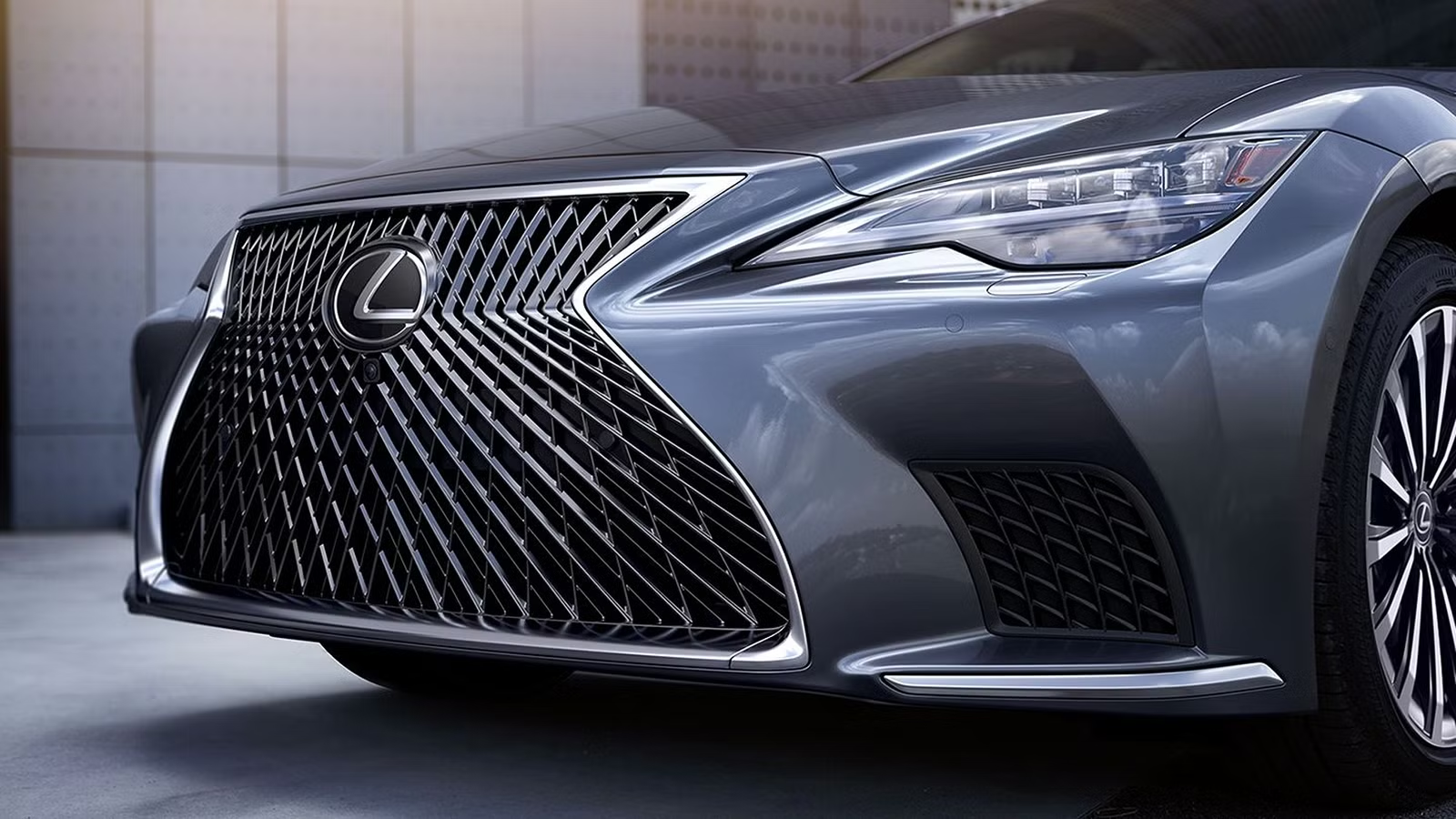
The Spindle Grille dominates the front fascia, but unlike certain German rivals that grafted oversized grilles onto their vehicles without fully integrating them into the overall design, the Spindle Grille blends harmoniously with the LS’s curvaceous bodywork.
Whether the LS is outright pretty is a matter of personal taste, but most observers would agree it presents a more cohesive design than the current 7 Series. The Genesis G90 may be the current design favorite in the segment, but the LS holds its own against its peers.
A Well-Crafted Interior

Like the exterior, the LS’s interior has been refined over the course of its lifetime. The most significant change was replacing the polarizing Lexus Remote Touch touchpad-based infotainment system with the newer Lexus Interface, which required the main touchscreen to be repositioned further forward. Another defining feature of this generation is the use of Kiriko glass — a traditional Japanese art form in which intricate patterns are hand-cut into glass, developed in partnership with Asahi Glass Company.
One of the LS’s most appreciated qualities is something that isn’t remotely cutting-edge: physical controls. As automakers increasingly strip cabins of buttons and knobs in favor of touchscreens, the LS retains a generous complement of tactile controls. Better still, they feel premium to the touch, making every interaction feel both intuitive and special.
Optional extras elevate the experience further, including a 23-speaker Mark Levinson Reference Surround Sound System. Opting for the Executive Package upgrades the Adaptive Variable Suspension to air suspension and adds a pair of VIP-class rear seats with a central touchscreen to control various vehicle functions.
A Serene Yet Capable Drive
Comfort In Spades

Unsurprisingly, Lexus’s flagship is loaded with refinement, making every mile feel serene. Rattles and vibrations are virtually nonexistent, and outside noise is suppressed to a whisper. The S-Class may still set the ultimate benchmark for cabin quietness, but the LS is already superlatively hushed in its own right. Road imperfections are absorbed with real delicacy, further contributing to the car’s tranquil character.
As for handling, the Lexus LS 500 is best described as capably composed. Grip limits are surprisingly high for a car of this size, though the LS’s mass makes itself felt when direction changes are demanded quickly. That’s no criticism — this is a full-size luxury sedan, not a track car. On a well-chosen stretch of twisty road, the LS performs with genuine confidence.
Though The Hybrid Isn’t That Efficient

Somewhat surprisingly, the Multi Stage Hybrid’s goal of blending spirited performance with efficiency doesn’t translate into a dramatic fuel economy advantage over the standard model. The LS 500h returns a combined EPA figure of 25 MPG, which isn’t a significant leap over the LS 500’s 21 MPG combined rating. The hybrid’s strongest case may simply be its additional refinement at low speeds. Even so, the blended e-CVT and four-speed automatic transmission performs impressively — even at wide-open throttle, the V-6 recorded a 70-dB noise level, which is lower than both the current S-Class and the newer 7 Series.
Sources: Lexus, KBB

Related posts


Latest Post


No Comments