
Ducati’s Supermono Turned One Cylinder Into a Racing Cathedral
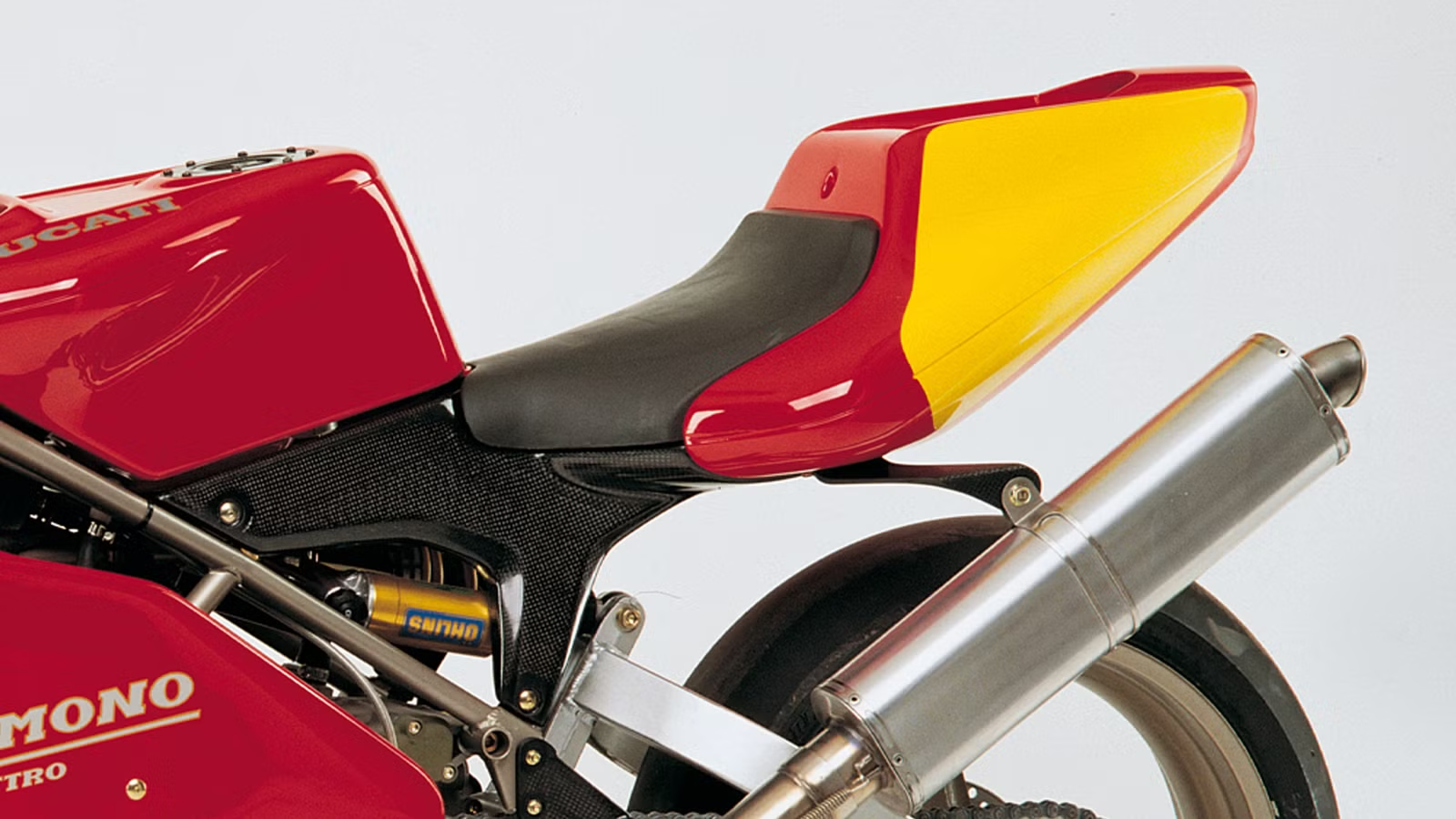
In the early 1990s, Ducati decided to do something it hadn’t done for years; it created a single-cylinder race bike. This race bike couldn’t just be any regular bike, though, as the architecture had to be built from scratch and, in true Ducati fashion, it had to win. While the manufacturer made just 67 bikes, they created something so good, so awe-inspiring, that not only is it still talked about today, but it’s one of the most successful bikes to ever leave Ducati’s production line.
Before Superbikes Took Over, Europe Fell In Love With Big Singles

Europe has long held a passion for single-cylinder racing. Their comparative simplicity, lightness, and sharp handling made them popular, and with fewer moving parts, they were cheaper and easier to produce than their multi-cylinder cousins. This made them an attractive prospect not just for factory teams but for enthusiastic amateurs, too, with the Sound of Singles formula becoming the perfect playground for them. For many riders who wanted affordable, competitive racing, it became one of the best places to find these machines.
Rather than being a traditional manufacturer-backed championship, the Sound of Singles was a racing formula that grew in popularity across Europe after beginning in Britain. The series promoted affordable, lightweight racing built around large-capacity four-stroke single-cylinder motorcycles, offering riders enough technical freedom that the sport’s popularity soon attracted factory involvement. And while familiar names like Honda and Yamaha, along with more niche brands like Gilera, lined up on the grid, there was one that was more of a surprise: Ducati.
Ducati was, and still is, best known for creating V-twin-engined bikes. The Italian brand is almost synonymous with the layout, having introduced its first production 90-degree V-twin with the 1971 750 GT by Fabio Taglioni. But by the late 1980s, the development and marketing opportunities offered by the Sound of Singles formula were too hard to ignore. Ducati wanted to enter, but it would have to go back to the drawing board to do so.

Racing Rules Sometimes Create Engineering Masterpieces

History shows that some of the world’s most extraordinary racing machines weren’t created without a rule book — they were created because of one. Formula 1 has a litany of examples, like Gordon Murray’s 1978 Brabham BT46B fan car, which placed a large fan on the back that was “primarily” for cooling, with the “secondary” effect of sucking the car onto the track for more grip. In IndyCar, Penske Racing’s 1994 PC-23 used the Mercedes-Benz 500I engine, a larger-displacement pushrod engine that exploited a loophole in the Indy 500 rules and went on to win by over eight seconds.
Ducati was no stranger to this in motorcycle racing. While innovations like the Desmodromic valve system, which mechanically closed valves rather than relying solely on springs to reduce the risk of valve float at high engine speeds, were well within the rules of its competition, Ducati had worked within those rules to great effect. When it arrived in the late 1980s, World Superbikes allowed both V-twins and four-cylinder bikes to compete against each other, but, to keep them somewhat equal, V-twins could have more displacement (1,000 cc) than four-cylinder bikes (750 cc). Ducati’s 851 combined the advantages of the V-twin layout with modern racing technology to immense success, winning the first World Superbike race and taking the title two years later.
It was this understanding of both engineering and the rules that led to one of Ducati’s most surprising, yet successful, bikes.
The Supermono Was Ducati’s Unlikely Racing Weapon

The 1993 Ducati Supermono was a considerable departure from the norm for the Bologna-based bike manufacturer, with the most obvious reason being that it was the first time it had released a single-cylinder bike since 1974. Ducati had built its name on V-twins, so the decision to develop a new bike specifically for single-cylinder competition was out of character. But as the championship grew. So did the level of competition. Rather than adapting one of its existing motorcycles, Ducati elected to build a purpose-designed racer from the ground up, with a single objective: win.
A key part of the Supermono was its remarkably slim bodywork. With just a single cylinder to package instead of Ducati’s usual V-twin, designer Pierre Terblanche had far more freedom than he normally would have. Rather than simply making the bike narrower, he used that extra space to sculpt the bodywork around the 549 cc engine as tightly as possible, creating one of the most aerodynamic motorcycles Ducati had ever built. At 75 horsepower it wasn’t the most powerful bike Ducati had in its lineup (that accolade belonged to the 888 SP5, which made 118 hp) but with just a 277-lb dry weight, it was nimble enough.
The single-cylinder nature of the bike did raise a problem that Ducati wasn’t used to, though: vibration. The V-twin layout naturally canceled many of the forces that cause vibration, but a single large piston offered no such luxury. To combat this, Ducati engineers added a fake con rod to the crankshaft opposite the real connecting rod. This was weighted and moved at the same time as the real piston, with the forces canceling each other out and resulting in a far smoother ride. This also carried the benefit of weight reduction — something that Ducati was hyper-vigilant about with the Supermono.

Every last bit of weight that could be shaved off was saved. Carbon fiber was used extensively across the bodywork, subframe, fuel tank, airbox, and elsewhere. Even the gas cap wasn’t safe. The wheels were made from magnesium, as were the engine covers. It made for a particularly light bike that, while not the absolute lightest on the grid (the Gilera Saturno Piuma, for example, weighed 267 lbs dry) was the best overall package.
Despite all of this, the Supermono was never intended to be a road bike. Ducati built it solely to compete in the European Sound of Singles Championship, producing just 67 examples between 1993 and 1995. It was effectively a factory race bike that just happened to exist outside of Grand Prix racing. And it was the most forward-thinking machine that Ducati had in its stable.
The Most Sophisticated Single-Cylinder Racer Ducati Ever Built

The bike wasn’t just an engineering marvel, as it had true pedigree on track. In the hands of Italian racer Mauro Lucchiari, it won both the Rider and Manufacturer titles in its debut season in the European Supermono Championship. The bike then placed second in the Singles TT race at the 1994 Isle of Man TT in the hands of Kiwi Robert Holden, then won the class by a minute and a half the following year. But with its purpose fulfilled, Ducati put the bike to pasture.
67 Bikes Later, The Supermono Became Ducati Royalty

As the Supermono came in such a limited run, it’s an incredibly rare and prized bike today. Just finding one for sale is a feat in itself so, when they do cross the block, they can go for a lot.
A bike in Australia sold for $110,000 AUD ($76,767 USD) in 2024, while a remarkably well-kept example sold for a stunning $230,050 in early 2026. It is easy to understand why, given that the bike is essentially a one-of-one within Ducati’s catalog. It spawned no road-going versions, had no successors, and existed purely to race. Two years and 67 bikes later, it was gone forever. But its legacy, and what it achieved, lives on.
Sources: Gilera Saturno Piuma Corsa

Related posts





Latest Post


No Comments