
5 Budget Muscle Cars Built to Fool Insurance Companies
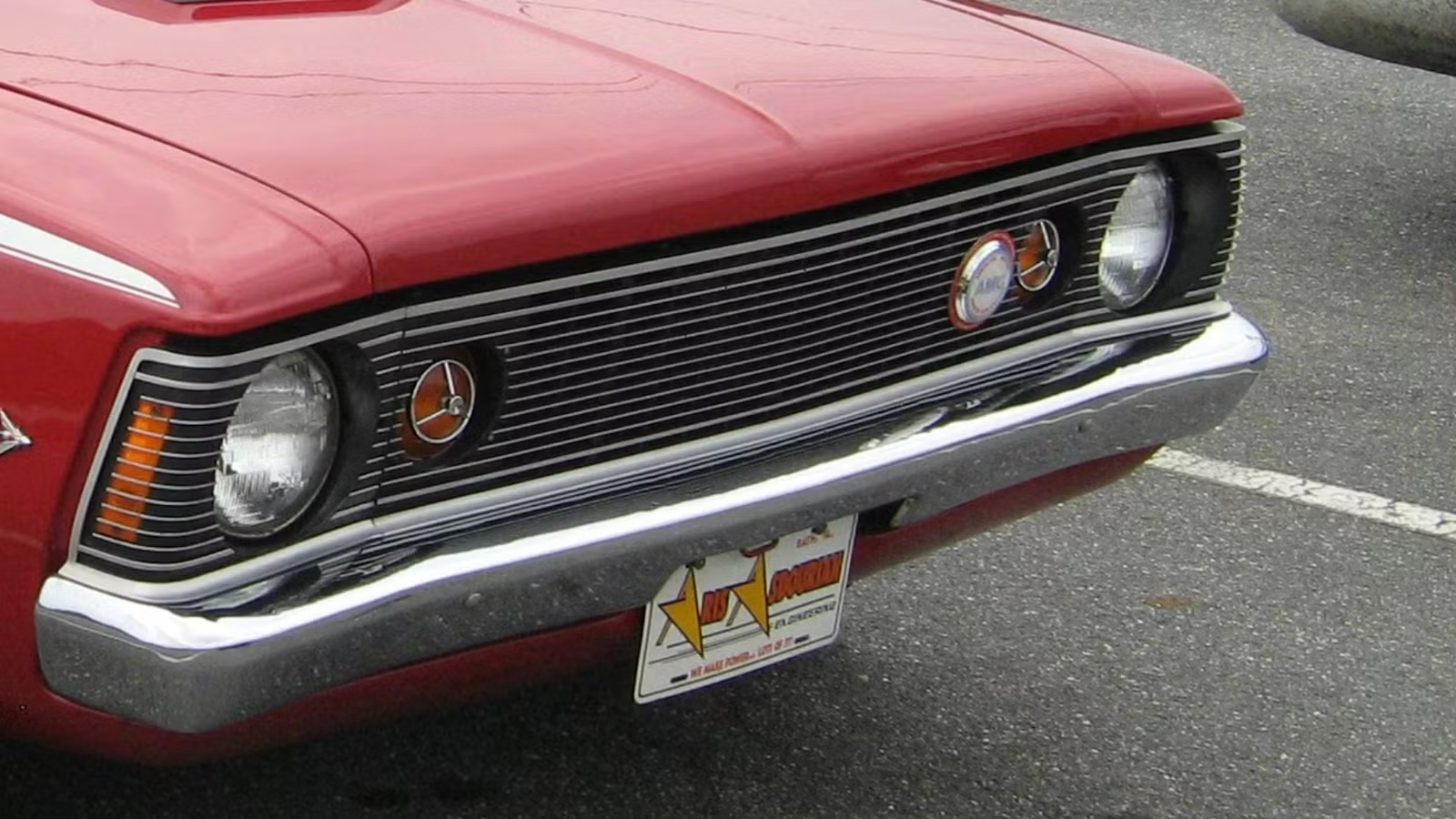
The insurance crisis didn’t kill the muscle car. It just forced Detroit to hide it better. By the early 1970s, anything wearing an SS, GTO, or R/T badge carried a premium steep enough to rival the car payment itself, so the factories got creative, putting the same engines in quieter badges with lower stated output. These five are ranked here from the mildest factory horsepower to the wildest, since most of them rolled off the same handful of assembly lines within a year or two of each other. The cars built to disappear are now harder to find than the icons they were built to undercut.
5
Chevrolet Heavy Chevy Chevelle
Horsepower: 240 HP

Chevrolet’s Heavy Chevy opens this list with the least factory muscle of the five, and that was the whole point. Built to dodge the SS insurance bracket, it ran on the base Chevelle rather than the upscale Malibu that carried the SS badge, so there was no red flag for adjusters to spot. Chevrolet’s own 1972 brochure called it an economical running mate to the one on top. That’s the SS, and Chevrolet sold it purely as a styling package, with a domed hood, blacked-out grille, Rally wheels, and a stripped interior to save weight and cost. None of that stopped buyers from optioning real iron underneath, up to the 402 cubic-inch LS3, the same big-block once known as the 396 and marketed by Chevy as the “Turbo-Jet 400,” rated 240 to 260 horsepower depending on the model year. The 454 stayed off the order sheet entirely, reserved for the SS alone.
The package came with F41 heavy-duty suspension and a domed hood held down by hood pins and lanyards, dressed in full-length body stripes doing the visual work the SS badge couldn’t. Chevy ran the same play across the showroom floor, launching the Rally Nova alongside it as a companion insurance-dodger built on the smaller Nova platform. Buyers got a bench seat over rubber floor mats inside, in keeping with the whole exercise. Spend nothing on flash, put everything into the engine bay. Chevrolet built 6,727 Heavy Chevys in 1971 and 9,508 in 1972, a total of 16,235, with only 286 of the 1972 cars carrying that 402, and just 272 of those paired with the special heavy-duty MC1 three-speed manual. Clean examples now trade between approximately $33,000 and $72,577.
4
AMC Hornet SC/360
Horsepower: 245 HP


Next up is the AMC Hornet SC/360, and AMC said the quiet part out loud. Its own 1971 print ad called the car a sensible alternative to the money-squeezing, insurance-strangling muscle cars of America, and it meant every word. Standard form got a 360 V8 rated 245 hp tuned specifically to land in a lower insurance bracket, while the optional $199 Go Package bumped that to 285 with a four-barrel carburetor, functional ram air, a handling package, a large tachometer, and raised white-letter tires. Base price was $2,663, about $40 under a 1971 Plymouth Duster 340, putting AMC’s budget muscle play directly against Mopar’s.
Buyers could step up from the standard three-speed to a Hurst-shifted Borg-Warner Super T-10 four-speed, with a Dana rear axle available up to 3.91 gears for anyone chasing a quicker launch. At around 3,200 pounds, a stock SC/360 ran the quarter mile in 14.80 seconds at 94.6 mph in period press and media testing, brisk numbers for something that still looked like an econobox from the curb. AMC built exactly 784 SC/360s against a planned run of up to 10,000, and only 578 of those got the four-barrel engine. Surviving examples are scarce, with only a handful of them remaining today, and clean cars now command an average price of $48,250.
3
Oldsmobile Rallye 350
Horsepower: 310 HP

Oldsmobile’s Rallye 350 splits the difference, and the brand wasn’t shy about why it existed. A key feature in selling the Rallye 350 was insurability; Oldsmobile promised real performance without the premium that came with a 442. The package ran for 1970 only, built around a single engine, the L74 350, rated 310 hp and 390 lb-ft of torque. Every Rallye 350 left the factory in Sebring Yellow, the only factory color offered, with a W25 fiberglass hood and the mandatory FE2 heavy-duty suspension package standard, though body styles varied across the F-85 and Cutlass S lines, so no two were quite the same car under that paint.
Period press and media testing clocked a Rallye 350 at 0-60 in 7.0 seconds and through the quarter mile in 15.27 seconds at 94 mph, numbers that held up well against costlier rivals carrying twice the displacement. A 3.42 Anti-Spin rear axle was available for buyers who ordered the four-speed, sharpening the car’s straight-line credentials further. Oldsmobile built 3,547 of them in that single model year, including 1,020 F-85 Club Coupes, and that scarcity has pushed the market up steadily. The average price tag today sits at $30,429, with a 1970 example bringing $50,600 at an auction earlier this year.
2
Pontiac T-37
Horsepower: 345 HP

Pontiac’s T-37 takes the next spot, it got here by hiding the GTO’s engine in a cheaper, quieter box. The GTO had the performance. It just couldn’t dodge the premium. Insurers weren’t being paranoid about it. Pontiac’s GTO was racking up steep claims from young drivers in nearly 400-horsepower cars, and underwriters had started pricing that risk directly into premiums. Opening it up to the T-37 was Pontiac quietly admitting the GTO’s own hardware was the real product, and the badge just decided what you paid to insure it.
T-37 replaced the Tempest name for 1971, built on the same 112-inch LeMans chassis specifically to qualify for a lower insurance class, and Pontiac knew exactly what it was doing: build a car that cost and insured for less, then quietly open the order sheet to the same 455 H.O. that powered the GTO, rated 335 hp and 480 lb-ft of torque. Additionally, it could be had with a Ram Air III V8 that pushed power to 345 hp. Of roughly 44,986 T-37s built, 5,802 were V8s, and only a handful carried that 455 H.O. Today, T-37s average around $23,160 at auction, with prices ranging from $11,000 to as much as $30,800 for the right car.
The Most Underrated Muscle Car Of The ’70s
Despite its elevated styling and a potent engine, this General Motors muscle car doesn’t get nearly the credit it deserves.
1
Pontiac GT-37
Horsepower: 345 HP

Closing the list is the GT-37, Pontiac’s dedicated performance package layered onto that same T-37, and its own tagline put the pitch plainly. There’s a little GTO in every GT-37, and you don’t have to be over 30 to afford it. That line did most of the selling by itself. GT-37 added a Hurst shifter, GTO-style hardware, and the identical 455 H.O. that closes out this list in a tie with the T-37, each carrying a $358 premium over the base car. Of course, the Ram Air III engine was also an option. Visual details shifted mid-run, too.
Early 1971 cars wore eyebrow-style stripes echoing the GTO Judge, before Pontiac switched to a reflective sword-style stripe partway through the year, a detail collectors now use to date a car within its own model year. Pontiac built 7,221 GT-37s across the 1970 and 1971 model years, with the 455 H.O. cars making up only a tiny fraction of that total. The current asking prices generally land between $13,000 and $21,000, a fraction of genuine GTO money for a nearly identical thrust. Detroit built all five of these to disappear. Fifty years later, that’s exactly why they’re worth finding.
Sources: Classic.com, Bring A Trailer, Mecum

Related posts
Latest Post


No Comments