
The Forgotten Dodge Pickup That Invented The Factory Custom Truck
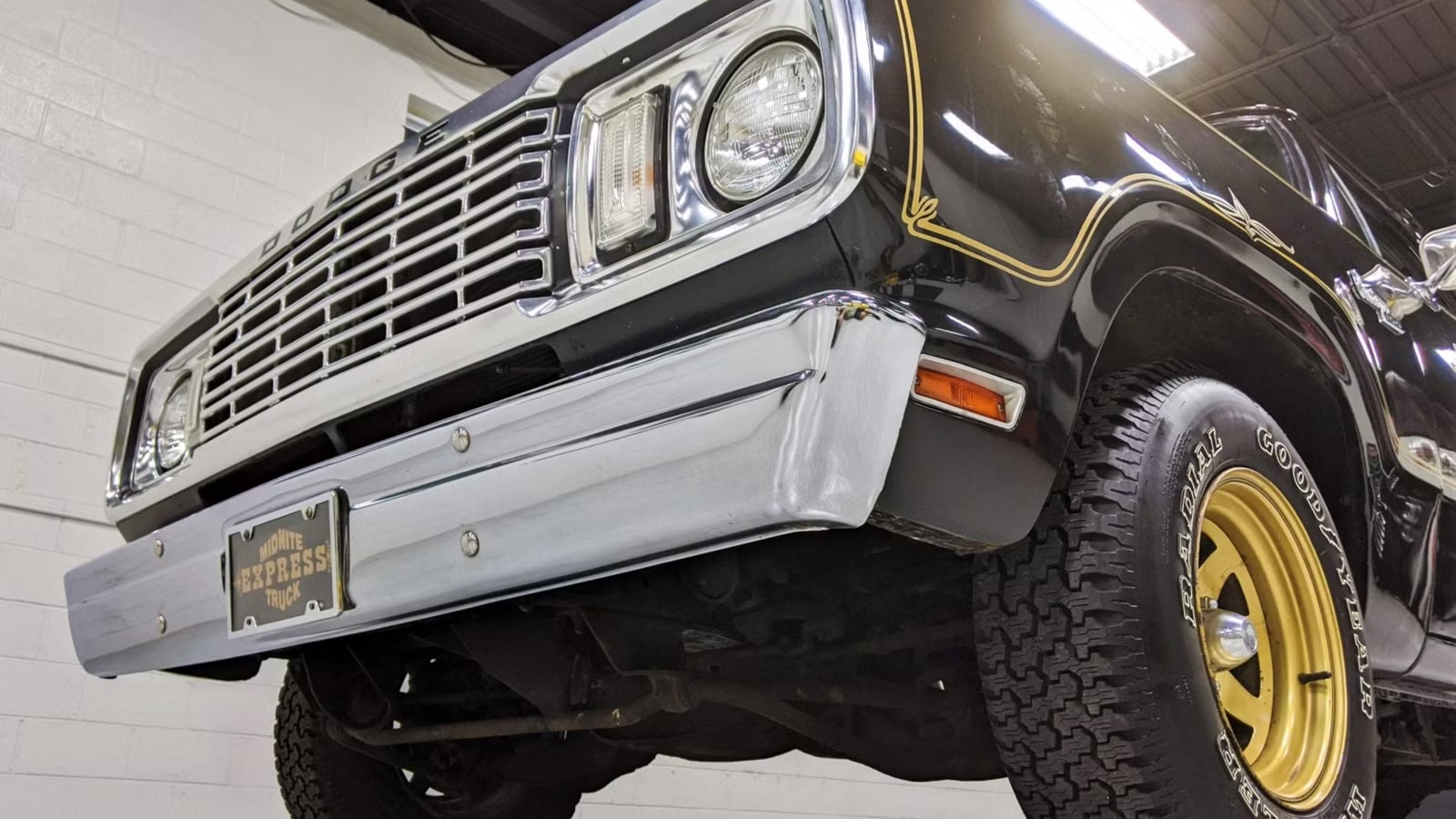
From the beginning, pickup design has been utilitarian and, because they were primarily used for work, rarely had any fancy trim. That was the mindset of the manufacturers, but actual truck owners not only took pride in their rides, but also wanted to show them off, so a healthy aftermarket bolt-on, stick-on, slap-on industry arose. Truck owners, like muscle or sports car aficionados, wanted their vehicles to look cool, so they decked them out with graphics, bold rims, fender flares, and whatever else stood out. In the mid-1970s, Dodge figured out that truck owners wanted some style and swagger, launching the first factory custom pickup that was cooler than an aftermarket build and a lot cheaper.
Warlock Casts A Style Spell On The D100 Lineup

Debuting as a show truck in 1976, and hitting regular production in 1977, the Dodge Warlock was an appearance package of the D/W-series pickup lineup. It was a flared fender, chrome stepside beauty with gold pinstriping, unique graphics, oak bedrails, and golden wheels. The interior was black with gold accents on the dashboard and designs on the doors. Available as either a D100 two-wheel drive or W100 four-wheel drive, it had several engine options, but no standard was tied to the package. The Warlock looks the baddest in Black Sunfire Metallic, and that’s the one most people remember, but it was available in Bright Canyon Red, Medium Green Sunfire Metallic, Citron Green Metallic, and Sunrise Orange, as well as special-order dealer colors. This was a stunning custom pickup, where the factory did all the work and for less money than could be achieved through the aftermarket.
Esoteric Knowledge of the 225 Slant Six

Because the Warlock looks so insanely wicked, many people assumed it was a muscle truck, but in fact, it was all about the style. In keeping with the demand for fuel economy during the Malaise Era, the Warlock was even available with a 100-horsepower 225 slant-six that got a combined 17 MPG. While that doesn’t sound amazing to us in the age of hybrids, the typical V8 got around 10 MPG back then, so the slant-six Warlock was the Toyota Prius of the day. Obviously, the performance of a 100-horsepower six-cylinder wasn’t setting any records, but the Warlock was about cruising and looking cool, so the 225’s 16-second 0-60 acceleration wasn’t a serious issue. Hauling a heavy load was another thing altogether, but being seen on the boulevard was achievable with even the weakest engine option, and it was guaranteed to turn heads.
440 Hidden Treasure

Most enthusiasts probably think the mighty Chrysler 440 Magnum V8, disappeared at the end of the Golden Age of American Muscle, but it actually continued on for most of the 1970s. The days of 375 raging horses, however, were long gone and by 1978, its last year of production, it was down to 225 horsepower and 345 pound-feet of torque. The 440 was an extremely rare option on the Warlock that upped the performance to an approximate 9-second 0-60 time and 16-second quarter-mile. Again, this is not particularly impressive today, but for the time, it was genuinely formidable. Chrysler never published production numbers for the Warlock broken down by engine option, but researchers estimate that only 70 or so rolled out with a 440 under the hood.

Dodge’s Adult Toy Lineup

Nowadays, when you mention adult toys, it is bound to elicit some snickers, but back in the late ’70s, it was the most standout ad campaign going. Dodge’s Adult Toys were “lifestyle machines” meant to capitalize on the truck and van customization craze. The lineup included the Warlock as well as its companion, the Li’l Red Express, the off-road Macho Power Wagon, and the super custom Street Van. All the Adult Toys came with bright graphics, plenty of chrome, and tons of custom features. Dodge was hoping to corner the factory custom market, and they did since they were the only game in town . More importantly, the Adult Toys campaign proved the viability of bold trims and appearance packages for trucks, with its influence felt all the way to modern times. There probably wouldn’t have been trucks like the Chevy 454 SS or the Ford Raptor, if not for Dodge’s Adult Toys.
Stepside Corvette Killer

The Dodge Li’l Red Express was a similar custom concept as the Warlock with the added awesomeness of chrome exhaust stacks. It was also more than just an appearance package, at least in 1978, because it exploited a few loopholes that allowed engineers to install a high-performance 360 police engine. Dodge learned they could use an already-certified engine without having to go through another round of emissions testing, and light trucks did not require catalytic converters, so this was the freest breathing engine on the street. Producing 225 horsepower and 295 pound-feet of torque, the ’78 Li’l Red Express accelerated from 0-60 in 7.5 seconds, ran a quarter-mile in 15.5 seconds, and had a top speed of 118 MPH.
It was the 0-100 speed that really set it apart, being the fastest vehicle Car & Driver tested that year, including the Corvette. Unfortunately, those numbers are not available, but the Li’l Red Express also beat the Chevy sports car’s 7.7-second 0-60 time and 15.8-second quarter-mile, so it was definitely a ‘Vette killer.
Plain Jane Chevy and Ford Trucks

To be clear, we appreciate late-’70s Chevy and Ford trucks, not necessarily in stock form, but rather with some custom resto-mod work. Straight from the factory, they were rather plain, and when stacked up against the bold styling of the Dodge Warlock, they looked like wallflowers that nobody would ever ask to dance with. That 1977 Ford F-150 Ranger XLT’s (pictured above) two-tone paint scheme is retro-cool today, but back then it was terribly dated. With a striking paint job, some bold graphics and striping, as well as some distinctive wheels, that Ford pickup would be a head-turner. In stock form, that F-150 is perfectly suited to hauling bales of hay, but next to the Warlock’s factory custom flair, it would have looked decidedly out of place on the boulevard.
Beauty Of The D100 Custom Sport Special

The 1965 Dodge D100 Custom Sport Special is indeed special because it’s the first factory custom pickup as well as the debut muscle truck. From a style and equipment perspective, the CSS had many features that were not common in trucks at the time, like bucket seats, center console, and full instrument gauge cluster. The exterior also spiced things up with chrome bumpers and trim, plus striping on the hood and roof. Performance-wise, the CSS was a genuine street rod when optioned with the 365-horsepower, 470 pound-feet of torque 426 Street Wedge V8. The high-performance package also included a 727 LoadFlite automatic transmission, heavy-duty suspension, dual-exhaust, and power steering, so it was not just a factory custom, but also the first example of a luxury pickup.
Downing White Russians With The Dude

Introduced in 1970, the Dodge Dude is the spiritual predecessor of the Warlock factory custom. The appearance package on the D100 half-ton pickup featured body-length C-shaped side stripes with a “Dude” cowboy hat logo, as well as a special Dodge decal on the tailgate. It also featured chrome bumpers and light bezels, with body-color mirror arms and gas cap, plus painted wheels with chrome dog-dish hubcaps. The style was meant to mimic Dodge’s Scat Pack muscle cars, but the Dude didn’t get Hemi or Six-Pack options, with the 383 V8 being the biggest available engine. Like the Warlock, the Dude was a cruiser meant to look cool rolling by, not a vehicle that was feeding a steady diet of dust to challengers. That being said, the 335-horsepower, 425 pound-feet of torque 383 of the Dude didn’t exactly suck, and it could probably hang with most GM and Ford muscle cars in 1969.
Warlock Magic in the Modern Age

In 2019, the Warlock trim made a comeback on the Ram 1500, as a total black-out off-road package. Long-time fans were disappointed that the new Warlock didn’t have gold pinstripes, oak bed rails, or gold wheels, but it was actually a fitting tribute because it was a truck that looked special from the factory, which was the essence of the original. Back in the late ’70s, people wanted a pickup that looked like a street rod, but in modern times, trucks are customized for rugged off-road use. The 2019 Warlock came with a blacked-out grille, fender flares, powder-coated bumpers, tow hooks, 20-inch black wheels, and a 1-inch lift—all the kinds of upgrades people typically add through customization. This one, on the other hand, came straight from the factory and for less money than sourcing everything through the aftermarket.
Value Of Warlock’s Spellbook

The original Warlock began shipping in 1976, but 1977 was its official first year and production ran through 1979. Dodge, who is normally great at keeping track of production numbers, didn’t have records for the Warlock because it was an appearance package rather than a vehicle model. Estimates are that around 8,000-10,000 Warlocks were ordered over its run, with the two-wheel-drive 360 V8 being the most common configuration.
Hagerty tells us a 225 six-cylinder D100 Warlock starts at $8,500 for a fair condition example and goes up to $64,300 for a Concours condition 360 V8 show truck. For the ultra-rare W100 Warlock 440, the range goes from $12,900 for one that lost its magic to $101,000 for a master spellcaster. That price may be a bit inflated, though, as the most expensive ’77 W100 440 we could find was that frame-off resto pictured above that sold for just $35,200 at Mecum Las Vegas 2025. This is actually a remarkable classic bargain, with the top sale being just $41,800, which requires no witchcraft to enchant a seller.
Sources: Hagerty, Mecum, Dodge

Related posts

Latest Post


No Comments