
The Inline Six That Invented The Downsized-Turbo Years Before The EcoBoost
The Ford EcoBoost mindset, small displacement chasing big numbers through forced induction and clever breathing, was already British doctrine in the 1930s – nearly 80 years before the downsizing revolution that has come to dominate the modern auto industry.
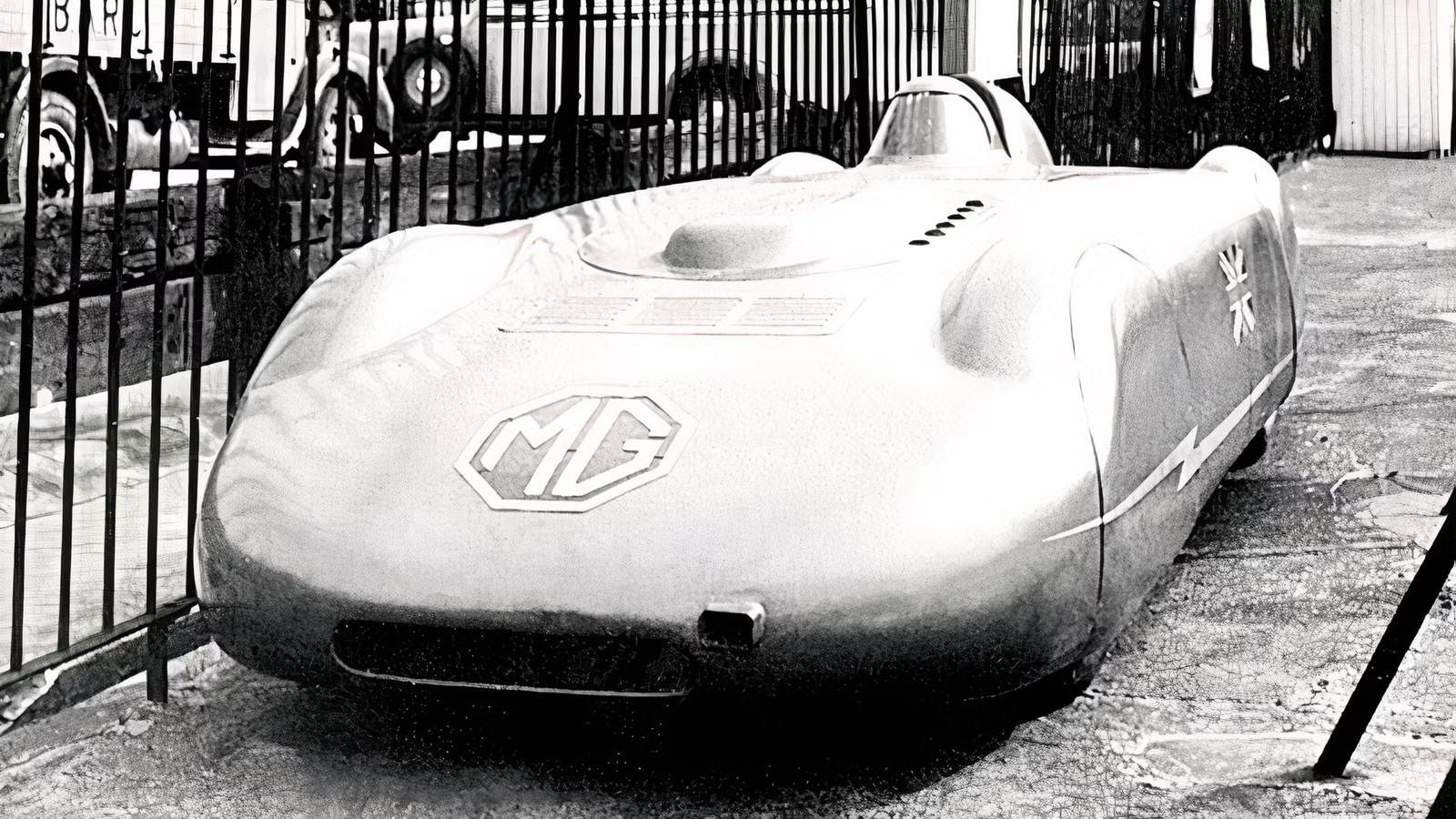
MG’s ‘Dinky Six’ L-Type six-cylinder engine had a capacity of just 1,086 cc, making it smaller than some motorcycle engines. In stock form, it produced 41 hp, but the fitment of a supercharger almost tripled the power to 120hp in racing trim. In its most extreme application, powering MG’s EX135 record car, it produced nearly 200 hp to achieve a record-breaking 204.2 mph top speed in 1939. It also had the wild modularity of blanking cylinders to chase smaller engine capacity records, all the way down to 350 cc.
Tiny Capacity, Big Performance
Ford’s EcoBoost engines led the way for downsizing in the modern era – delivering high-tech small-capacity engines that are compact and fuel efficient, but rely on turbocharging to match or exceed the performance of much bigger and less ‘eco-friendly’ units.

It’s a formula that has been followed by all automakers as they strive to meet ever-stricter fuel economy and emissions targets. Hence, gas-guzzling naturally aspirated V8s have mostly been dropped in favor of turbocharged sixes, while turbo four-cylinder engines dominate the space previously occupied by V6s. It has also led to the demise of most V10 and V12 engines.
However, almost eight decades before Ford began the trend, a small British car brand was redefining the concept of performance provided by tiny engines displacing barely more than a US quart of milk.
70% Smaller Than A 1932 Ford Flathead V8

Back in the 1930s, MG produced a miniature six-cylinder engine with a bore and stroke of 57 x 71 mm and a capacity of just 1,086 cc (often cited as 1,087 cc, or just 66 cubic inches) – less than one-third the size of Ford’s 1932 3.5-liter (221 cu in) flathead V8, which produced 65 hp.
Based on the in-line four-cylinder overhead camshaft engine found in the 1930 Wolseley Hornet, MG added two cylinders to create its first six-cylinder engine. While the original four-pot Wolseley unit was rated at a mere 12 hp, MG’s six-cylinder twin SU-carbureted rework more than tripled the power to 37 hp in the 1932 K-series Magnette. For the sportier 1933 L-series Magna, the engine received a cross-flow cylinder head and coil ignition, which raised the power to 41 hp and allowed it to rev to 5,500 rpm as opposed to 4,100 rpm for the less powerful version.

The Magnette and Magna were available in a variety of chassis and body styles, ranging from open roadsters and sports cars to tourers, saloons and coupes. They were positioned above the cheap and cheerful 847 cc 8 hp MG Midget, which was the company’s first sports car, and its larger 2.5-liter straight-six 18/80 open and closed ‘touring’ cars.
Racing Improves The Breed

From the very first automobiles, motor racing and speed record attempts were considered essential platforms to prove their performance and durability. It’s no surprise that this philosophy extended to MG too. Over the years, the British marque scored numerous memorable wins. Most notably for MG’s tiny six-cylinder engine, it powered a pair of K3 Magnette race cars to first and second in the 1,100 cc class of the legendary 1933 Mille Miglia (1,000-mile) road race.
The engine was extensively upgraded for racing, with a Powerplus supercharger bolted on to produce around 120 hp – three times the power of the base engine. This translates to 110.5 hp per liter, all the way back in 1933. As a cheeky comparison, the 2002 Ferrari Enzo produces 108.5 hp per liter from its 651 hp naturally aspirated 6.0-liter V12, while Ford’s 315 hp 2.3-liter four-cylinder turbocharged EcoBoost engine used in the 2026 Mustang has 139 hp per liter.
The supercharged K3 Magnette also scored wins at the steeply banked Brooklands circuit in the UK, achieving an unbeaten 1,100 cc class record of 124.4 mph, along with victories at the Monte Carlo Rally and the 1933 RAC Tourist Trophy with Tazio Nuvolari at the wheel.
Speed Legends Unite

Despite the proven winning credentials of MG’s impressive little six-cylinder engine, the company wanted more and was drawn to the allure of breaking land speed records. Veteran British pilot Lieutenant Colonel Goldie Gardner had worked as team manager for Malcolm Campbell’s attempt to become the first person to reach 300 mph in a car, while Reid Railton designed Campbell’s famous Bluebird – a 10,000 lb behemoth, powered by a 36.5-liter (2,227 cu in) 2,500 hp supercharged Rolls-Royce R V12 aircraft engine that set a 301.1 mph record at Bonneville Salt Flats in 1935.
Gardner and Railton teamed up with MG to transform a K3 Magnette into a record-beater for 1938. Prior to this, the former pilot and prolific record-setter had traveled to Frankfurt, Germany in 1937 where he set a host of international class records, clocking 148.8 mph over the flying kilometer in his little MG K3 single-seater.
Eberan von Eberhorst, the engineer behind the legendary Auto Union Silver Arrows, advised Gardner to develop a more streamlined, aerodynamic car, which would allow him to go much faster. On returning to the UK, Gardiner convinced MG to support his efforts, and he acquired the privately owned MG EX135 experimental single-seater race car which had been built four years earlier.
Almost 200 HP From 1.1 Liters

For the new record attempts, Railton designed a completely enclosed bodywork for EX135, with the driver only visible through a tiny Perspex bubble. The car retained its 1,086 cc capacity, but it was equipped with a massive Zoller supercharger that helped it produce over 195 hp running on a volatile mixture of petrol and methanol.
On its first outing at the November 1938 German Speed Week near Frankfurt, EX135 achieved 187.63 mph for the flying mile on a new six-mile stretch of Adolf Hitler’s revolutionary new autobahn. A year later, just months before World War II broke out, Gardner returned with EX135, which had been fitted with a longer-ratio top gear. He claimed the 750-1,100 cc class records over the 2 kilometer, 1 mile, and 5 kilometer distances, at average speeds of 203.5 mph, 203.3 mph and 197.5 mph respectively.
The team then decided to aim for the 1,100-1,500 cc class records as well. Overnight, the engine was bored out to 1,105 cc, and they set the records over the same distances at averages of 204.3 mph, 203.9 mph and 200.6 mph.
Small Engine, Big Attitude

After WWII, EX135 accumulated numerous other class records by some rather unconventional methods. Gardner and his team treated the six-cylinder engine like a Lego set, as they played around with engine capacities and configurations. In 1946, a short-stroke crankshaft was fitted, bringing the capacity down to 750 cc, achieving an extraordinary 159 mph over the flying mile.
The following year, the crew removed two pistons and conrods, and blanked off two cylinders to compete in the 500 cc class, achieving 118 mph. In 1949, it was converted to run on just three cylinders with the same capacity, and clocked 154.9 mph. And in 1950, running three cylinders and a mere 350 cc, it achieved 121 mph.
Historical Solutions For Modern Engines

Modern high-tech engines have taken many of these principles to extraordinary levels, but with rather different objectives. Today, downsizing, turbocharging, cylinder deactivation, continuously variable valve timing and sophisticated engine management systems are used to deliver big-engine performance from smaller, more efficient powerplants, while meeting increasingly stringent emissions and economy regulations.
But the basic idea is anything but new. Almost eight decades before Ford’s EcoBoost engine family arrived with the 3.5-liter twin-turbo V6 in the 2009 Taurus SHO, MG and a remarkably talented team of engineers were already proving just how much performance could be extracted from an unlikely hero: a tiny but robust engine with a capacity not much greater than a jug of milk.
And in the remarkable EX135, they created what was effectively a downsizing laboratory on wheels – one capable of turning barely a liter of displacement into more than 200 mph of record-breaking performance.
Sources: Slash Gear, MG Owners Club UK, The MG Car Club Ltd, British Classics UK, MGA Guru, Primotipo, AROnline, MG

Related posts




Latest Post



No Comments