
The Honda 350 That Needed Four Cylinders To Make Just 34 HP
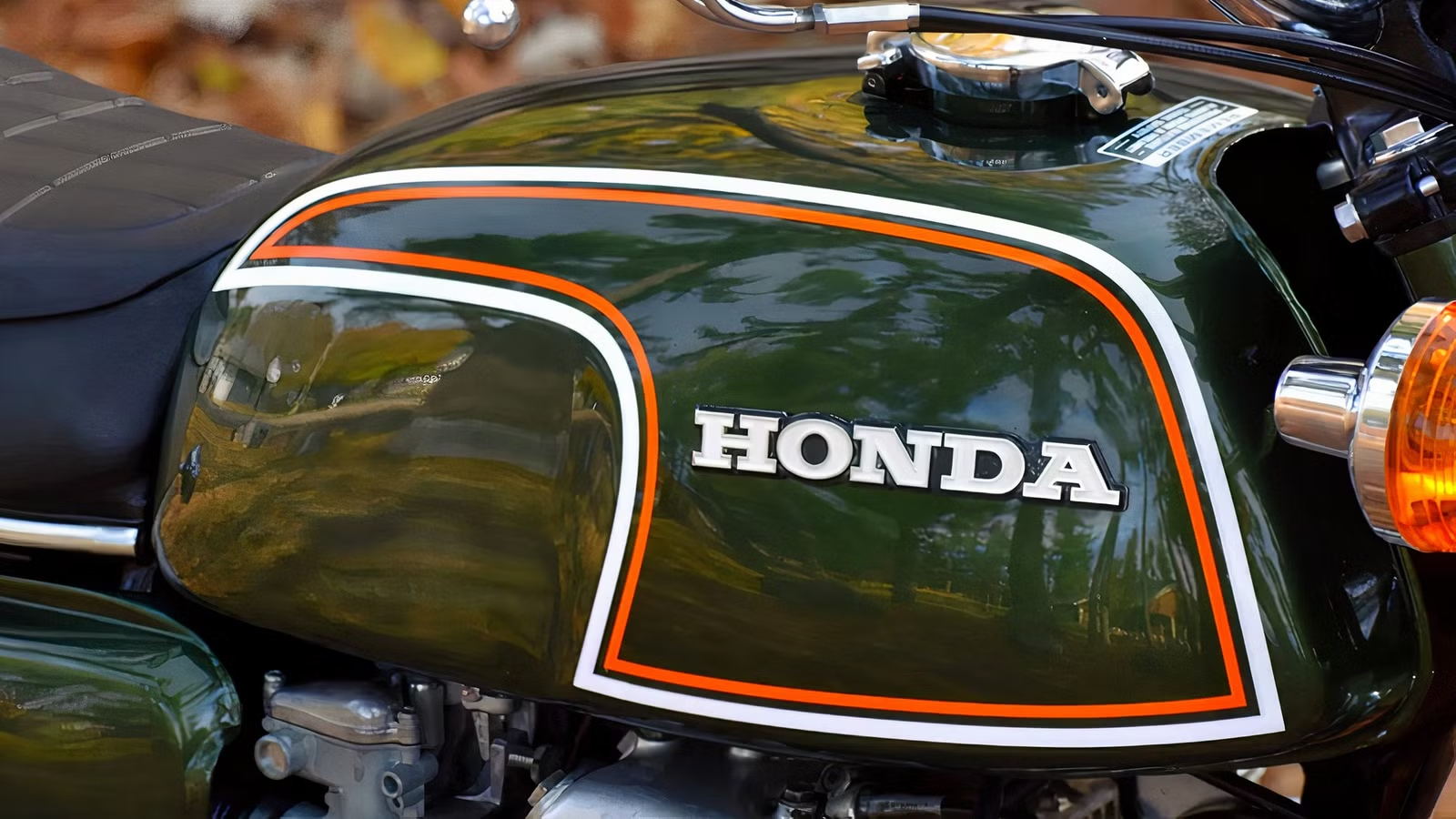
The Honda CB750 Four is the stuff of legend, and its colossal impact on the motorcycle industry still reverberates to this day. It popularized the inline-four engine layout by making it accessible to the masses, pioneered the use of a disc brake on a production bike, and was an all-round better and much more reliable machine than its European rivals. Other Japanese manufacturers wasted no time following Honda’s lead, kicking off the golden age of UJMs (Universal Japanese Motorcycles) in the seventies. That pressure was too much for established British brands to bear, so they quickly found themselves on the path toward bankruptcy. It didn’t happen solely as a result of Japan’s takeover, but motorcycles like the CB750 did expose the cracks beneath the surface and it was simply too late for them to be fixed.
Honda’s Flagship Came In Guns-Blazing On All Fronts

Widely regarded as the world’s first true superbike, the CB750 benefited from a 736cc SOHC four-banger making 67 horsepower and 44 pound-feet of torque. This oomph got transferred to the rear wheel through a five-speed transmission, ultimately leading to a top speed of 124 mph. As such, Honda’s icon became the world’s fastest production motorcycle at the time of its release in 1969, and it held that title up until ‘72 when it was surpassed by the Kawasaki Z1. We could keep on talking about how great the first-gen CB750 was, but today we’re here to look at a different variant of the CB lineage. And even though it may not have the fame or historical significance of its bigger sibling, it’s still a very interesting machine for us to analyze in-depth.
The CB Lineup Extended Far Beyond Its Most Famous Constituent

When you think of other CB models loved by the public back in the day, you’ll likely be picturing the CB400F Super Sport or Honda’s earlier CB450 Black Bomber from the sixties. Both of these middleweight UJMs were fantastic, for sure, but so was the slightly smaller variant that’ll be taking the spotlight in the following paragraphs. It came as a result of some riders wanting a more manageable, downsized four-cylinder bike, and Honda sought to capitalize on this demand with a CB variant for the 350cc class. Of course, the company already offered the CB350 twin back then, but it sought to inject a little more excitement into the mid-sized segment with a couple of extra cylinders. And, in doing so, it came up with one of the most interesting 350s of that era.
Honda Gave Us Something Truly Special With The CB350 Four

Two cylinders are good, but four cylinders are better, right? This seems to have been Honda’s philosophy when it launched the CB350 Four for the model-year 1972, looking to attract buyers who wanted that sweet inline-four smoothness without committing to a bigger bike. So, whereas the CB350K had an air-cooled 325cc parallel-twin bringing it to life, the CB350F was instead kitted with a 347cc inline-four powerplant. The engine featured a single overhead cam, quad 20-millimeter (0.78-inch) Keihin carburetors and a compression ratio of 9.3:1. Its bore and stroke measured 47 and 50 millimeters (1.85 and 1.97 inches), respectively, proportions similar to the CB750’s but just smaller overall.

In terms of power output, the four-cylinder mill could summon up to 34 ponies and 20 pound-feet of twist, so it had slightly less top-end power and a little more torque than the CB350K. But the Four was, of course, much smoother, with many riders noting a near-total lack of vibration akin to that of the flagship 750. Power made its way to the rear wheel via a five-speed transmission, ultimately resulting in a top speed of 98 mph. That may lean toward the modest side of things especially by today’s standards, but it was right in line with your typical 350cc motorcycle back in the day. As for the bike’s chassis, it was nothing unusual for a motorcycle in the seventies.
At its core stood a tubular steel frame featuring a semi-double cradle design, supported by telescopic forks up front and twin shock absorbers out back. And just like its big brother, the CB350 Four employed a disc brake at the front along with a traditional drum at the opposite end. It made use of an electric starter motor for convenience, too, while also retaining the kickstart pedal as a backup just in case. Reliability was as good as you’d expect from a Honda motorcycle, and dry weight was rated at 352 pounds. All things considered, the CB350F made for a solid mid-sized bike with just enough power to keep you entertained, but it most certainly wasn’t without its downsides.
What Held The CB350 Four Back From Greatness?

Having a four-cylinder motor to play around with is cool and all, yet it was far from the most practical choice for a number of reasons. On the one hand, the CB350K was a lot lighter than the Four at just 328 pounds without fluids, all while having a couple of extra ponies in its stable and only a bit less torque. Moreover, the added complexity of two more cylinders meant higher costs for maintenance and basic upkeep, which wasn’t exactly ideal when you could just go with the twin and avoid that extra hassle. Higher fuel consumption was another thing to consider with the CB350F, and this was by no means insignificant at a time when the 1973 oil crisis was just around the corner. So, in hindsight, the downsized CB was a very interesting piece of machinery, for sure, but it didn’t make much sense from a commercial standpoint.
Consequently, it only stayed in production until 1975 before getting replaced with the bigger, better and quicker CB400F Super Sport. And the 400 became a smash-hit in no time, sporting a 408cc inline-four with more usable torque and able to hit speeds of up to 104 mph. The 350’s five-speed gearbox made room for a six-speed on its successor, while the ergonomic package became more aggressive with a lower handlebar and foot pegs mounted further back. Now, the CB400F tipped the scales at over 400 pounds fully loaded, so it didn’t exactly hold much of a weight advantage over its forerunner. But many riders still claimed it felt much more agile, and their positive reception of the updated CB was directly reflected by its commercial success.
Largely Forgotten, But A Fun Little Curiosity To Look Back On

While the CB750 and 400F became icons of the UJM craze from the 1970s, the CB350 Four never got to enjoy nearly as much clout. It remains somewhat underappreciated to this day, but we must give credit where credit is due despite its flaws. Because it did pave the way for the later CB400F to become such a beloved classic Japanese middleweight, having walked so its successor could eventually run. That makes it the precursor to something fantastic, and it also held the distinction of the world’s smallest four-cylinder bike at the time of its release. So even if the CB350F doesn’t quite get as much recognition as it should, it does occupy a cool little place in Honda’s motorcycle history.
And UJM aficionados won’t hesitate to splurge a decent bit of cash on well-kept examples with low mileage at auction, as shown by several listings on Bring a Trailer and elsewhere. Case in point: a mint-condition CB350 Four sold for $11,800 back in 2024 — not bad for a bike that didn’t live up to people’s expectations during its short production run! You won’t always have to spend five figures to get your hands on one such specimen, though, as examples in decent shape regularly change hands for around five grand or less. This means you can get a taste of that vintage four-cylinder goodness for a mere fraction of what you’d pay for a CB750, which is a pretty tantalizing prospect to say the least.
Sources: Honda, Whiteknuckler Brand, National Motorcycle Museum, Old Bike Australasia, Motorcycle Classics, Web Bike World, Bring a Trailer

Related posts


Latest Post


No Comments