
10 Legendary Harley-Davidson Engines That Refuse To Die
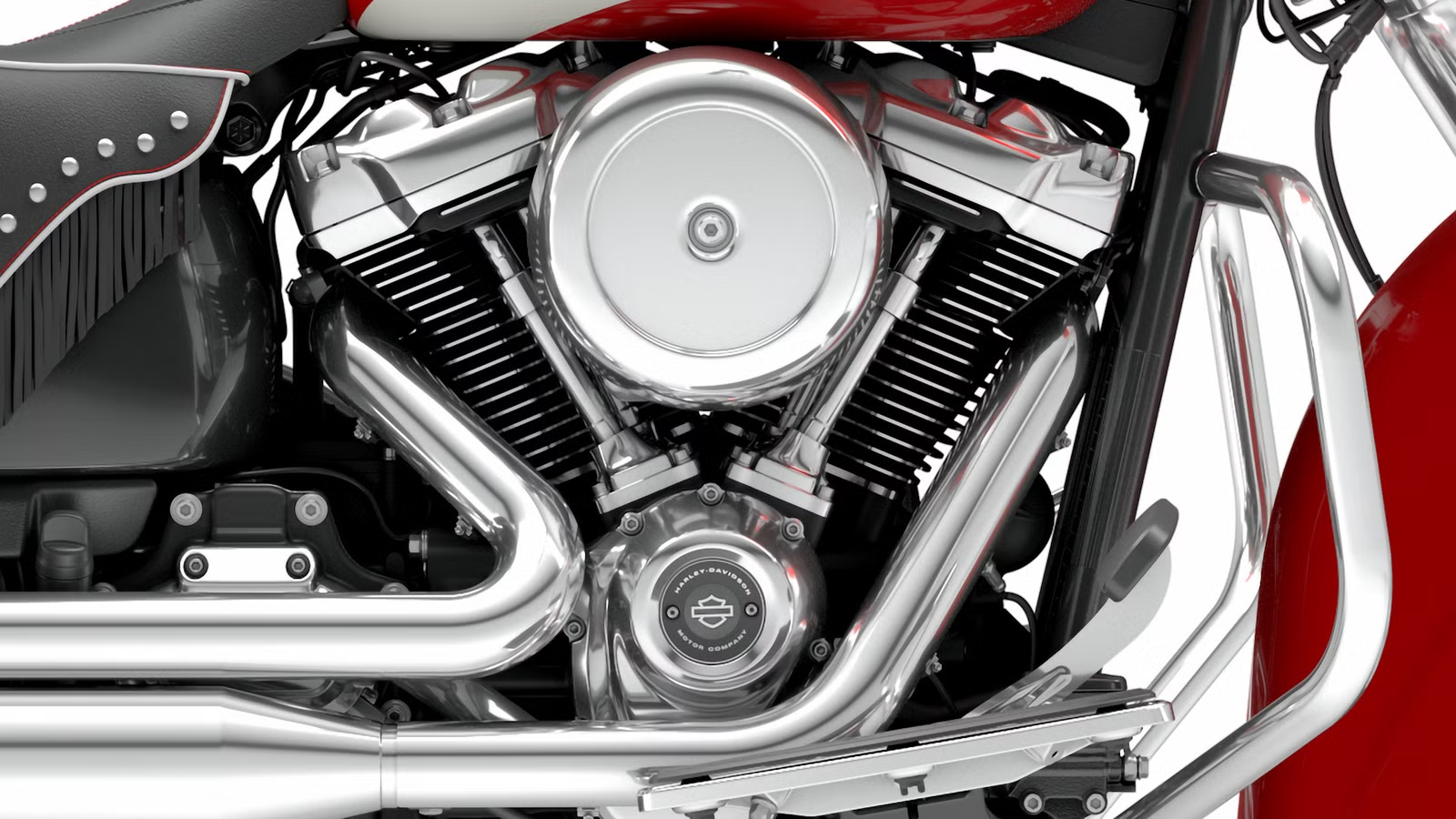
Few brands in motorsport carry the kind of mythological weight that Harley-Davidson does. For more than 120 years, the Milwaukee marque has been building cruiser and tourer motorcycles without interruption — and through all of it, the heartbeat has remained the same: a long-stroke V-twin with that unmistakable low-idle burble, the so-called ‘potato potato’ that no engineer has ever fully replicated. Across those decades, a handful of engines have defined what Harley-Davidson means, powering the brand’s bikes for generations and inspiring imitators from every corner of the globe.

What makes these engines truly legendary, though, isn’t just their history — it’s their staying power. Their straightforward design and usable power output keep them viable in used Harley-Davidsons right now. Parts are plentiful and affordable, and the knowledge required to maintain or rebuild them is freely available for the hands-on rider. If wrenching isn’t your thing, finding a competent specialist is rarely a challenge.
Here, then, are 10 legendary Harley engines that refuse to die. We’ve ordered them by launch year to give the list some order. Also, where there are multiple displacement and power outputs available for a series, we’ve gone for the highest displacement and power output versions for the sake of brevity.
Harley-Davidson F-head
Years Of Production: 1903-1929

The F-head is Harley’s first Big Twin engine, and it used an intake-over-exhaust valve configuration — as opposed to side valve or overhead valves. It carries historical significance not just to Harley-Davidson, but in the broader context of the V-twin and motorcycles as a whole. If you come across an image of a Harley-Davidson that looks like a bicycle with a V-twin bolted in, there’s a strong chance you’re looking at an F-head.
|
Engine Type |
45-degree V-twin, air-cooled, side valve, 2 valves per cylinder |
|
Fuel Delivery |
Carburetor |
|
Largest displacement |
1,210 cc |
|
Max Power |
24 HP @ NA RPM |
|
Max Torque |
NA |
This engine series remained in production for 26 years. Over that span it gained chain drive, a freewheel clutch, foot pedals for the brake and clutch, and eventually a conventional three-speed transmission. A dual-action rear brake and a kick-starter were also introduced, replacing the earlier pedal-starting mechanism. The later variants are the ones you’re more likely to be able to work on today, as the earliest technology has long been consigned to the history books. It’s rare to encounter one of these engines outside a museum or private collection, simply due to their age.
Harley-Davidson Flathead
Years Of Production: 1930-1948/73

H-D moved on from the F-head with the Flathead, a side-valve design that powered some of the most legendary Harleys of all time. It remained in production for 18 years in two-wheelers, and for an extraordinary four decades in servi-cars. Side-valve engines are inherently simple: the valves sit to the side of the piston rather than overhead, so the cylinder head requires no extra space for valve gear — hence the flat head — and the total number of moving components is minimal.
|
Engine Type |
45-degree V-twin, air-cooled, side valve, 2 valves per cylinder |
|
Fuel Delivery |
Carburetor |
|
Largest displacement |
1,340 cc |
|
Max Power |
39 HP @ 4,200 RPM |
|
Max Torque |
NA |
Since the valves are inverted, the cams sit low in the engine, which also simplifies lubrication. All of that should have made the Flathead exceptionally reliable, but in practice it wasn’t quite so. At least repairs were extremely straightforward.
Harley-Davidson Knucklehead
Years Of Production: 1936-1947

The Knucklehead made its debut eight years before the Flathead was phased out — a curious overlap of technologies, especially given that the Flathead was actually discontinued a year after the younger Knucklehead. The Knucklehead was a landmark engine for H-D because its fundamental design elements can still be found in Harley engines to this day.
|
Engine Type |
45-degree V-twin, air-cooled, OHV, 2 valves per cylinder |
|
Fuel Delivery |
Carburetor |
|
Largest displacement |
1,208 cc |
|
Max Power |
60 HP @ 5,200 RPM |
|
Max Torque |
70 LB-FT @ 4,000 RPM |
It arrived with an impressive 40 horsepower and promptly set land speed records. The Knucklehead’s design familiarity to modern engines means it’s easier to work on — or to find someone who can — compared to the Flathead. Its significance to the Harley lineage also suggests that the value of surviving Knuckleheads will likely continue to climb.
Harley-Davidson Panhead
Years Of Production: 1948-1965

The Panhead was developed once Harley could redirect its attention away from wartime production. It built on the Knucklehead’s strengths, but the additional power generated more heat, making thermal management a priority. Aluminum heads were chosen for their heat-conducting properties, though the expansion characteristics of the new material caused a number of early headaches. Oil leaking from the top end is a common issue on early Panheads, and H-D continued refining the design throughout its production life.
|
Engine Type |
45-degree V-twin, air-cooled, OHV, 2 valves per cylinder |
|
Fuel Delivery |
Carburetor |
|
Largest displacement |
1,208 cc |
|
Max Power |
60 HP @ 5,200 RPM |
|
Max Torque |
70 LB-FT @ 4,000 RPM |
Toward the end of its run, a foot gear shifter was added, as was the first electric starter in Harley-Davidson’s history — fitted to the Electra Glide. Notably, the Panhead also powered the first Harley to feature rear suspension, the Duo Glide.
Harley-Davidson Ironhead
Years Of Production: 1957-1985

We take a break from the big twins to talk about the Ironhead. It doesn’t get nearly enough credit, given everything it achieved. The name comes from its iron cylinder heads, in contrast to the aluminum used elsewhere. Despite its relative lack of recognition among casual enthusiasts, the Ironhead earns its place here not only for its longevity but because it cemented Harley’s racing reputation.
|
Engine Type |
45-degree V-twin, air cooled, OHV, 2 valves per cylinder |
|
Fuel Delivery |
Carburetor |
|
Largest displacement |
997 cc |
|
Max Power |
57 HP @ 5,800 RPM |
|
Max Torque |
51.5 LB-FT @ 3,500 RPM |
The XR750 that the Ironhead powered is the most successful racing bike in history. Even if AMA flat-track racing isn’t your thing, you’ve seen this engine in action if you’ve ever watched Evel Knievel. Its extensive competition history means parts and expertise remain plentiful to this day.
Harley-Davidson Shovelhead
Years Of Production: 1966-1984

While the Ironhead was tearing up racetracks, the Shovelhead was developed to succeed the Panhead, since new features like rear suspension were adding considerable weight to the motorcycles and blunting performance. Several innovations debuted during the Shovelhead’s 18-year run, including alternators replacing generators and a floatless carburetor.
|
Engine Type |
45 degree V-twin, air cooled, OHV, 2 valves per cylinder |
|
Fuel Delivery |
Carburetor |
|
Largest displacement |
1,337 cc |
|
Max Power |
64 HP @ 5,400 RPM |
|
Max Torque |
67 LB-FT @ 3,600 RPM |
The Shovelhead earned a reputation for unreliability, though much of that was a consequence of the fuel crisis and the poor-quality fuel of the era not suiting its design. Later models reverted to a conventional carburetor and should be straightforward to work on. The absence of lead in modern fuels can affect valve seats, but as with many Harley engines, replacement parts engineered to address this are available if you know where to look.
Harley-Davidson Evolution
Years Of Production: 1984-2000

The importance of the Evolution engine to Harley-Davidson cannot be overstated. After the Shovelhead’s reliability struggles, the company needed a new engine that could restore its reputation — one that was dependable, produced enough power to compete with the Japanese manufacturers, and didn’t leak oil. The Evolution delivered on all counts and then some, turning the company’s fortunes around. It proved so popular that it became the foundation for aftermarket powerplant suppliers like S&S Cycle.
|
Engine Type |
45-degree V-twin, air-cooled, OHV, 2 valves per cylinder |
|
Fuel Delivery |
Constant velocity carburetor |
|
Largest displacement |
1,340 cc (Evolution 82) |
|
Max Power |
58 HP @ 5,800 RPM |
|
Max Torque |
68 LB-FT @ 3,500 RPM |
CV carburetion and later fuel injection were introduced with the Evolution, as was electronic cruise control. The engine was also designed with ease of maintenance as a priority; most service work can be carried out without removing it from the frame. The Evolution’s proven reliability means you’ll still find a large number of Evolution-powered Harleys on the used market today, and keeping the carbureted versions running won’t tax an experienced home mechanic.
Harley-Davidson Twin Cam
Years Of Production: 1999-2017

The Twin Cam had big shoes to fill. The Evolution had become a darling of the aftermarket, with everyone from boutique builders to backyard tuners trying to extract more power from it. Harley therefore designed the Twin Cam to be future-proof, engineering it so that increased displacement and power could be unlocked as needed down the road. The Twin Cam was the first H-D engine to use oil jets aimed at the underside of the pistons for cooling.
|
Engine Type |
45-degree V-twin, air-cooled, OHV, 2 valves per cylinder |
|
Fuel Delivery |
Electronic Sequential Port Injection |
|
Largest displacement |
1,690 cc (Twin Cam 103) |
|
Max Power |
75 HP @ 5,010 RPM |
|
Max Torque |
100 LB-FT @ 3,500 RPM |
It also introduced the first digital ignition systems with variable ignition timing, sequential port fuel injection that the Milwaukee-Eight continues to use, a six-speed gearbox, a rudimentary form of rear cylinder deactivation, and twin cooling. Twin cooling is a solution that preserves the visual appearance of air-cooled cylinders while circulating water through the heads — particularly around the exhaust ports — to keep temperatures in check. The Twin Cam’s relative youth and its mechanical commonality with current Harley engines will ensure it remains well-supported for years to come. It doesn’t hurt that it powers some genuinely excellent Harley-Davidson motorcycles.
Harley-Davidson Revolution
Years Of Production: 2002-2017

The Revolution engine series remains the most un-Harley-like powerplant to ever carry the Harley-Davidson name, with the possible exception of the Revolution-derived Revolution Max series. It was Harley’s first water-cooled engine and traced its lineage to the powerplant that drove the VR-1000 superbike. Roush had a hand in developing that racing engine, and Porsche assisted in adapting it for the V-Rod.
|
Engine Type |
60-degree V-twin, liquid-cooled, 4 valves per cylinder |
|
Fuel Delivery |
Electronic Sequential Port Injection |
|
Largest displacement |
1,250 cc |
|
Max Power |
123 HP @ 8,000 RPM |
|
Max Torque |
86 LB-FT @ 7,000 RPM |
With credentials like those, the numbers make more sense: peak power arrives at 8,000 RPM and peak torque at 7,000 RPM — figures that were virtually unheard of for a Harley at the time of its introduction. This engine also gave rise to the Revolution X series that powered the Street lineup, and the Revolution Max shares more than just a name with it.
Harley-Davidson Milwaukee-Eight
Years Of Production: 2017-
The Milwaukee-Eight is the youngest engine series in Harley’s current lineup. It walks the line between honoring the character of a traditional Harley powerplant — keeping the faithful onside — and delivering the refinement that modern riders expect. Harley has managed this balance well, offering the engine in multiple displacements ranging from 107 to 121 cubic inches (1,753–1,983 cc). Heat reduction is addressed through oil or water cooling for the cylinder heads, and by relocating the catalytic converters away from the rider.
|
Engine Type |
45-degree V-twin, air-cooled cylinders with oil/liquid-cooled heads, 4 valves per cylinder |
|
Fuel Delivery |
Electronic Sequential Port Injection |
|
Largest displacement |
1,983 cc |
|
Max Power |
127 HP @ 4,900 RPM |
|
Max Torque |
145 LB-FT @ 4,000 RPM |
Vibration is managed by counterbalancers fitted across the range. All variants use four valves per cylinder, which is unique for an air-cooled Harley engine. The most advanced Milwaukee-Eight engines feature variable valve timing on both intake and exhaust valves, though this is currently reserved for the highest-displacement versions — leaving the door open for further development across the rest of the range.
Sources: Harley-Davidson

Related posts
Latest Post


No Comments