
The EV Brand With Low Maintenance Costs And High Reliability
Owning a car has never been cheap, but the full picture of what it costs goes well beyond the sticker price. Fuel, insurance, and routine upkeep all add up — and as vehicles age, repair bills tend to climb. With the average car on U.S. roads now more than 12 years old, long-term maintenance costs matter more than ever. For drivers considering an electric vehicle, one question keeps coming up: do EVs actually save money to run, or do their complex battery systems and specialized service requirements cancel out the fuel savings? The data offers a clear answer — and one brand stands well above the rest.

You really only notice the maintenance costs when you have to service your car or have something repaired once it is out of warranty. And the older the car gets, the more often things need to be repaired. Maintenance costs are not the same as reliability, although they often correlate. A car that seldom breaks down but is expensive to repair when it does can carry a higher maintenance cost over time than one that breaks more frequently but is cheap to fix.
Tesla: Setting The Standard For Maintenance Costs
Exceptional Affordability In Maintenance For The First Five Years
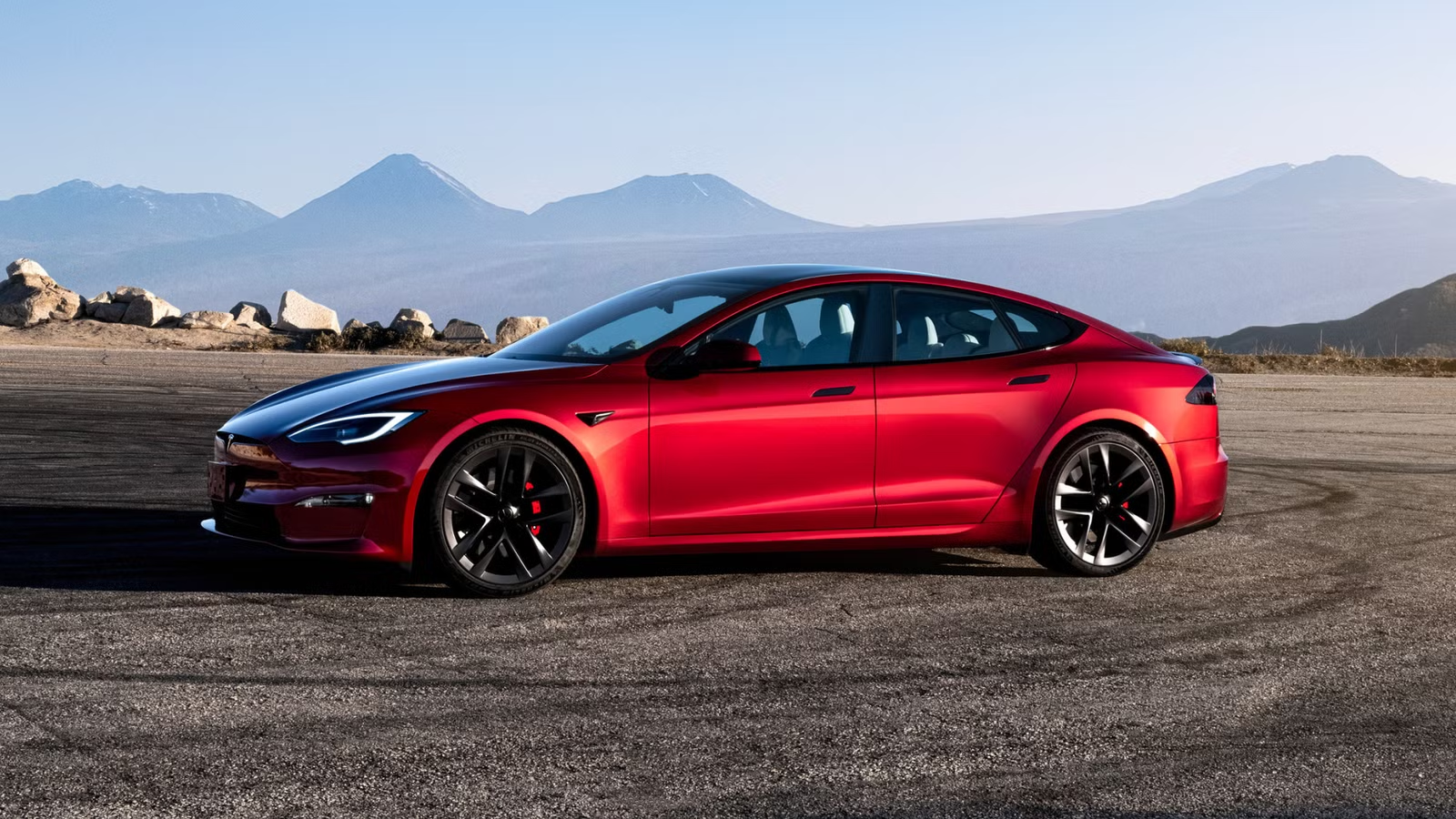
Tesla is the EV brand with the lowest maintenance costs over a 10-year period, compared to all other car brands readily available in the U.S. A brand like Ford, for example, makes ICE, hybrid, PHEV, and EV models. Tesla competes with Ford and other carmakers across that entire spectrum of powertrain options.

The fact that Tesla — as one of the few companies that make only EVs — can compete with and beat all other brands on maintenance cost is remarkable in itself. There is a perception that EVs are more expensive to maintain than ICE vehicles. That perception may be misplaced, yet it is true that EVs are still less reliable than ICE vehicles on average. This comes down to the relative youth of EV technology compared to the highly mature engineering that underpins internal combustion engines.
Low Maintenance Built Into The Design
As the pioneer of today’s EVs, Tesla has more experience with the technology than any other automaker. The age of the Tesla lineup is sometimes cited as a weakness. The Model S launched in 2012, the Model X in 2015, and the Model 3 in 2017. Only the Model Y in 2020 and the Cybertruck in 2023 arrived in this decade. While that kind of model-age spread would be a liability for an ICE lineup, EVs operate by different rules.
Tesla has kept its vehicles feeling current through regular styling updates and over-the-air software improvements, and battery technology has advanced considerably over the years. The underlying drivetrain, however, remains largely unchanged — because the Tesla EV drivetrain is so mechanically simple, with so few moving parts, that there is relatively little that needs updating.
First Five Years For Under $750

The first five years of any Tesla will cost on average $730 to maintain. This is partly due to over-the-air software updates that can resolve or prevent problems without a dealership visit. The main driver is Tesla’s 4-year/50,000-mile basic vehicle warranty, backed by an 8-year/100,000-mile battery and drivetrain warranty (mileage limits vary by model). The fact that Tesla can offer such an extended drivetrain warranty speaks directly to the simplicity and inherent durability of its EV platform.
Long-Term Value: Tesla’s Superior 6-10-Year Performance
Consistently Low Costs Over the Lifespan of Ownership

It is during the second five years of a car’s life that expenses can escalate — most warranties have expired by then, and aging components begin to fail. But because Tesla’s drivetrain and battery warranty extends to eight years, this normally costly window remains competitive with the best vehicles on the market.
Next Five Years Cost $4,320
According to Consumer Reports, the maintenance cost of a Tesla for years 6 to 10 is just $4,320 on average. Add the $730 cost for the first five years, and a full decade of Tesla ownership comes to only $5,050 in maintenance. The 8-year drivetrain and battery warranty clearly contributes to this figure, but even beyond warranty coverage, Tesla’s build quality and the minimal number of moving parts that can wear out mean components last longer, and there is simply less to go wrong. That same simple drivetrain also frees Tesla owners from scheduled engine tune-ups.
Five Lowest Maintenance Brands

The second five-year maintenance costs among the top five brands are remarkably close, with only $350 separating Toyota and Hyundai at the widest point, and Tesla and Toyota just $20 apart. This does highlight the value proposition of a used Lincoln or Toyota — ICE or hybrid — given the significant MSRP gap between those vehicles and even the most affordable Tesla.
|
Total 10-year Maintenance Costs |
First Five Years |
Second Five Years |
|
|
Tesla |
$5,050 |
$730 |
$4,320 |
|
Lincoln |
$5,200 |
$850 |
$4,350 |
|
Buick |
$5,300 |
$1,000 |
$4,300 |
|
Toyota |
$5,300 |
$1,100 |
$4,200 |
|
Hyundai |
$5,680 |
$1,130 |
$4,550 |
It is also worth looking at the five most expensive brands for maintenance over 10 years.
|
Total 10-year Maintenance Costs |
First Five Years |
Second Five Years |
|
|
Volvo |
$9,825 |
$1,775 |
$8,050 |
|
Audi |
$11,050 |
$2,050 |
$9,000 |
|
Mercedes-Benz |
$13,100 |
$3,500 |
$9,600 |
|
Porsche |
$16,000 |
$5,000 |
$11,000 |
|
Land Rover |
$17,450 |
$3,700 |
$13,750 |
The Engineering Behind Tesla’s Reliability
High-Quality Components And Cutting-Edge Innovation Lead The Way

When Tesla launched the Roadster in 2008, it established a template for successful EVs that endures to this day. Components like batteries, electronics, and software have advanced enormously since then, but the fundamentals of that original EV were sound, and Tesla has spent the years since refining that solidly engineered foundation.
EV Powertrain Pays Off
When you think of the components that commonly fail in ICE vehicles, the list is long: cooling systems, oil circulation, timing belts, exhausts, gearboxes, ignition systems, and a variety of sensors can all cause problems. Fuel pumps and injectors are also fragile parts essential to ICE operation — and every one of them is unnecessary in a Tesla.
The Tesla drivetrain is elegantly simple. Permanent magnet synchronous motors and durable battery packs deliver power with minimal degradation over time. Regenerative braking means the conventional friction brakes are used far less frequently, extending their service life considerably.
Drivetrain Reliability Compared

ICE cars, backed by decades of refinement, remain the gold standard in reliability. Conventional hybrids are nearly as dependable, while EVs and PHEVs still see the most reliability challenges. EVs are around 42 percent more likely to experience problems than ICE vehicles — a meaningful improvement from the 79 percent gap recorded the prior year. Plug-in hybrids carry the most complex drivetrains, combining both ICE and EV infrastructure, and are currently about 70 percent more likely to cause problems than ICE vehicles, down sharply from 142 percent the year before.
How Tesla’s Software And Service Keep Costs Low
Innovations In Software And Remote Diagnostics Reduce Visits To The Shop

Early in its history, Tesla identified and addressed the friction points in the customer-OEM relationship that cost time and money and caused frustration. Rather than chasing flashy new models every couple of years, it built excellent cars from the outset, kept them fresh through continuous updates, and established a customer-first service philosophy that remains rare in the automotive world.
Over-The-Air Updates
A Tesla is essentially a high-performance computer on wheels. Tesla’s over-the-air updates continuously fix software bugs, improve vehicle behavior, and can even address certain hardware-related issues — all without a service center visit. The technology underpinning Tesla is largely mature, and the problems that do arise tend to be software glitches in the infotainment system or minor issues with peripheral features. For situations that require a hands-on fix, Tesla also offers a mobile service that dispatches a technician directly to the owner, eliminating the time and expense of a traditional service center visit.
Tesla App
There is an app for everything, and in the case of Tesla, that means everything from emergency roadside assistance to booking and paying for a service center visit.
Sources: Tesla, Consumer Reports

Related posts


Latest Post


No Comments