
The Naked Motorcycle That Quietly Becomes The Perfect Daily Ride
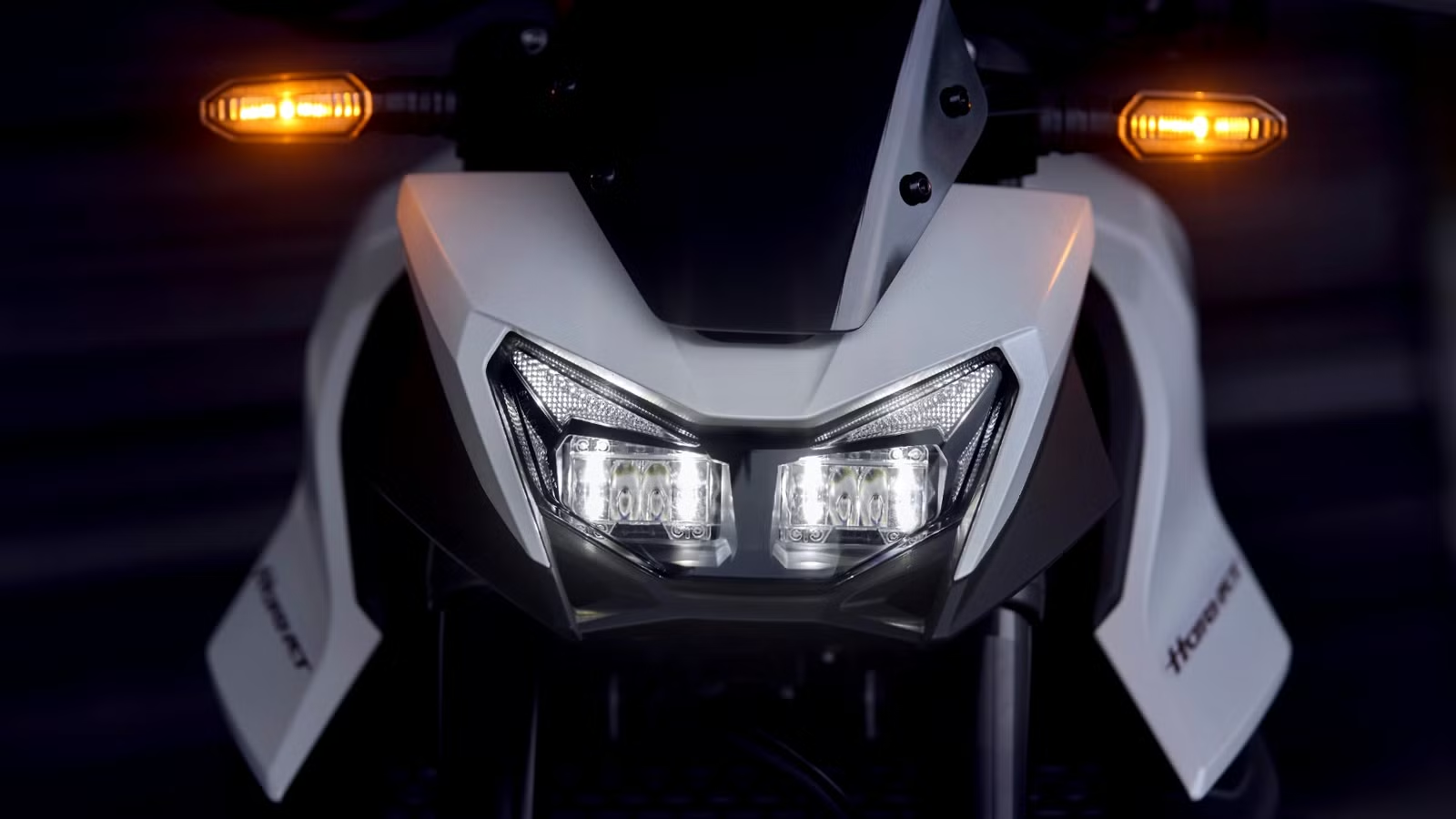
Every rider has imagined the perfect commute on his/her naked bike. Empty roads, green lights all the way to work, and enough sweeping corners to make a Monday morning feel like a Saturday ride. Reality looks very different. Most commutes involve creeping traffic, constant stoplights, and plenty of moments where you’re feathering the clutch more than enjoying the motorcycle beneath you.

The latter has been simply accepted as part of owning a manual bike. Your left hand gets a workout. Your wrist learns to balance clutch engagement with throttle input. However, all of us have—at some point—wondered if there was a way out of this. A machine that makes the commute fun, but also lets your wrist relax when traffic gets out of hand. Honda has a brilliant solution that’s easy on the pocket.
The Clutch Fatigue Every Commuter Learns To Live With
Clutch control is arguably the single hardest skill for a new rider to internalize, and it’s not close. Finding the friction zone, modulating it against throttle input, doing all of that while also watching for the car that’s about to pull out of a side street — it’s a lot of simultaneous processing for someone who’s had a license for six weeks. Drop the bike at a light because you let the clutch out too fast, and that embarrassment tends to stick with a rider far longer than it should.


Even experienced riders aren’t immune. Months of daily traffic wear down the same left hand and left ankle in slightly different ways. Thus, bikemakers have started innovating to minimize this problem. Yamaha’s Y-AMT system automates shifting entirely on select models, and Honda’s own DCT has been doing something similar on bigger machines for over a decade. While these work, both also remove the mechanical connection some riders specifically don’t want to give up. A great middle point for a fun commute then comes in the form of Honda’s innovative E-Clutch.
The Honda CB750 Hornet E-Clutch Quietly Becomes The Perfect Daily Ride
Base Price: $7,999

On paper, the 2026 Honda CB750 Hornet E-Clutch is still a mid-displacement streetfighter built to be thrown around a backroad. What’s changed is that Honda has quietly made it just as comfortable sitting in traffic, and the trick is a system that costs buyers nothing extra. E-Clutch is now standard equipment across the board, even though the MSRP is the same $7,999 as before.
That price stands out more once you look sideways at the competition. The Yamaha MT-07 starts at $8,599, the Kawasaki Z900 and Suzuki GSX-8S both land north of $9,000, and the Triumph Trident 660 is priced at $8,745. None of them offer anything resembling E-Clutch at this price point, which leaves the CB750 Hornet occupying a strange, useful space: cheaper than most of its direct rivals, and armed with tech none of them have an answer for yet.
What Helps The CB750 Be An Effortless Daily Ride

It helps to be clear about what this system isn’t. It’s not a DCT-style automatic, and there’s no clutch-free version of this bike being sold. You still shift gears yourself, using the same foot lever you’d use on any manual six-speed. What E-Clutch removes is the requirement to touch the handlebar-mounted clutch lever at all. A small motor manages clutch engagement and disengagement electronically — off the line, through gear changes, and coming to a stop.
Under the hood, it’s leaning on the bike’s throttle-by-wire system to blip the throttle automatically on downshifts, matching engine speed to road speed so the transition doesn’t lurch. You can even dial in how firm the shift lever feels, choosing between soft, medium, and hard resistance independently for upshifts and downshifts. And crucially, the traditional lever never goes away — pull it in whenever you want full manual control, and the electronics simply step back.
A Parallel-Twin Built For Real-World Torque

Power comes from a 755cc liquid-cooled parallel-twin producing a claimed 90.5 horsepower and 55.3 lb-ft of torque, built around a 270-degree crank that gives it a lopsided, almost V-twin-like pulse rather than the buzzy feel some parallel-twins default to. The valve train uses Honda’s Unicam design, a single-overhead-cam layout the company originally refined on its off-road machines, where keeping the cylinder head compact and light matters as much as outright output. That same compactness pays off here in a lower center of mass and a noticeably tidy top end.
The Efficiency Equation

Honda’s engineers also built in a downdraft intake path with what the company calls a Vortex Flow Duct, designed to accelerate airflow specifically through the 3,000 to 8,000 rpm band — the range where most commuting actually happens — to improve fuel atomization and, by extension, real-world mileage. A counterbalancing system tied into the primary drive keeps vibration in check, which sounds like a footnote until you’ve spent forty-five minutes on the highway with numb hands on a bike that lacks one.
Ergonomics That Don’t Punish A Long Commute

Elsewhere, the seat height is a low 31.3 inches, so that most riders can plant both feet flat at a stoplight without stretching or shifting their weight off the saddle. Curb weight lands at 432 pounds when fully fueled, ten pounds heavier than the outgoing standard-clutch model, but still light enough for quick direction changes. Once aboard, Honda describes the CB750 Hornet’s ergonomics as an “open riding position,” and that’s a fitting description. The handlebars are said to be wide enough to provide excellent leverage without forcing the rider to stretch forward. Footpegs are positioned beneath the rider rather than tucked aggressively rearward, while the seat allows enough room to shift around during longer rides.
The Chassis And Suspension Are Simple

The frame is a steel diamond design using the engine as a stressed member, a fairly conventional approach that keeps things light without sacrificing rigidity. Up front, a 41mm Showa SFF-BP inverted fork splits damping and spring functions between its two legs, a setup meant to keep the ride composed over rough pavement while still holding its line under harder braking. The rear runs a Pro-Link shock with 5.1 inches of travel.
Braking duties fall to dual 296mm discs with radial-mount, four-piston Nissin calipers up front and a single 240mm disc out back, with ABS standard across both. The 120/70 front and 160/60 rear tire sizing is squarely middleweight-naked territory — wide enough for stability at highway speed, narrow enough that the bike still tips into turns without much effort at commuting speeds.
Tech That Stays Out Of The Way Until You Need It

A 5-inch color TFT display anchors the cockpit, paired with Honda RoadSync smartphone connectivity that puts turn-by-turn navigation prompts right on the dash instead of forcing riders to glance down at a phone mount. Riding modes include Standard, Sport, Rain, and two rider-programmable User slots, each adjusting throttle response and the level of intervention from Honda Selectable Torque Control and wheelie control. None of it demands attention when it’s working correctly. The system quietly manages the parts of riding that used to demand constant, conscious effort, and gets out of the way the moment you’d rather just ride.
Source: Honda Powersports

Related posts

Latest Post


No Comments