The Electrified SUV That Quietly Solves Daily Driving Stress
8 minutes reading
Saturday, 12 Sep 2026 00:00 0 48 autotech
Hybrid cars are steadily growing in popularity in the U.S. market. Gas prices have risen significantly over the past year, prompting consumers to opt for more efficient vehicles. Modern hybrids are now a more viable option compared to their purely internal combustion counterparts.
Many new-car buyers are demanding stress-free ownership. For 2026, one Japanese hybrid SUV benefits from a well-rounded specification that focuses on dependability and efficiency without compromising comfort and specification.
Close-up shot of 2026 Honda CR-V Sport Touring Hybrid instrument clusterHonda
Honda pioneered the American hybrid landscape when it launched the original Insight in 1999. This was a quirky two-door liftback that took full advantage of a lightweight aluminum body and a compact Integrated Motor Assist system. To this day, the specialist hybrid achieves a record-breaking fuel efficiency that even modern hybrids fail to match. As a result, it has evolved into a cult-classic option among hypermilers.
Over the decades, the Japanese company’s engineering focus shifted from this early parallel hybrid setup toward more sophisticated multi-motor architectures. This modern approach uses a traction motor to drive the wheels directly in most scenarios, while a second motor acts as a generator, creating a driving feel that mirrors the smooth, instantaneous torque of an electric vehicle. Beyond these mechanical benchmarks, Honda has executed significant quality upgrades to its cabin experience. The brand moved away from the hard plastics and utilitarian layouts of the early 2000s, embracing a more premium design and tech-focused cabin philosophy.
The Honda CR-V Hybrid Offers Stress-Free Ownership
Front 3/4 action shot of 2026 Honda CR-V Sport Touring Hybrid driving on roadHonda
The 2026 Honda CR-V maintains a strong reputation in the U.S. market thanks to its longstanding and consistent performance as a cost-effective and dependable family SUV that suits both urban and active lifestyles. As a result, the CR-V benefits from impressive value retention, making it a viable investment for those needing a dependable vehicle for the long haul.
Overall, Edmunds predicts that the front-wheel-drive Sport Hybrid will carry a True Cost to Own of roughly $35,368 over the first five years of ownership, which factors in insurance, maintenance, taxes, financing, depreciation, and fuel. The base Honda CR-V Sport Hybrid loses around $10,310 of its value to depreciation over the course of five years, which is an impressive value retention rate by compact SUV standards. Additional five-year operating expenses include spending $5,580 on maintenance, $601 on repairs, and $6,032 on fuel.
Good Value Retention Earns Favor From Owners
Rear 3/4 action shot of 2026 Honda CR-V Sport Touring Hybrid driving on roadHonda
Using its own distinct tracking metrics, CarEdge indicates that a typical Honda CR-V loses 30 percent of its value after five years, resulting in a strong residual value profile. The site estimates five-year insurance premiums to total around $9,795, alongside a highly competitive long-term maintenance cost of $2,425, which sits well below the average for a compact crossover.
iSeeCars holds a similar sentiment with the CR-V Hybrid, highlighting that it will lose 33.7 percent or $12,001 of its value after five years, resulting in the Japanese HEV SUV earning an 8.0/10 retained value score. J.D. Power gives the same model an 85/100 score for resale. The SUV also scores 83/100 for driving experience, 84/100 for quality and reliability, and 81/100 for dealership experience, bringing its overall consumer-verified rating up to 83/100.
Performance Outputs Appropriate For Urban Traversing
Honda CR-V HybridHonda
Honda offers the CR-V Hybrid with a choice of front-wheel or all-wheel drivetrains, both of which produce a combined 204 horsepower and 247 pound-feet of torque. This power is managed by an advanced two-motor hybrid system that functions without a conventional transmission, utilizing direct-drive gearing instead of a traditional CVT. Honda limits both configurations to a 115 MPH top speed.
Unlike many competitors that use a separate electric motor to power the rear axle, Honda opts for a mechanical driveshaft linking the front-mounted hybrid system to a conventional rear differential for its all-wheel-drive setup. This traditional mechanical link explains why the model’s total system output remains the same regardless of whether you choose the front-wheel-drive or all-wheel-drive configuration. In terms of utility, the hybrid variant is rated for light-duty tasks, with a maximum towing capacity limited to 1,000 pounds.
Honda’s Impressive HEV Consumption Estimates
Rear 3/4 action shot of 2026 Honda CR-V Sport Touring Hybrid driving on roadHonda
The 2026 Honda CR-V’s hybrid system employs a supplementary compact lithium-ion battery pack, resulting in an impressive and financially appealing 43/36/40 MPG EPA consumption estimate on the city/highway/combined cycle for the front-wheel drive option. The all-wheel drive model returns a slightly worse 40/34/37 MPG result. While these are not segment-leading results, they are still impressive figures for a fully functional family SUV.
The 14-gallon gasoline tank gets you 560 miles of range in front-wheel drive guise, which the all-wheel drive system lowers to 518 miles. Honda’s hybrid system is a series-parallel system, which allows the electric motor to operate independently. The front-wheel-drive model is likely to save you $3,250 in fuel costs over five years, compared to the average new vehicle in the U.S. This will cost an estimated $1,550 to refuel over a year and $2.59 to drive 25 miles. A full tank of gas will cost around $58.
A Suspension Made For High Comfort Levels
Profile action shot of 2026 Honda CR-V Sport Touring Hybrid driving in cityHonda
The 2026 Honda CR-V utilizes a front MacPherson strut setup paired with an independent multi-link rear suspension system. Front spring rates and tuned damper valving absorb initial bump impacts. The multi-link rear architecture places springs and dampers at lower mounting points. This positioning allows the rear wheels to move slightly rearward when striking bumps, reducing harsh impact energy into the cabin. Front-wheel-drive variants provide 7.8 inches of ground clearance, while all-wheel-drive models feature 8.2 inches.
This ride height balances obstacle clearance with a low center of gravity to optimize roll control. Stiffened aluminum front subframes and rigid rear subframe mounts isolate road noise and mechanical vibration. Fluid-filled compliance bushings dampen high-frequency road chatter before vibrations reach the passenger compartment. Low-friction dampers control body motion during cornering maneuvers and eliminate floating over continuous crests. Honda tunes the spring rates for progressive linear compliance, providing secondary ride comfort on broken pavement.
Honda’s Competitive Pricing Adds Appeal
Shot of 2026 Honda CR-V Sport Touring Hybrid interior showing cabinHonda
The $35,630 base Sport trim hits the value sweet spot because it gives buyers the core CR-V Hybrid experience without pushing the price into near-luxury territory. You still get the efficient 204-horsepower hybrid system, 18-inch gloss black wheels, roof rails, full LED headlights, heated front seats, a sunroof, dual-zone climate control, and Honda’s updated nine-inch touchscreen with wireless Apple CarPlay and Android Auto.
That matters because this is where the CR-V Hybrid makes its strongest case against both cheaper sedans and larger SUVs. While the Accord Hybrid costs less and the Pilot offers more space, the CR-V Hybrid lands in the crucial middle ground where families get SUV versatility, strong efficiency, and a more premium daily-driving experience without stepping into a much higher price bracket.
Shot of 2026 Honda CR-V Sport Touring Hybrid interior showing seatsHonda
The $38,725 Sport-L is the smarter upgrade for buyers who want the CR-V Hybrid to feel more upscale without paying for the fully loaded model. Its leather upholstery, driver-seat memory, wireless phone charger, and a higher-quality eight-speaker audio system make the cabin feel noticeably more upscale, especially for commuters and families who spend long periods inside the vehicle.
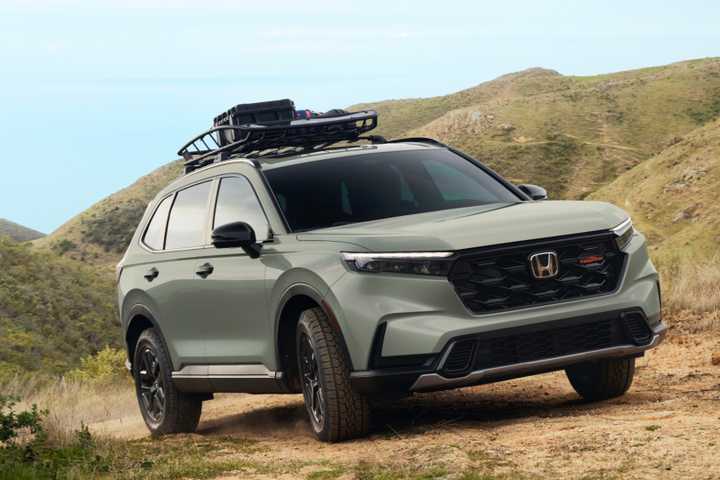
The $38,800 TrailSport makes sense for buyers who want extra all-weather confidence and a tougher look, but it is not automatically the best value for everyone. Its standard all-wheel drive, all-terrain tires, power tailgate, heated steering wheel, all-weather mats, and unique Shark Gray wheels give it a more adventurous edge, but shoppers who mostly drive on pavement may find the Sport-L’s comfort upgrades more useful day to day.
2024 Honda CR-V Hybrid Sport Touring interiorHonda
The $42,550 Sport Touring justifies its premium when buyers want the CR-V Hybrid to feel like a near-luxury SUV without paying luxury-brand money. Its hands-free tailgate, Google-based infotainment system, Bose audio, satellite navigation, 19-inch gloss black wheels, and expanded drive modes make it the most polished version of the lineup. It costs noticeably more, but it also best supports the article’s core argument: the CR-V Hybrid can deliver premium features, strong efficiency, and family practicality in one package.
The 2026 Honda CR-V Hybrid offers a spacious interior design that lets you make the most of its passenger and cargo utility. Occupants in the front enjoy 41.3 inches of legroom and 38.2 inches of headroom, as all hybrid trims come standard with a sunroof. You also get 55.6 inches of hip room and 57.9 inches of shoulder space.
Rear passengers benefit from 41.0 inches of legroom, 38.2 inches of headroom, 52.6 inches of hip room, and 55.9 inches of shoulder room. For storage, the hybrid configurations feature 36.3 cubic feet of trunk space, which is slightly less than the purely gas-powered models due to battery placement. This space expands to 76.5 cubic feet with the rear seats folded flat.
Base Trim Engine
2L I4 Hybrid
Base Trim Transmission
CVT
Base Trim Drivetrain
Front-Wheel Drive
Base Trim Horsepower
145 HP @6100 RPM
Base Trim Torque
138 lb.-ft. @ 4500 RPM
Base Trim Fuel Economy (city/highway/combined)
43/36/40 MPG
Base Trim Battery Type
Lead acid battery
Make
Honda
Model
CR-V Hybrid
Sources: Honda, Edmunds, iSeeCars, CarEdge, the EPA, and J.D. Power.










No Comments