The Affordable Mid-Engine Sports Car Outrunning A Cayman GTS
11 minutes reading
Wednesday, 24 Jun 2026 14:00 0 87 autotech
The conventional wisdom has always been simple: if you want a world-class mid-engine sports car, you pay the European premium. For decades, that meant sending your check to Stuttgart, Maranello, or Sant’Agata. Today, that logic is harder to defend than ever. An American made sports car has redrawn the performance map in ways that would have seemed implausible just a few years ago. It is a genuinely mid-engined, rear-wheel-drive sports coupe producing 495 horsepower from a naturally aspirated 6.2-liter V8, and it starts at approximately $76,345. That is around $27,000 less than the Porsche 718 Cayman GTS 4.0’s $103,300 base price.
The Porsche 718 Cayman GTS 4.0 is a formidable benchmark. With a high-revving, naturally aspirated 4.0-liter flat-six producing 394 horsepower, razor-sharp steering, and a chassis widely considered one of the most balanced in the sports car segment, it sets the credibility bar for this class. But documented lap data from independent sources, including Car and Driver’s direct head-to-head test, shows the American challenger matching or beating the Cayman GTS 4.0’s on-track times while costing significantly less.
When Smart Engineering Delivers Supercar-Like Pace Without The Premium
A front 3/4 shot of a 2011 Ferrari 458 ItaliaFerrari
For most of automotive history, mid-engine placement was the exclusive preserve of exotic machinery. Ferrari, Lamborghini, McLaren. The layout that positions the engine just ahead of or beside the rear axle, optimizing weight distribution and mechanical grip, carried a price tag to match its engineering pedigree. When mid-engine sports cars appeared at more accessible price points, the original Honda NSX being the defining exception, they were engineering outliers celebrated precisely because of their rarity.
Front 3/4 shot of 2025 Porsche 718 Cayman GTS 4.0 in redPorsche
That landscape has shifted materially. The Porsche 718 Cayman, in GTS 4.0 specification, now represents the European standard-bearer for what a serious, driver-focused mid-engine sports car should feel like at under six figures. It deploys a 4.0-liter naturally aspirated flat-six making 394 horsepower and 317 pound-feet of torque, revving freely to 8,000 rpm, and is available with either a close-ratio six-speed manual or Porsche’s own seven-speed PDK dual-clutch automatic. Weighing around 3,086 pounds, the Cayman GTS 4.0 generates 1.03 g on the skidpad and stops from 60 mph in 98 feet. It is precise, communicative, and deeply satisfying — essentially the platonic ideal of the driver’s sports car, priced from $99,700.
The German Supercar That Plans To Show The Corvette ZR1 Who’s Boss
This German brand isn’t giving up on reclaiming its lap record.
How The C8 Corvette Stingray Z51 Delivers Exotic-Car Balance
Chevrolet
Into that landscape arrives the C8 Corvette Stingray Z51: mid-engine, rear-wheel-drive, 495 horsepower, 470 pound-feet of torque, and a base price that enters the conversation at roughly $76,345. The Z51 package, a $6,345 add-on to the base Stingray’s starting $70,000 before fees, delivers upgraded Brembo brakes, a performance-tuned suspension with magnetorheological dampers, an electronic limited-slip differential, a performance exhaust, a rear spoiler, a front splitter, and Michelin Pilot Sport summer tires. The result is not a budget approximation of exotic performance. It is the real thing, and independent track data proves it.
Base Trim Engine
6.2L V8 ICE
Base Trim Transmission
8-speed auto-shift manual
Base Trim Drivetrain
Rear-Wheel Drive
Base Trim Horsepower
490 HP @6450 RPM
Base Trim Torque
465 lb.-ft. @ 5150 RPM
Base Trim Fuel Economy (city/highway/combined)
16/24/19 MPG
Base Trim Battery Type
Lead acid battery
Make
Chevrolet
Model
Corvette Stingray Coupe
The mid-engine layout in the C8 is not a marketing conceit. General Motors relocated the 6.2-liter LT2 V8 from its traditional front-mounted position to just ahead of the rear axle, a fundamental architectural decision that changes how the car behaves at the limit in measurable ways.
Chevrolet
The C8 Stingray Z51’s weight distribution sits at approximately 40 percent front, 60 percent rear, a balance that places mass closest to the car’s center of gravity and reduces polar moment of inertia. In practical terms, the car rotates more willingly around its own axis, transitions between directions feel more fluid, and traction off the apex is maximized because the driven rear wheels are loaded by the engine’s mass above them. Chevrolet pairs this geometry with a dry-sump lubrication system, aluminum double-wishbone suspension at all four corners, and the Z51-specific magnetorheological shock absorbers, which adjust their damping rates thousands of times per second based on sensor inputs from accelerometers across the car.
The Michelin Pilot Sport 4S tires fitted as standard to the Z51, 245/35ZR19 at the front and 305/30ZR20 at the rear, are asymmetric summer performance compounds matched to the chassis’ cornering targets. The electronic limited-slip differential, also exclusive to the Z51, redistributes torque between the rear wheels to maximize traction during corner exit. At Car and Driver’s Grattan Raceway test, the C8 Z51 recorded a figure-eight time of 23.4 seconds at 0.86 g, 0.2 seconds quicker than the Cayman GTS 4.0, which managed the same course in 23.6 seconds at 0.85 g. The gap is marginal, but the direction of the result is not.
14 Affordable Alternatives To The Porsche 911 In 2026
These sports cars prove that you can still find the magic and thrill of a proper sports car for less than the price of a Porsche 911.
Lap Times, Acceleration, And Track Data That Put The Cayman GTS 4.0 Under Pressure
2025 Porsche Cayman 718 GTS cabin shotPorsche
Numbers without context are noise. Here is the context. Car and Driver conducted a direct comparison test between the 2020 Chevrolet Corvette Stingray Z51 and the 2020 Porsche 718 Cayman GT4, a car sharing the same 4.0-liter naturally aspirated flat-six as the GTS 4.0, at the same 394 horsepower output, in a platform built specifically for track use. The venue was Grattan Raceway in Belding, Michigan, a 1.9-mile technical circuit that rewards chassis balance, mechanical grip, and braking precision over raw power.
The result: Chevrolet Corvette Stingray Z51, 1:26.4. Porsche 718 Cayman GT4, 1:26.5. One tenth of one second separated the two cars after multiple laps of independent professional testing. The C8 Z51 was faster. It was also faster to 60 mph. Car and Driver recorded 2.9 seconds to 60 mph versus the Cayman’s 4.4 seconds, and through the quarter mile at 11.2 seconds compared to 12.0 seconds for the Porsche. The C8’s straight-line superiority is decisive; its lap-time parity with a car priced higher and engineered specifically for circuit performance is the more remarkable finding.
LapMeta’s Broader Database Corroborates The Pattern
Chevrolet
The C8 Stingray Z51 has recorded a 1:53.4 at Buttonwillow Raceway’s 13CW configuration, a track that combines tight technical sections with long full-throttle sweeps, demanding both cornering balance and power delivery. Owner and track-day records at venues including Virginia International Raceway show the C8 Z51 consistently producing lap times in the same bracket as competitors costing substantially more. The car’s 495 horsepower and 470 pound-feet, deployed through a launch control system and a genuinely quick dual-clutch transmission, translate to mid-corner drives that compensate for any small chassis deficit against lighter European rivals.
Track-day owners consistently report the C8 Z51 as approachable at the limit. The mid-engine balance means understeer is manageable and progressive, rather than the sudden, difficult-to-catch snap associated with front-heavy sports cars. Multiple owners participating in open-lapping events at circuits like the Autobahn Country Club and Thunderhill note that the car rewards early throttle application and responds predictably to trail braking. The C8 is not as scalpel-sharp as the Cayman GTS 4.0 in corner entry — the Porsche’s smaller dimensions and lighter weight give it an edge in feedback and immediacy — but the lap times make the performance case without ambiguity.
The Japanese Sports Car That Drives Like A Porsche – Without The Ownership Anxiety
Satisfying ownership costs with driving dynamics on-par with Porsche.
Dual-Clutch Precision, Everyday Comfort, And Performance You Can Use
Shot of 2021 Chevrolet Corvette Stingray 3LT engine bayBring A Trailer
Both the C8 Corvette Stingray Z51 and the Porsche 718 Cayman GTS 4.0 offer dual-clutch transmission options, but the execution and positioning of each unit differs in ways that matter to a daily driver. The C8 uses an eight-speed dual-clutch gearbox developed in partnership with Tremec, a wider-ratio unit than the PDK, designed to balance track-day launch performance with highway cruising refinement. It enables the C8’s 2.9-second 0-60 mph time through a launch control system that manages wheel spin and clutch engagement with precision. In automatic mode, it manages gear selection well for everyday driving; in manual mode via the steering-column-mounted paddles, response is immediate and satisfying.
The Porsche 718 Cayman GTS 4.0 is offered with either a six-speed manual or the brand’s seven-speed PDK dual-clutch. The PDK is, by common consensus, one of the most refined dual-clutch units available in any production car, faster than a human can shift, perfectly calibrated in automatic mode, and responsive to manual inputs. It is also available with a stick shift, which the C8 is not. The Corvette is dual-clutch only, and buyers who prioritize the engagement of rowing their own gears will find that the Porsche offers something the Chevrolet simply cannot. That is a genuine product difference, not a quibble.
In Everyday Use, The C8 Z51 Acquits Itself Well
The interior is a considerable step forward from any previous Corvette generation, a driver-focused cockpit with a 12-inch reconfigurable instrument cluster, an eight-inch center touchscreen, and materials that no longer embarrass the car’s performance credentials. Forward visibility is excellent thanks to the low cowl enabled by the mid-engine layout. Cargo space, 12.6 cubic feet split between a front trunk and rear storage, is usable. Fuel economy on the highway is a respectable 25 mpg. The Z51 suspension, while firmly calibrated, does not produce the tooth-rattling ride associated with dedicated track-only upgrades.
The 718 Cayman GTS 4.0 offers a more uniformly polished daily experience: Porsche’s interior fit and finish remains the segment reference, the ride quality in normal mode is genuinely comfortable, and the flat-six soundtrack is one of the great sensory experiences in modern motoring. Options lists, however, are where Porsche extracts its badge tax most aggressively: adaptive cruise control, rear-view cameras, and premium audio can add thousands to a car already priced over $100,000.
Why The C8 Corvette Stingray Z51 Is The Smart-Money Choice
Chevrolet Corvette C8 Stingray (2020), top down, profileChevrolet
The math is straightforward. A 2026 Chevrolet Corvette Stingray with the Z51 Performance Package starts at approximately $76,345. A comparably equipped 718 Cayman GTS 4.0 begins at $103,300, a gap of roughly $27,000 before either buyer adds a single option. Once you account for common additions (adaptive dampers, premium audio, enhanced interior trims), well-equipped examples of each car diverge further. That $27,000 buys a lot of track days, tires, and maintenance.
The performance case for spending the extra money on the Porsche is difficult to construct on lap-time data alone. Independent testing shows the C8 Z51 matching the Cayman family’s lap time with a tenth of a second to spare, besting it to 60 mph by a wide margin, and producing more power than the Porsche’s flat-six can generate from its naturally aspirated architecture. For buyers primarily interested in what the car does at the limit, the Corvette delivers equivalent, and in some measurable respects superior, performance per dollar.
Depreciation Is Where The Calculus Shifts
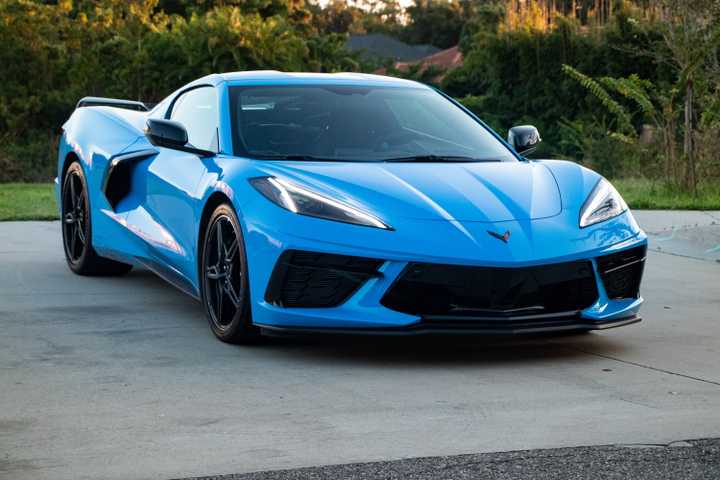
Rear 3/4 shot of 2025 Chevrolet Corvette Stingray in blue parkedCarBuzz
Porsche’s 718 Cayman GTS 4.0 is a strong value-hold: the 718 range consistently ranks among the lowest-depreciating sports cars on the market, with studies showing five-year depreciation rates in the 10 to 22 percent range. A 2021 Cayman GTS 4.0 purchased at launch near $100,000 retains approximately $85,000 in current private-party value, a remarkably stable curve. The C8 Corvette Stingray, by comparison, depreciates more aggressively. Several market analyses note that C8 Stingrays have lost value at a faster rate than the Porsche equivalents, particularly as the initial post-launch demand premium has normalized. Buyers who prioritize long-term ownership cost, or plan to sell within three to five years, should factor that into the equation honestly.
Side angle shot of 2025 Corvette Stingray in red parked outside of tennis clubCorvette
Where the Corvette’s value proposition is most compelling is for the buyer who will keep the car, drive it hard, and is not financing a hedge against resale. The C8 Z51’s running costs are not dramatically higher than the Cayman’s, scheduled service intervals are comparable, and the V8’s mechanical simplicity means fewer complex sub-systems to maintain than the Porsche’s sophisticated flat-six. Insurance rates vary by region and driver profile, but the C8’s lower purchase price generally produces a lower insured value.
The Porsche 718 Cayman GTS 4.0 is a magnificent sports car. Its steering is more communicative, its throttle response more tactile at the limit, and its brand prestige remains unrivaled in this segment. For buyers for whom those qualities justify a $24,000 premium, and who plan to sell within a few years and benefit from Porsche’s superior residuals, the Cayman is the correct answer. For everyone else — the buyer who wants documented mid-engine performance, genuine track capability, more power, and a starting price that keeps the bank account intact — the C8 Corvette Stingray Z51 makes an argument the lap times fully support.
Sources: Porsche U.S., Chevrolet U.S. & Car and Driver















No Comments