
The Diesel Engine That Refuses To Die After 300,000 Miles
The slow demise of diesel engines reflects a fundamental shift in global automotive priorities. Diesel engines once won massive favor in pickup trucks and SUVs for good thermal efficiency and long-distance torque. Today, diesels are starting to fade as a result of declining market share under stringent global emissions regulations, expanding urban zero-emission zones, and rising compliance costs.

Modern tailpipe standards require increasingly complex systems, including multi-stage selective catalytic reduction and diesel particulate filters. These diminish inherent manufacturing cost advantages. At the same time, rapid advances in gasoline-hybrid architectures and battery-electric powertrains deliver comparable efficiency with lower urban emissions.
How Mercedes-Benz Approached Engine Manufacturing In The 1970s
During the 1970s and 1980s, Mercedes-Benz operated under an uncompromising engineering-first philosophy, prioritizing heavy-duty mechanical durability, overbuilt cast-iron components, and extreme thermal resilience. This was an era when the German brand didn’t have to worry about high manufacturing costs. Modern Mercedes-Benz engine design centers on modularity, high efficiency, and advanced electronic integration.

Today, lightweight aluminum block construction, high-pressure direct injection, integrated 48-volt mild-hybrid electrification, and turbocharging maximize power density while minimizing emissions. While legacy engines relied on mechanical simplicity and physical overengineering to survive decades of continuous operation, modern engines rely on sophisticated sensor networks, automated thermal control, and optimized software to balance high performance with strict international environmental regulations.
The OM617 Is A Diesel Engine That Lasts Forever

In the long and storied history of automotive engineering, few powerplants have achieved the near-mythical status assigned to the Mercedes-Benz OM617 diesel engine. Debuting in 1974, this straight-five diesel engine arrived at a pivotal moment in automotive history, right in the wake of the 1973 global oil crisis. Automakers around the world were scrambling to produce vehicles that offered sensible fuel economy without sacrificing structural substance.
Mercedes-Benz responded with an engine that redefined consumer expectations for diesel cars. Prior to the OM617, passenger diesel cars were largely viewed as sluggish, noisy, and agricultural vehicles reserved for taxicabs or frugal commuters. The introduction of a five-cylinder diesel changed that dynamic entirely, offering a blend of smoothness, acceptable performance, and an unyielding commitment to longevity that set a benchmark for generations to come.
The OM617 Revolutionized Diesel Passenger Cars

The OM617 made its official debut under the hood of the W115 chassis 240D 3.0 in 1974. It quickly earned the distinction of being the world’s first production five-cylinder diesel passenger-car engine. Over its production run, from 1974 to 1991, the engine found a home in several of the most iconic vehicles Mercedes-Benz ever produced. The most widespread application was in the legendary W123 series, particularly the 300D sedan, the 300CD coupe, and the spacious 300TD station wagon.
It also powered the flagship W126 S-Class sedans, specifically the 300SD, proving that a diesel engine could belong in an executive luxury flagship. Off paved roads, Mercedes used the OM617 in early G-Wagen models, where its dependability and low-end grunt made it an indispensable companion in remote parts of the globe. The engine also served in various Mercedes-Benz commercial vans and transport vehicles, further proving its versatility in demanding roles.
How Mercedes Made A Bulletproof Diesel Engine

At the core of the OM617’s legendary status is an engineering philosophy that prioritized over-engineering and simplicity over absolute power output. To understand its layout, one must examine the fundamental design choice to add a fifth cylinder to the established four-cylinder OM615 and OM616 designs.
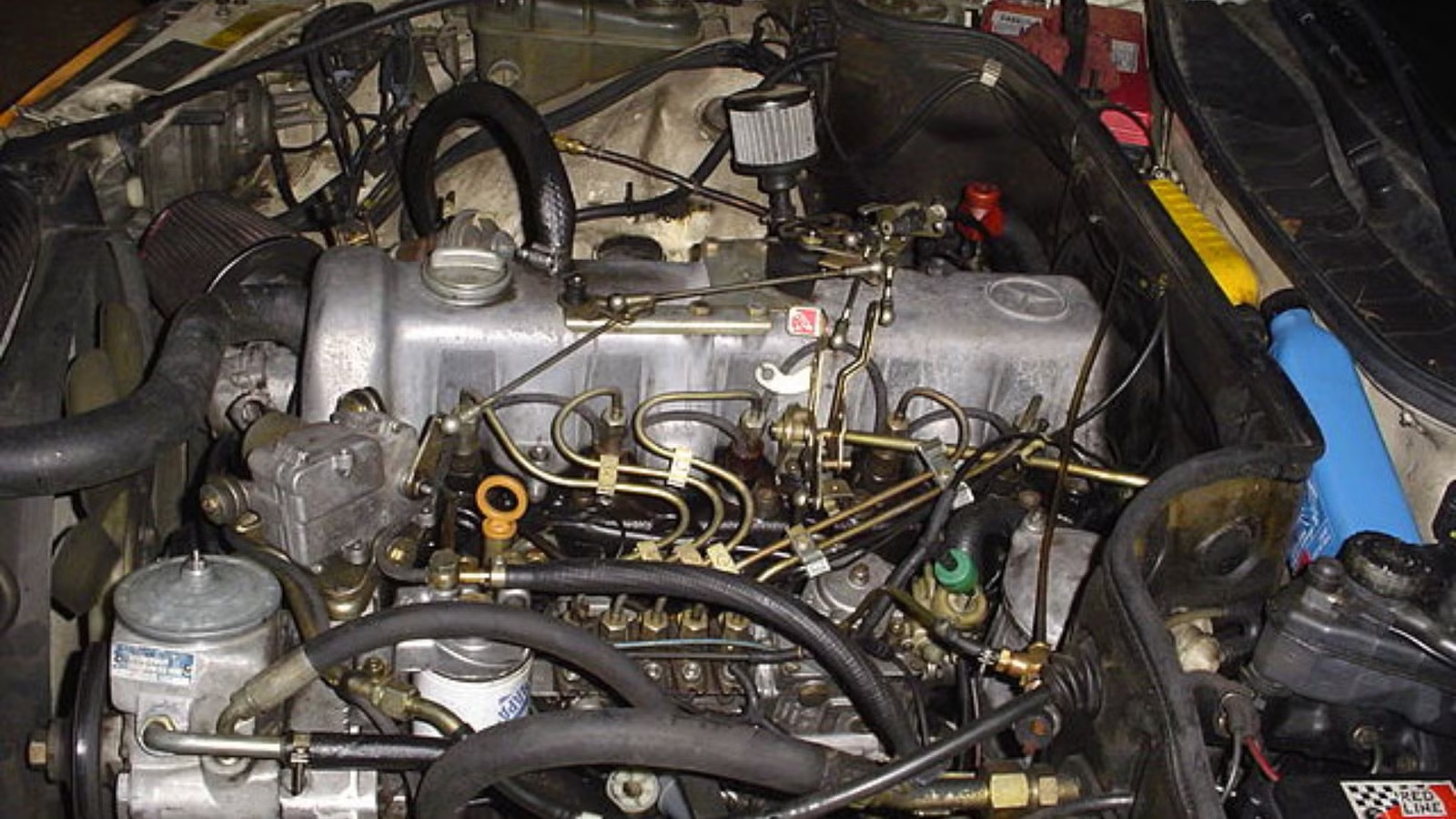
Mercedes-Benz engineers wanted to increase engine capacity and smooth out power delivery without making the engine block too long to fit in existing passenger-car engine bays, making an inline-five the ideal compromise. The engine features a heavy cast-iron block mated to a cast-iron cylinder head, eliminating the thermal expansion mismatch issues that often cause head gasket failures in modern aluminum-head engines. The forged steel crankshaft, supported by six main bearings, provides immense rigidity and reduces torsional vibration. Inside the block, oil-spray jets cool the undersides of the pistons, a high-performance technique for the era that ensured internal temperatures stayed low even under continuous heavy loads.
The OM617’s fueling system is another cornerstone of its legendary longevity. Modern diesel engines rely on complex electronic sensors, computerized engine control units, and fragile high-pressure common-rail systems. The OM617 utilizes a mechanical injection system supplied by Bosch. The mechanical M-type inline injection pump lubricates the engine directly through the oil supply. This mechanical design means that the engine requires almost zero electrical power to keep running once started.
As long as the mechanical fuel pump receives fuel and air, the engine will continue to run even in the event of an absolute electrical system failure. The unit uses indirect fuel injection with pre-combustion chambers, which softens the combustion knock typical of diesels and contributes to smoother idling, lower mechanical stress on internal components, and cleaner burning across varying fuel qualities.
Power Wasn’t Its Stongest Suit

In terms of power output, early naturally aspirated versions of the 3.0-liter OM617 produced 79 horsepower and 127 pound-feet of torque. While these numbers delivered modest acceleration times, the engine was praised for cruising continuously at highway speeds without straining.
Recognizing the demand for more highway-merging power, especially in the North American market, Mercedes-Benz introduced the turbocharged version, known as the OM617A, in 1979. Equipped with a Garrett turbocharger, updated sodium-filled exhaust valves, and enhanced piston cooling, the OM617A pushed power to about 123 hp and 184 lb-ft of torque. This turbocharger transformed the driving experience, providing the necessary punch to make the heavy W123 and W126 chassis lively while maintaining the underlying mechanical bulletproof durability of the original design.
The OM617 Coasts Past Two Million Miles

The real-world proof of the OM617’s engineering prowess lies in the staggering mileage figures recorded by owners worldwide over the past five decades. It is not uncommon to find W123 300D models comfortably exceeding 300,000 miles on their original factory engine blocks and cylinder heads. Numerous documented examples have crossed the half-million-mile mark with only standard maintenance and routine component replacements like water pumps or alternators.
One famous Greek taxi driver, Gregorios Sachinidis, donated his 1976 Mercedes-Benz 240D to the official Mercedes-Benz Museum after accumulating over 2.8 million miles, a journey made possible by the foundational durability shared across this engine family. Vehicles equipped with the OM617 frequently serve in remote regions of Africa, South America, and Eastern Europe, running on low-quality fuel and under harsh conditions where modern vehicles with delicate sensors would swiftly fail.
Keeping The Mercedes Diesel Running Is A Simple Task

Maintaining an OM617 engine is surprisingly straightforward, making it a favorite among vintage automobile enthusiasts and home mechanics. Regular fluid changes are the single most critical factor in achieving multi-hundred-thousand-mile longevity. Ideally, change the engine oil and oil filter every 3,000 to 5,000 miles using high-quality, heavy-duty diesel engine oil with high zinc content to protect the valve train.
Because the engine features a solid-lifter valve design rather than hydraulic lifters, periodic manual valve adjustments are mandatory every 15,000 miles to maintain optimal compression and prevent valve burn. Replacing the primary and secondary fuel filters every 10,000 to 15,000 miles is equally essential to keep the mechanical injection pump running smoothly and prevent dirt particles from clogging the pre-chamber fuel injectors.

When it comes to maintenance costs, keeping an OM617 running remains affordable, especially when compared to maintaining modern luxury diesel vehicles. Basic consumables such as oil filters, fuel filters, air filters, and valve cover gaskets are readily available through vintage European parts suppliers and cost a fraction of modern equivalents.
Major repairs are rare, but servicing wear-and-tear items like glow plugs, water pumps, fuel hoses, and vacuum lines is inexpensive and easy because of the spacious layout of vintage Mercedes engine bays. The main cost usually comes from preemptive rust prevention on the host vehicle chassis rather than mechanical failures in the engine bay.
Sources: Mercedes-Benz and Hemmings.

Related posts



Latest Post




No Comments