
The Cruiser With Yamaha Reliability And Harley Character
Harley-Davidson might be going through a bit of a rough patch at the moment, but it still reigns supreme in the cruiser segment. That’s not to say other manufacturers didn’t attempt to carve out their own little slice of the pie, though, some more successfully than others. BMW has the R 18, Triumph offers the massive Rocket 3, and there are several Japanese machines with Harley character for buyers to choose from. Today we’ll be focusing on one such specimen in particular, which provides a very nice blend of dependable Japanese engineering and American V-twin personality. And although there wasn’t any shortage of solid candidates for us to choose from, this one has all the necessary credentials to fit the bill better than most.
Where To Look For Harley Spirit Without The Badge

Let’s give the honorable mentions their time in the spotlight before we get to the meat and potatoes, starting with the Suzuki Boulevard M109R. Still in production today, it features a liquid-cooled 1,783cc (109-cubic-inch) goliath good for up to 125 hp and 118 lb-ft of torque. But the M109R’s character leans more toward power cruiser rather than the traditional side of things, so it doesn’t quite fit our premise as well as others. The Honda VTX1800 and Yamaha Road Star 1700 are close matches, as well, yet the model we have in mind was actually produced by Kawasaki. And even though it was discontinued all the way back in 2010, it remains one of the most fascinating cruisers to ever hit the road.
Kawasaki Never Hesitated To Show Its Wild Side

Looking back, Kawasaki’s determination to one-up its competition seems to date all the way back to the Z1 in 1972. Numerous other instances have occurred ever since, but the one relevant to our story today took place in 2004 at the height of the cruiser displacement wars between Japanese brands. Honda held the crown at the time with the VTX1800, and Kawasaki was set on stealing its glory with something truly outstanding. However, the idea wasn’t to surpass the Honda’s 1,795cc V-twin incrementally, but to leapfrog past it with an extra 250cc at the very least. In doing so, Kawasaki came up with the biggest mass-produced V-twin motorcycle in existence, showcasing many similarities to Harley’s big twins but also some key differences.

The Kawasaki Vulcan 2000 Took Things To The Absolute Extreme

Enter the mighty Vulcan 2000, also known as the VN2000 and released as a 2004 model after three and a half years in development. People have drawn parallels between Harleys and Kawasaki’s gargantuan cruiser ever since day one, not just from a cosmetic standpoint but in relation to the bike’s overall demeanor. Starting with the powertrain department, the Vulcan 2000 was put in motion by a liquid-cooled 2,053cc (125-cubic-inch) V-twin whose bore and stroke measured 103 and 123.3 millimeters (4.05 and 4.85 inches), respectively. Valve actuation took place via pushrods along with rocker arms, because using overhead cams would’ve blown the engine’s height out of proportion and packaging efficiency was key with such an enormous motor. And by employing pushrods, the Kawi came much closer to that authentic Harley DNA than, say, Suzuki’s DOHC-equipped Boulevard.
But the VN2000 also diverged from the formula with four valves per cylinder, electronic fuel injection and liquid cooling. Still, Kawasaki went to great lengths to make the latter as unobtrusive as possible, so the radiator was tucked in tight between the frame’s down tubes at the front. A single-pin crankshaft gave the engine that deep rumble we love to hear from a proper cruiser, and then there are the numbers really driving the point home. The mill could unleash 116 hp at 5,000 rpm and 141 lb-ft of crushing torque at 3,000 revs, courtesy of that long-stroke architecture engineered for low-end pull. Power travels to the rear wheel by means of a five-speed transmission and a belt drive, which further enhances the motorcycle’s Harley-esque identity.

Oh, and speaking of that rear hoop, it came wrapped in a big old tire measuring 200 millimeters (7.87 inches) in width. For a short period following the VN2000’s release, that was the widest rear tire you could get on a production V-twin cruiser. So, obviously, Kawasaki wasn’t just thinking big in terms of the engine, but looking to apply that bigger-is-better philosophy wherever it could. And because you need some serious stopping power to bring such a huge machine to a halt, the Vulcan 2000 featured dual 300-millimeter (11.81-inch) discs and four-piston Tokico calipers at the front. On the other hand, the rear end came with a 320-millimeter (12.6-inch) rotor pinched by a two-piston caliper. Kawasaki went to town in the suspension department, as well.
The VN2000 sat on 49-millimeter (1.93-inch) forks and a single shock absorber, concealed out of sight to create the impression of a hardtail construction at the back. Ergonomically, the Kawi had a low seat height at just under 27 inches, right in line with what you’d expect from a cruiser but still pretty remarkable given that beast of an engine. A 32-degree rake had the forks angled just right, while the Vulcan’s wheelbase measured a battleship-worthy 68.3 inches. Top all that off with plenty of chrome, a beefy fuel tank and some gorgeous exhaust pipework, and normies might actually assume they’re looking at a Harley until they get up close. The Vulcan 2000 was far more sophisticated than Milwaukee’s machines in many regards, though, while also benefiting from that top-notch Japanese reliability. But there was, of course, one notable trade-off with a bike this big, that being the creature’s sheer heft at more than 800 pounds wet.
Enhancing That Harley Vibe Even Further

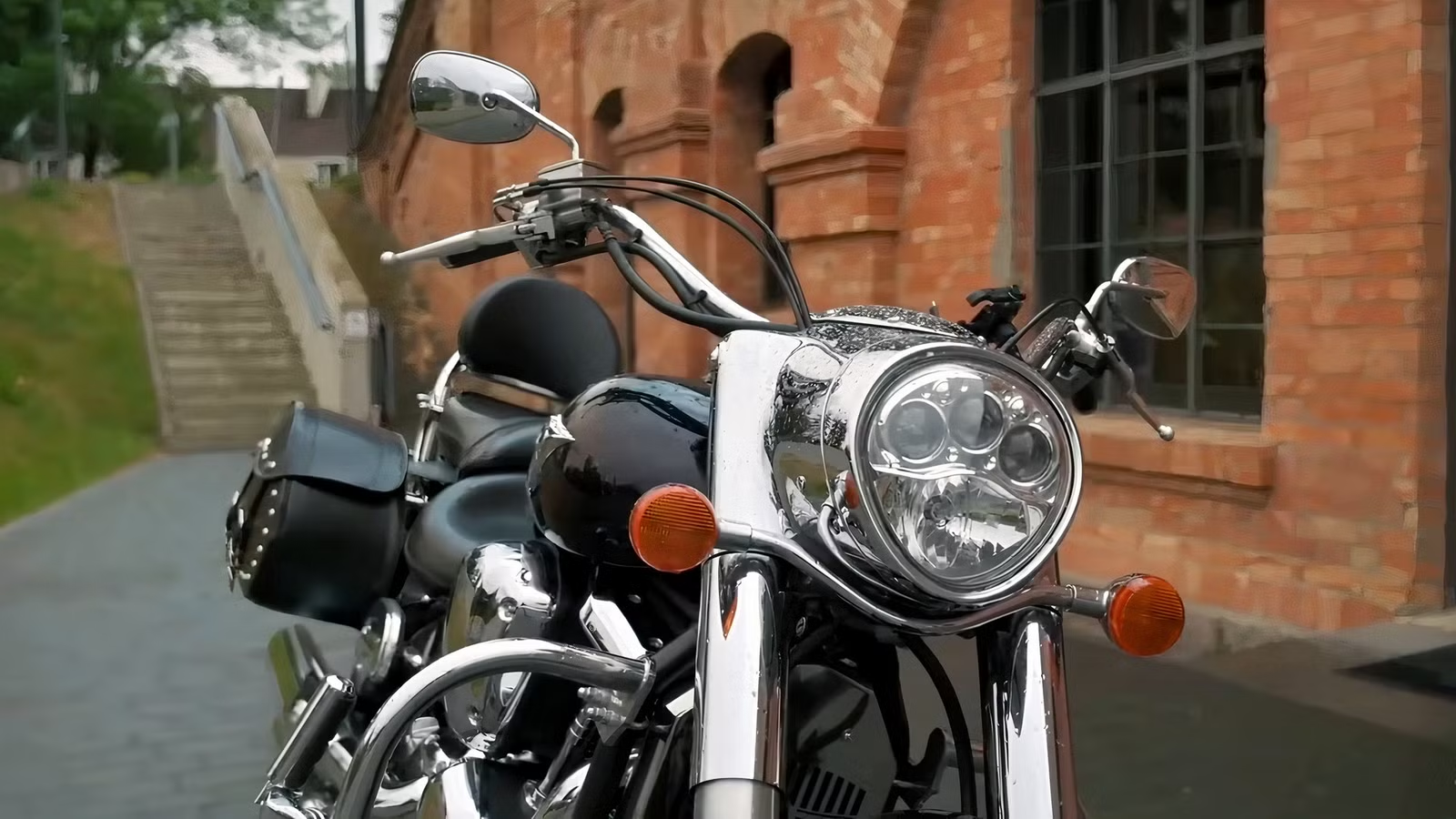
Now, the similarities between the standard VN2000 and Harley-Davidson’s cruisers are striking, to say the least, but a couple of variants really dialed things up to eleven. Kawasaki came up with the Classic and Classic LT versions for the model-year 2006, the first of which did away with the base model’s not-so-traditional “bug-eye” headlight in favor of something more conventional. This brought the Vulcan even closer to that quintessential Harley aesthetic, and then there was the touring-focused Classic LT. It had a passenger backrest, saddlebags for storage and a windshield to give riders some proper wind protection. Kitted with all these goodies, the Classic LT is where the whole Milwaukee influence reached its visual peak in earnest.
What Came Of Kawasaki’s Big Cruiser Ambitions In The End?

Despite how impressive the Vulcan 2000 might’ve been, the public’s interest in gigantic cruisers slowly fizzled out and the model was taken off the assembly line in 2010. Now, the pool of potential buyers for a two-liter V-twin behemoth was never going to be substantial, so the Kawi was more of a niche curiosity than a model you’d expect to become a best-seller. But the VN2000 did put an end to the V-twin displacement wars once and for all, and its 2,053cc powerhouse remains one of the biggest engines used in a production motorcycle to this day.
Kawasaki never released any official data on the number of Vulcan 2000s sold, yet the model is known to have been produced in fairly limited quantities. And, as such, getting your hands on one today won’t be easy, but you should keep an eye on marketplaces like Cycle Trader or MotoHunt if you’re hoping to one day experience what the VN2000 brought to the table. Prices generally tend to fall below $10,000, with exact figures depending heavily on factors like the motorcycle’s mileage, condition and model-year. And with a Vulcan 2000 in your possession, you’ll be the proud owner of something truly special while also getting to flex on Harley owners with that huge motor and its ungodly torque output.
Sources: Kawasaki, Harley Davidson, Suzuki

Related posts

Latest Post


No Comments