
The Cheapest Way Into Real Superbike Performance
There was a time when buying a liter-class sports bike was almost suspiciously straightforward. You handed over a vaguely reasonable amount of money, got an aluminum frame wrapped around an inline-four producing an irresponsible amount of power, and spent the next several years discovering just how little of its performance you could actually use. Those days haven’t completely disappeared, but superbikes have become dramatically more expensive. And very few truly affordable superbikes remain.
Big Bucks Traditionally Bought You Big Power

Spend enough and today’s market will happily sell you a 200-plus-horsepower motorcycle with aerodynamic winglets, electronically controlled suspension, elaborate dashboards, and enough computing power to make your right wrist look considerably smarter than it actually is. The problem is that superbike pricing has moved with the technology. Getting into the genuine liter-bike club increasingly means getting uncomfortably close to $20,000, and in several cases blowing straight past it.
Modern Superbikes Are Expensive For A Reason

That’s pretty understandable, as all of that engineering costs money, and it comes on top of increasingly exotic mechanical hardware. Today’s fastest superbikes use lightweight wheels, massive radial brakes, elaborate aluminum frames, high-spec suspension, variable valve technology in some cases, and engines producing around or beyond 200 horsepower while still meeting road-bike emissions and durability requirements. The result is an extraordinary level of performance, but it’s also pushed the traditional liter bike away from being the relatively attainable performance bargain it once was.

That’s what makes the cheaper end of the category so interesting. You don’t necessarily need electronically adjustable suspension or a tablet-sized dashboard to experience what makes a proper superbike special. Strip away some of those expensive extras while keeping the liter-class engine, serious chassis, strong brakes, and the electronics that actually matter, and the price can come down considerably. One manufacturer has done exactly that, and its flagship superbike can be bought for way under $20,000.

The Suzuki GSX-R1000 Still Does Things The Old-School Way

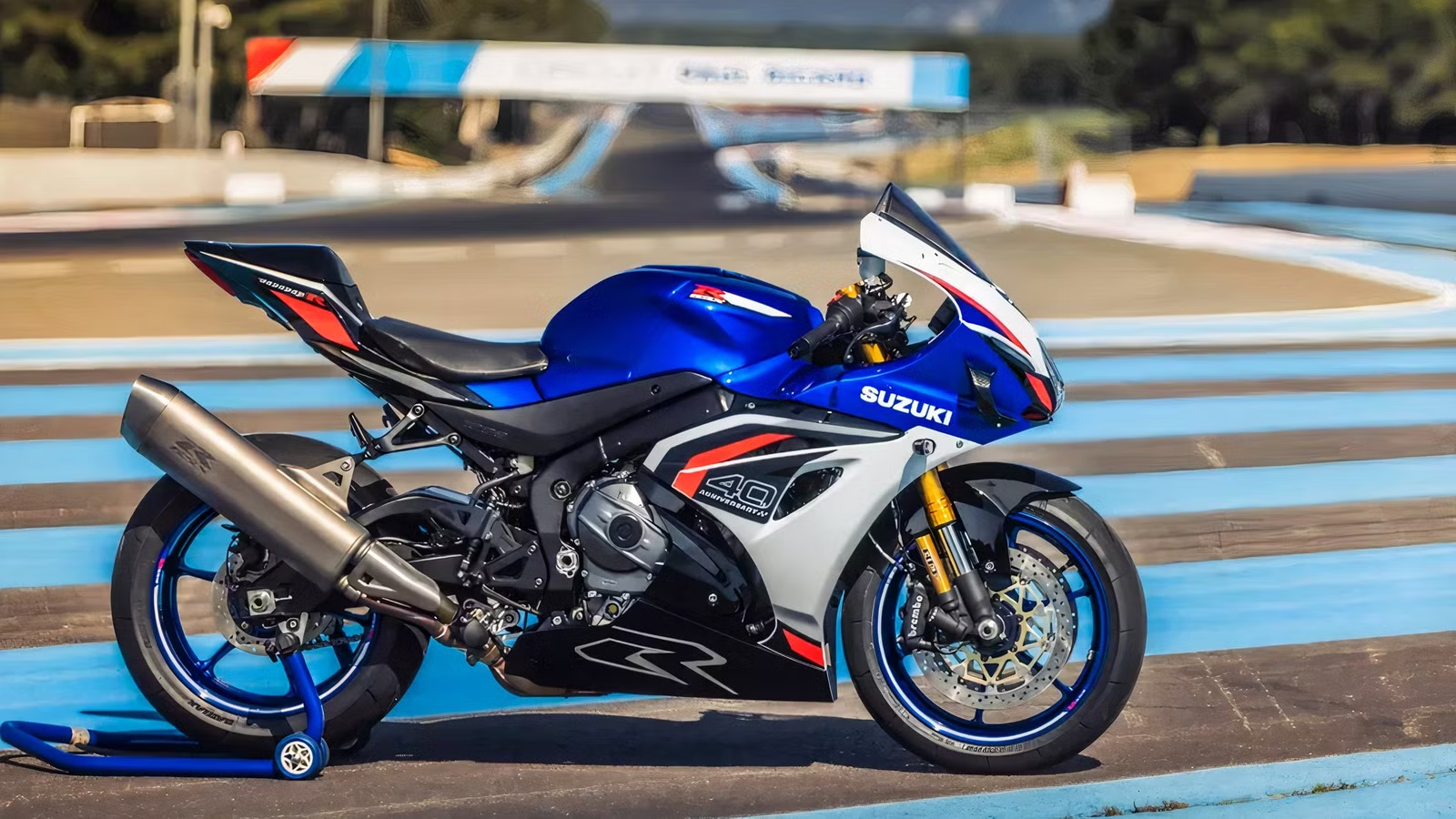
That motorcycle is the Suzuki GSX-R1000. With a base MSRP of $16,399, it undercuts the 2026 Honda CBR1000RR and Kawasaki Ninja ZX-10R, both of which start at $16,999. A BMW S 1000 RR has now climbed to $19,975 for 2027, while the Ducati Panigale V4 inhabits an entirely different neighborhood at $27,795.
Calling the GSX-R cheap would obviously be ridiculous. Sixteen grand is still sixteen grand. But within the increasingly expensive superbike category, there’s something appealingly direct about Suzuki’s proposition. You’re not buying a detuned middleweight wearing race-bike bodywork or an upright naked bike with superbike ancestry. You’re getting the current flagship GSX-R, with the riding position, chassis geometry, brakes, electronics, and absurd performance that come with it.
The Four-Pot Engine Has Been Seriously Updated

Underneath the bodywork sits a 999.8cc liquid-cooled DOHC inline-four with a 76.0mm bore, 55.1mm stroke, and 13.8:1 compression ratio. It’s rated at 192 horsepower and 81 pound-feet of torque. So clearly, this isn’t some softened street sports bike. Suzuki itself describes it as the most powerful and hardest-accelerating engine in GSX-R history.
And the latest version isn’t simply the old motor dragged through another model year. Suzuki redesigned the crankcases, enlarged the crankshaft journals, revised the cylinder head’s intake and exhaust ports, changed the head gasket, and altered cam timing and overlap. The top-feed injectors went from ten holes to eight, while a new intermittent camshaft lubrication system, wider cam chain, and revised sprockets were added to reduce internal losses and improve durability.

There’s also an entirely new 4-2-1 exhaust with its collector positioned closer to the engine for improved mass centralization. Power reaches the rear wheel through a six-speed transmission, a Suzuki Clutch Assist System wet multiplate slipper clutch, and a standard bi-directional quickshifter. The shift linkage can even be converted to reverse-pattern GP shifting while retaining quickshifter functionality.
It Has The Electronics A Modern Superbike Actually Needs

Part of the Suzuki GSX-R1000’s timeless appeal used to be that it wasn’t chasing competitors into every technological rabbit hole, but the newest bike has received a substantial electronics update. A Bosch IMU now feeds three-axis, six-direction motion data into the control systems, bringing the base GSX-R much closer to what you’d expect from a current liter-class machine without turning the cockpit into a rolling computer science project.
Suzuki’s Smart TLR Control combines traction control, Lift Limiter, and Roll Torque Control. The latter uses IMU and wheel-speed data to calculate lean angle and road speed before determining how much engine torque should be delivered through a corner. Launch control is also standard, and its calibration has been updated for the latest model. It’s a serious electronics package rather than a collection of basic safety systems added to tick specification-sheet boxes.
Cornering ABS Joins The Package

Motion Track ABS uses the IMU to account for what the motorcycle is doing under braking. If it detects rear-wheel lift during hard deceleration, it can adjust front brake pressure, while braking intervention is also altered when the motorcycle is leaned over. Up front, braking is handled by radial-mount four-piston Brembo Monobloc calipers grabbing twin discs, with a single-piston Nissin caliper at the rear.
The chassis remains refreshingly conventional in the best possible way. There’s a twin-spar aluminum frame, aluminum swingarm, fully adjustable Showa Big Piston Fork, and a link-type Showa rear shock with spring preload, rebound, and separate high- and low-speed compression adjustment. Bridgestone Battlax Racing Street RS11 tires measure 120/70ZR17 up front and 190/55ZR17 at the rear. This is still hardware intended to work hard on a racetrack.
The Key Numbers Remain Properly Superbike

The GSX-R1000 measures 81.7 inches long and rides on a 55.9-inch wheelbase. Seat height is a relatively manageable 32.5 inches, ground clearance is 5.1 inches, and fuel capacity is 4.2 gallons. Suzuki lists curb weight at 448 pounds, meaning the bike still combines liter-class power with a weight figure that would have looked completely outrageous on a road-going motorcycle not that long ago.
Instrumentation remains an LCD rather than a giant color TFT, which either looks refreshingly purposeful or somewhat ancient depending on your priorities. Lighting is LED front and rear, and the latest bike gets a lighter lithium-ion battery along with a more compact ABS control unit. The 40th Anniversary Edition comes in Pearl Vigor Blue/Pearl Tech White or Pearl Ignite Yellow/Metallic Mat Stellar Blue, complete with anniversary graphics and a commemorative fuel-tank emblem.

There’s even an optional set of carbon winglets inspired by Suzuki’s CN Challenge endurance racer, although they aren’t standard equipment. That distinction sums up the GSX-R rather nicely. Suzuki will sell you the aerodynamic jewel if you want it, but the basic motorcycle concentrates its money on the engine, chassis, brakes, electronics, and drivetrain instead.
You Don’t Need The Most Expensive Superbike
None of this makes the GSX-R1000 objectively better than the latest European exotica or even its Japanese rivals. The BMW S 1000 RR makes 205 horsepower and brings a much more elaborate electronics package, while Ducati’s Panigale V4 produces 209 horsepower and represents the sort of engineering excess people put on bedroom walls. Even Kawasaki’s newest ZX-10R gets a 5-inch TFT, integrated winglets, and 190 claimed horsepower.
At $16,399, the GSX-R1000 gets you through the superbike door for less than anything else in the current Japanese liter-class superbike crowd. It isn’t inexpensive, and 195-ish horsepower certainly isn’t sensible. But in a segment where prices increasingly resemble down payments on houses, Suzuki still offers the traditional superbike experience without asking you to pay exotic-bike money for the privilege.
Source: Suzuki Cycles

Related posts



Latest Post


No Comments