
Plymouth’s Forgotten 1969 Drop-Top Is Quietly Rarer Than The Cars That Buried It
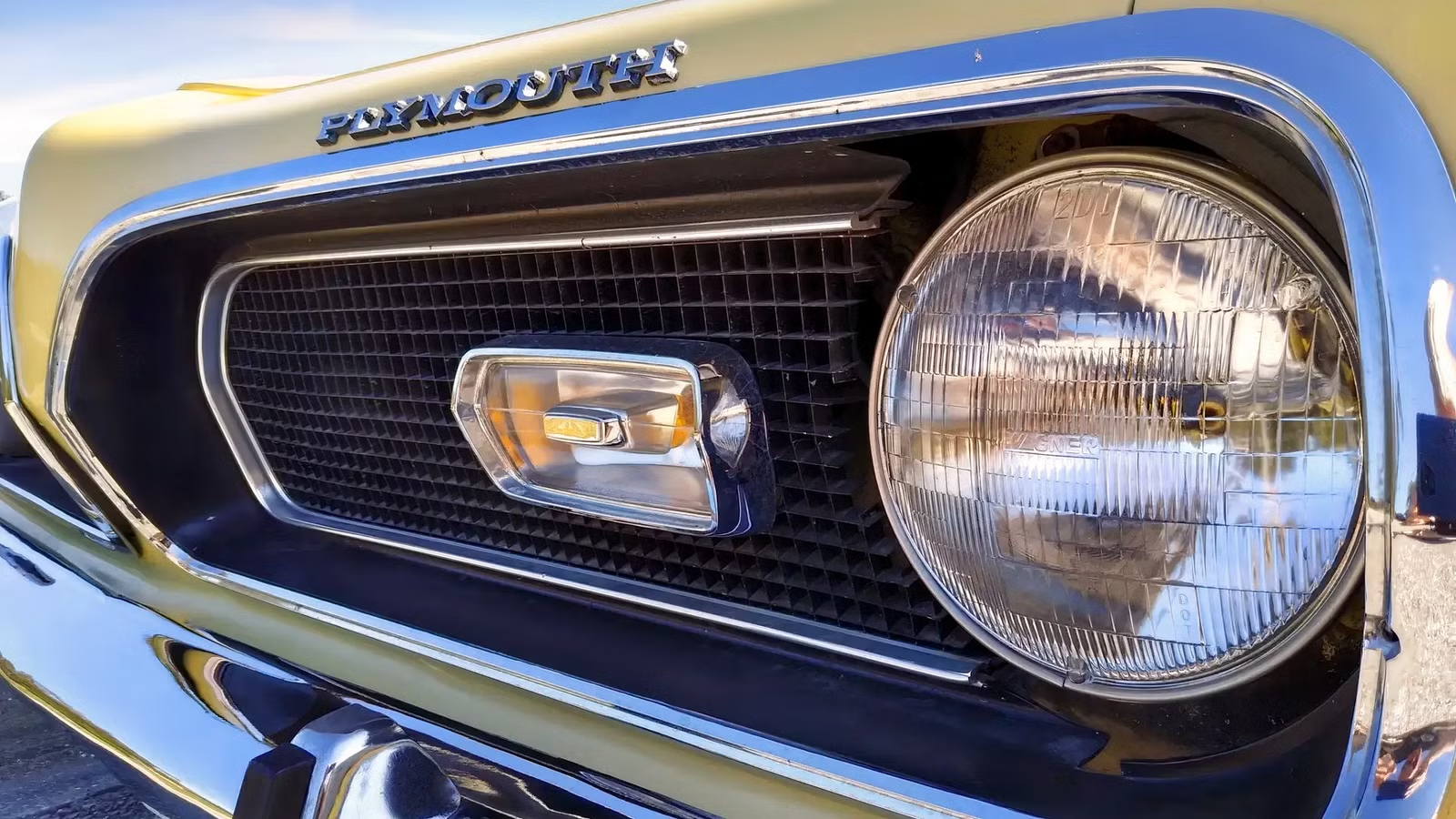
Muscle-car fame is a funny thing. Some cars become legends because of their enormous engines, outrageous styling, or spectacular auction prices, while other machines with equally good stories spend decades flying under the radar. Plymouth had a few of those forgotten gems, including a performance convertible built in tiny numbers just before its nameplate got a complete makeover. It had serious V8 power, proper performance hardware, and production figures that make collectors sit up. Yet the cars that followed stole most of its thunder. So how did such an unusual Mopar end up in the shadows?
Plymouth Was Fighting for Respect in the Muscle-Car Market

By the late 1960s, Detroit was locked in a fierce battle for performance-car buyers. Ford had the Mustang, Chevrolet had the Camaro, and both were selling by the hundreds of thousands every year. Plymouth was in the same fight, but getting noticed was another matter. The brand had the credentials, with Chrysler’s engineering resources and a stable of potent V8s to draw from. The problem was that a good performance car didn’t automatically become an icon. Styling, marketing, racing success, and public perception all played their part.
Convertibles sat in an awkward spot in this market. They offered open-air cruising and plenty of curb appeal, but they weren’t the obvious pick for buyers chasing the quickest quarter-mile times. A drop-top also tended to cost more than the equivalent hardtop, making it a more specialized purchase.
That left automakers juggling two very different priorities, building cars that delivered serious performance and selling enough of them to justify the investment. Plymouth had an intriguing answer in a compact drop-top that paired everyday usability with hardware aimed squarely at enthusiasts.

Plymouth Was Giving Its Compact Cars Serious Performance Hardware

Big engines in lightweight bodies had become a winning formula. A large V8 didn’t need a massive full-size car to live in, and the right engine in a smaller platform could be seriously entertaining. Chrysler’s A-body platform offered Plymouth a way to explore that idea. These compacts were smaller and lighter than the company’s midsize and full-size cars, and buyers could get far more than basic transportation, with upgraded suspension and much stronger engines on the options list.
Suspension mattered just as much as engine output. Extra horsepower made a car quicker in a straight line, but the chassis decided how confidently it handled that power. A proper performance package brought it all together, giving buyers more than a standard car with a bigger engine dropped under the hood.
There was a catch, however. Compact engine bays left very little room to spare, and stuffing a big-block V8 into one created real headaches around the accessories and steering. The engineering challenge was finding the right balance between power, practicality, and space. That mix of compact dimensions and serious mechanical hardware opened up some fun possibilities. One open-top combination, however, would prove far less common than its spec sheet might suggest.
Just 83 Examples of the 1969 Plymouth Barracuda Formula S Convertible Were Built With the 340 V8

1969 Plymouth Formula S Barracuda
Mecum
The car in question is the 1969 Plymouth Barracuda Formula S convertible, fitted with the 340-cubic-inch V8. Plymouth built 1,442 Barracuda convertibles for the 1969 model year, and published Mopar production figures put the number combining the open-top body, Formula S package, and 340 at just 83. Another 17 got the 383 big-block, for 100 Formula S convertibles in total.
That’s fewer than 6 percent of an already tiny convertible run. Put another way, Ford built roughly 3,600 Mustangs for every 340 Formula S convertible built for 1969. There’s a twist, too. Plymouth’s new ‘Cuda package arrived for 1969 on the hardtop and fastback only, so drop-top buyers who wanted the factory performance kit had to go the Formula S route.

1969 Plymouth Formula S Barracuda
Mecum
The 340 gave it real bite. Plymouth rated the small-block at 275 hp gross and 340 lb-ft of torque, plenty of muscle for a compact car, and it had already won over road testers since its debut in the 1968 Formula S. It also skipped the extra weight and bulk of the big-block options. The Formula S package added more than a badge.
Heavy-duty torsion bars, uprated rear leaf springs, a front stabilizer bar, and Firm-Ride shocks gave it a far more purposeful setup than a standard Barracuda. Drop the top, and it delivered the classic late-1960s American cruising experience. Yet with the 340 and upgraded suspension underneath, it wasn’t simply a sunny-day cruiser wearing a sporty badge.
The 383 V8 Made This Compact Plymouth a Tight Fit

Buyers who wanted more displacement could order the Barracuda with the 383 Super Commando V8. Rated at 330 hp gross and 410 lb-ft for 1969, the big-block comfortably out-muscled the 340 on paper. Squeezing it into a compact A-body, however, wasn’t as simple as installing a larger engine and calling it a day. The 383 was already a tight fit in the A-body engine bay, and the new-for-1969 440 ‘Cuda pushed things further still, with manual steering, unassisted drum brakes, and the TorqueFlite automatic as the only transmission.
That’s what makes the 340 car so interesting. The small-block delivered respectable punch without the same big-block compromises, a substantial V8 that actually fit. The 383’s extra 55 hp looked decisive on paper, but weight over the nose, gearing, and suspension all shaped how these cars really drove. The 17 Formula S convertibles with the 383 are rare in their own right. But the 340 version hits a sweet spot: a limited-production drop-top with real performance hardware and without the big-block baggage.
The Next Generation of Barracuda Left the Forgotten Convertible in the Shadows

1969 Plymouth Formula S Barracuda
Mecum
Timing didn’t do this convertible any favors. The 1969 model year was the last for the second-generation, A-body Barracuda, and for 1970, Plymouth rebuilt the car on the new E-body platform it shared with the Dodge Challenger. The E-body’s roomier engine bay took the 440 and the legendary 426 Hemi far more easily, and the redesigned car looked as muscular as it went.
The ‘Cuda name became tied to the most powerful versions, and Hemi-equipped examples eventually attracted enormous collector interest. The earlier convertible had a different story. It paired compact dimensions, a proper performance suspension package, and a small-block V8 in a body style Plymouth barely built, but it never had the later car’s broad-shouldered stance or headline engines.
None of that makes the 1969 car rarer than every later performance Barracuda, and a low production figure doesn’t guarantee a higher price. Rarity, desirability, originality, and condition are separate considerations. Still, 83 cars is an easy number to overlook when the conversation turns to famous Mopar muscle. For enthusiasts who appreciate unusual factory combinations as much as outright horsepower, that’s exactly why this forgotten Plymouth deserves a closer look.
Sources: Bring A Trailer, Mecum, Classic.com

Related posts


Latest Post


No Comments