
The Classic Muscle Car That Delivered Supercar Acceleration For A Fraction Of The Price
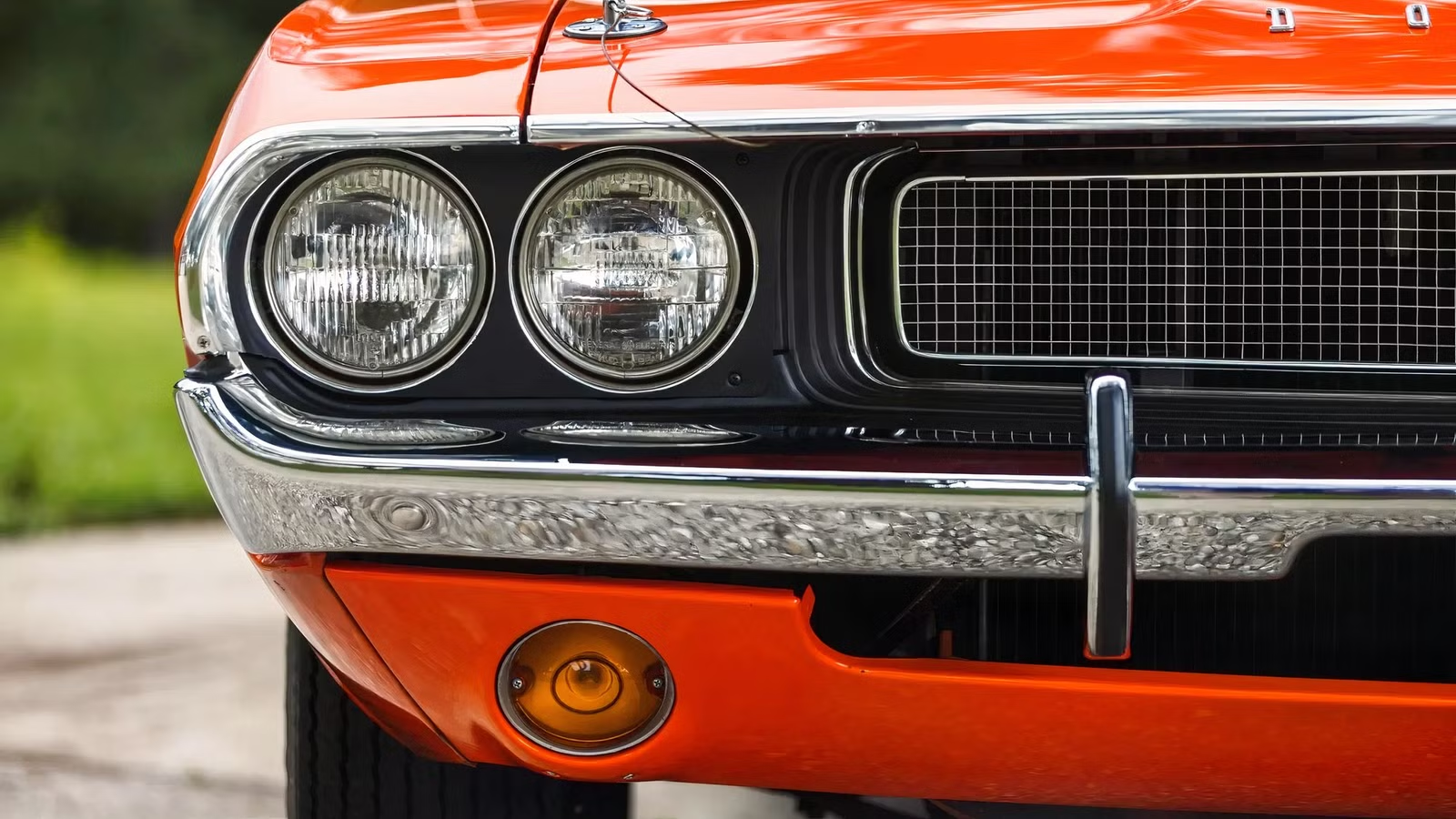
Right before the Malaise Era came around, things were getting pretty wild on the American muscle car segment. That may be an understatement, too, because the level of performance available relative to price was truly impressive and in a completely different league compared to what came next. A lot of that classic American V8 muscle could easily keep up with high-end European sports cars by the time the golden age was drawing to a close, all while costing considerably less even in top trims. That said, it’s no wonder so many people feel a deep sense of nostalgia toward that period.
The Horsepower Wars Culminated In Spectacular Fashion

Among the most formidable muscle cars on offer back then, you had future icons like the Hemi ‘Cuda and Chevelle SS 454 LS6, both highly capable and cherished by collectors today. The 425-horsepower ‘Cuda boasted a stout zero-to-60 time as low as 5.2 seconds according to some tests, while the Chevelle’s sat somewhere between 5.4 and 6.1 ticks of the stopwatch (depending on who you ask). Plymouth had the Road Runner A12 for performance-oriented buyers on tighter budgets, powered by a 440-cube Six-Barrel V8 with 390 horses ready to rock. It ran the quarter-mile in 12.91-13.88 seconds, just about the same league as a 1969 Chevrolet Camaro ZL1 whose time sat in the low 13s.
We could go on forever, but the point is clear — those were great times to be alive as an American car enthusiast with an insatiable hunger for speed. One could keep up with European exotics in a straight line at less than half the price, or even a quarter in some cases. For instance, the Lamborghini Miura SV could do zero to 60 mph in 5.8 seconds, a Ferrari 365 GTB/4 Daytona managed it in 5.4 ticks, and Aston Martin’s V8-powered DBS took 5.9 seconds to do the same. You’d be paying a pretty penny for the privilege, too, with the Lambo and Ferrari each costing around $25,000 fresh off the assembly line. That may not sound like very much at first, but it means approximately $200k in today’s money.
Supercar Capabilities For A Fraction Of The Price


Today we’re here to talk about one of the greatest legends from the golden age of muscle cars, which commanded only about a fifth of that $25k price tag for the Miura or Daytona. It wasn’t as affordable as the A12 and also slightly more expensive than the Chevelle LS6, but still considerably cheaper than Chevy’s Camaro ZL1. You will nowadays be paying a small fortune to get your hands on a clean example, though, because production numbers were extremely low for this particular variant in all its Hemi-infused glory. With that, let’s take a closer look.
1970 Dodge Challenger R/T 426 Hemi: A Symbol Of Peak Muscle Car Excess

If you were after the wildest Challenger available in 1970, then the R/T 426 Hemi was the one to get. And as the name suggests, the fabled big-block Hemi displaced a very generous 426 cubic inches — slightly smaller than a 440 Magnum or Six Pack while making considerably more power. Fed by dual Carter four-barrel carbs and boasting a compression ratio of 10.25:1, this race-derived powerhouse could muster up to 425 ponies at its peak. Torque was rated at 490 lb-ft, and all that force made its way to the rear wheels through either a four-speed manual or a three-speed automatic. Now, the stats vary quite a bit when it comes to performance data.
Car and Driver managed to take an automatic Hemi Challenger from zero to 60 mph in 5.8 seconds and across the quarter-mile mark in 14.1 ticks. We can reasonably say the manual version was faster, with many sources placing its time in the low-to-mid five-second range. And as for the Hemi R/T’s ability on the quarter-mile, a period test from 1969 recorded 13.1 seconds with a trap speed of 107.12 mph according to Hemmings. Beyond that, it would continue accelerating toward a top speed of around 150 mph. The engine was an absolute beast, so it’s no wonder that its reputation and mythical status have endured so well over the years. But the R/T configuration already came with a number of notable upgrades before you even added that Hemi into the mix.
What Else Was The Challenger R/T Defined By?

Better cooling, heavy-duty suspension, and bigger brakes were all on the menu, together with Dodge’s optional Shaker hood scoop. It featured a 383-cube Magnum V8 as standard equipment, providing 335 horsepower for you to play with. A 440 Magnum, 440 Six Pack and the coveted 426 Hemi were all optional, with the 440s able to produce 375 and 390 horsepower, respectively. And, in broader terms, the first-gen Challenger was built on the same Chrysler E-body platform as the Plymouth Barracuda. Its debut as a 1970 model was relatively late on the classic muscle car timeline, but it did give its main rivals — the Ford Mustang and Chevrolet Camaro — a run for their money before the entire segment took a nosedive. The Hemi-equipped R/T wasn’t just a feared contender among pony cars, though, because it could also hang with European supercars while costing far less.
How Did The Hemi Challenger Stack Up Against Exotics From Europe?

Comparing the flagship Challenger’s zero-to-60 time with that of the Miura SV or Ferrari Daytona, the similarities are striking. It wasn’t as nimble as those Italian sports cars, of course, but it most certainly excelled when it came to blistering straight-line acceleration. That glorious American V8 could even outrun the Miura on the quarter-mile, as the latter’s time is generally rated around the 14-second mark. And for a broader comparison, the Hemi Challenger was also faster than a contemporary Maserati Ghibli SS, Porsche 911 S and LS5-powered 454 Corvette according to many recorded tests. Then there was the pricing aspect to be taken into consideration.
Whereas the aforementioned sports cars (aside from the Corvette) would comfortably set you back more than $15–20k, a 1970 Dodge Challenger R/T Hemi had a starting MSRP of just over four grand. The end price paid by the customer was unlikely to exceed $5,000, or about $43k in today’s dollars. That, right there, was a colossal discrepancy, and part of the reason why these Hemi R/Ts continue to fascinate gearheads to this day. But finding a cheap example now is virtually impossible thanks to the car’s historical significance and extremely low production numbers. Although Dodge produced a large number of Challengers in 1970, very few were optioned with the range-topping Hemi V8.
The Hemi R/T Today: Cult Classic Treasure Worth A Fortune

Only 356 Hemi Challengers were produced for 1970, of which 287 were standard R/T hardtops, 60 were Special Edition (SE) variants, and only nine were convertibles. Unsurprisingly, that makes them rather hard to come by on today’s market, while buyers who manage to get their hands on one will find themselves crossing well into six-digit territory. Based on current data from JD Power, these precious old-school pony cars sell for $214,000 on average. But they can fetch considerably more, as demonstrated by the pristine low-mileage example sold on Bring a Trailer for $502,000 back in 2022. To be clear, that’s a hundred times the price of a new R/T Hemi back in the day. That figure speaks for itself.
Sources: Hemmings, Car Collector International, JD Power, Classic.com, Car and Driver, Bring a Trailer

Related posts





Latest Post


No Comments