
The Most Underrated Pontiac Muscle Car Produced In The ’60s
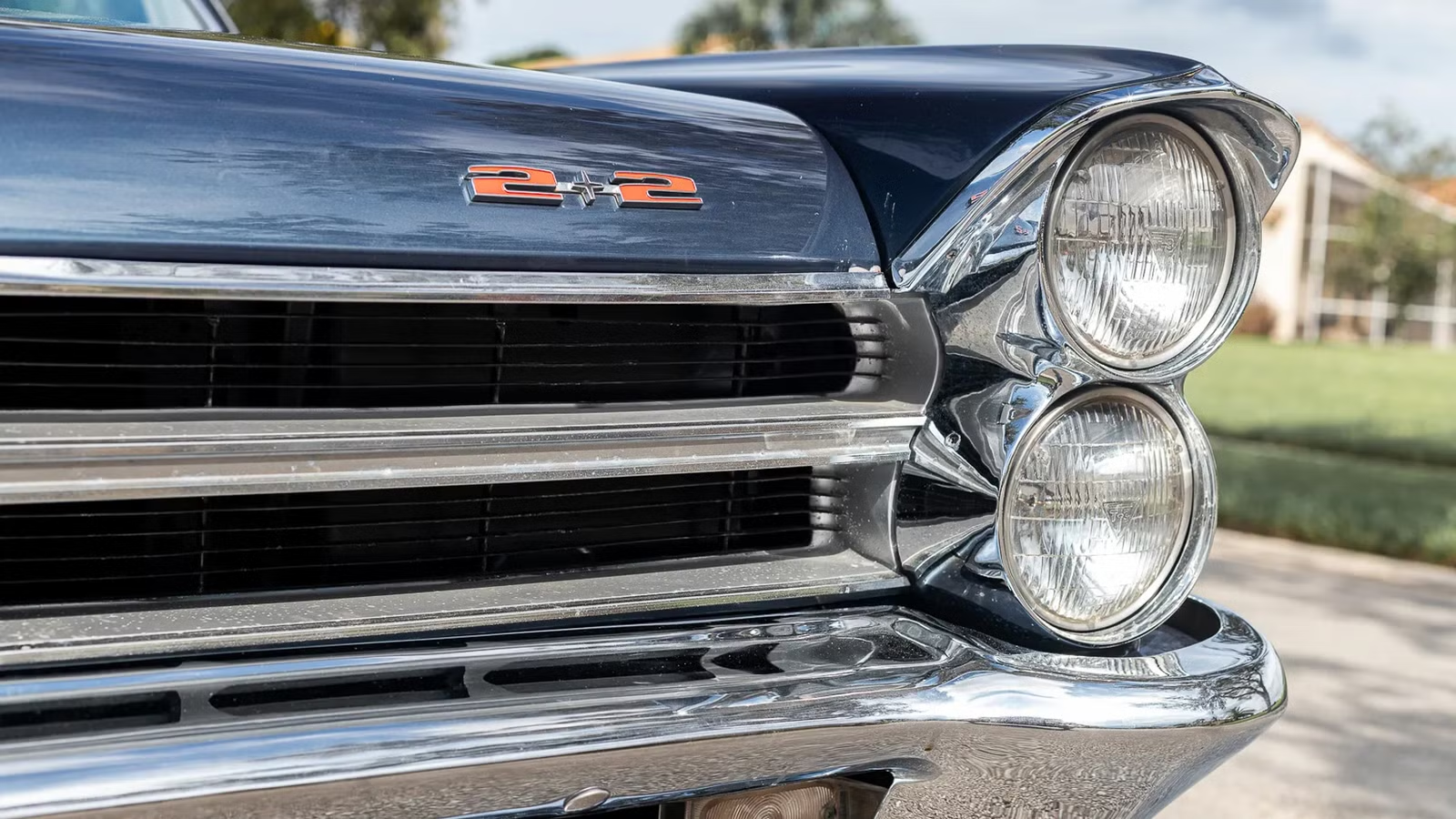
Pontiac’s 1960s muscle car legacy looms large in the collective memory of American automotive enthusiasts. The brand’s most celebrated nameplates from that decade have become blue-chip collectibles, commanding eye-watering sums at auction and dominating the conversation whenever golden-era performance cars come up. Yet for every icon that gets the spotlight, there’s at least one deserving machine left in the shadows — and in Pontiac’s case, that machine is a full-size bruiser that most collectors still walk right past. golden age of muscle Despite sharing the performance pedigree and styling cues that made Pontiac a powerhouse back in the day, this particular model hasn’t quite garnered the same fame. It deserves recognition not just for its raw power, but also for its unique blend of muscle and refinement. It’s still something of a hidden treasure in Pontiac’s legacy, which means you can find the car at surprisingly reasonable prices — all the more so given its relative Pontiac rarity.
The 1965 2+2 Is Truly Underrated Pontiac Muscle

While there are a number of Pontiac muscle cars that don’t receive the recognition they deserve, we feel that the 1965 Catalina 2+2 is the most criminally overlooked of the lot. The car boasted potent engine options, swooping curves, and impressive performance for its girth, but the sheer size of the thing meant that many enthusiasts looked to Pontiac’s more compact offerings instead. Lucky for would-be buyers, this means the Catalina 2+2 remains relatively affordable compared to other prized Ponchos of the day.
A Full-Size Take On Pontiac Performance
Back in the 1960s, Pontiac, like other brands under the General Motors umbrella, adapted its full-size formula across a number of different models. As the most luxurious offering in the lineup, the Pontiac Bonneville ruled the roost, while the Catalina was aimed at buyers shopping at a lower price point. To cater to performance enthusiasts, Pontiac introduced the Grand Prix in 1962, basing the design on the Catalina but borrowing features from the Bonneville like the interior trim and bucket seats.
In 1964, Pontiac expanded the lineup once again by giving the Catalina some sporting appeal with the 2+2 package. Being an option rather than a distinct model, this meant bucket seats, special door panels, a tachometer, and a vacuum gauge. The GM-wide B-body redesign the following year, however, gave Pontiac the impetus it needed to spin the 2+2 off as a standalone model, just as it had done with the LeMans and the GTO.

For around $400 more than a standard Catalina coupe (Hagerty), buyers received a four-barrel 421-cubic-inch V8, heavy-duty coil springs and shocks, a 3.42:1 rear end, dual exhausts, special badging, and exclusive trim features. With 338 horsepower and 459 lb-ft of torque on tap straight from the factory, it was marketed as the bigger brother to the genre-defining GTO.
The Swooping 2+2 Was A Slow Seller
Upon the debut of the 2+2 option in 1964, Pontiac sold some 7,998 Catalinas equipped with the package — even when it was limited to aesthetic changes. The following year, that number climbed to 11,521 2+2s, though 1966 didn’t bring the same success. By that point, buyers were showing a clear preference for the GTO, and Pontiac sold just 6,383 examples for the model year. Accordingly, Pontiac dropped the 2+2 as a distinct car for 1967, reverting the upgrades to an optional package. Sales dipped once again, falling to a mere 1,768 cars before Pontiac discontinued the 2+2 in the United States altogether.
For context, GTO sales numbers absolutely dwarfed the Catalina 2+2 throughout this period — both as an option and as a standalone model. Pontiac sold 32,450 Tempests equipped with the GTO package for the 1964 model year. 1965 saw that figure double to 75,352 GTO-equipped cars, and 1966 brought an even stronger result with some 96,946 cars sold. Even when GTO sales eased to 81,722 examples for 1967, they were leaps and bounds ahead of Catalina 2+2 numbers.
Why You May Want A Full-Size Pontiac
Tipping the scales at over 4,000 lbs and stretching some 214.6 inches long, there’s no getting around the fact that the Pontiac Catalina is a full-size American car. Even so, it’s a more potent machine than its 121-inch wheelbase might suggest — especially when you consider the engine options that were available at the time. Pontiac actually marketed the Catalina 2+2 under the memorable tagline “Stop telling me I’m beautiful. Love me for what’s inside.”
1965 Pontiac Catalina 2+2 Engine Options
|
Engine |
421 Base V8 |
421 Tri-Power V8 |
421 HO V8 |
|
Carburetor(s) |
Four-Barrel |
3 x Two-Barrel |
3 x Two-Barrel |
|
Horsepower |
338 Horsepower |
356 Horsepower |
376 Horsepower |
|
Torque |
459 LB-FT |
459 LB-FT |
459 LB-FT |
Hemmings
With the 2+2, Pontiac ditched the 256-horsepower 389 standard in the base Catalina and replaced it with what had previously been an extra-cost item: the 421 engine. Even the base-spec 421 with its four-barrel carburetor was good for 338 horsepower, but the addition of 10.75:1 compression, Tri-Power, and a hotter cam (in the case of the HO) could push output as high as 376 ponies. By contrast, Pontiac’s 1965 GTO came fitted with a 389 that produced anywhere from 335 horsepower to 360 horsepower depending on the specified carburetor setup.
Catalina 2+2 On-Road Performance
When equipped with the Tri-Power setup, Hot Rod reports that a 1965 Catalina 2+2 could hit 60 mph in 7.0 seconds, run the quarter-mile in the mid-15s, and reach a top speed of 125 mph. Not bad for a car of its heft — consider that the 3,660-lb GTO of the same year with a Tri-Power engine could do 0–60 mph in 5.8 seconds, the quarter mile in 14.5 seconds, and a top speed of 114 mph.
As a follow-up to its Ferrari and Pontiac GTO face-off, Car and Driver put together a similar piece comparing the 330/GT 2+2 and the Catalina 2+2 around the Bridgehampton road circuit. While you wouldn’t think that a luxury American sedan could hold a candle to an exotic Italian touring car, racing driver Walt Hangsen found the Pontiac surprisingly capable.
“The hood seems very, very wide and very, very long and when you first get in and drive off down the track — just sort of getting used to it — you get the feeling that it’s going to go straight at the first corner. Surprisingly enough, it doesn’t just go around the corner, it does a mighty fine job of it! It leans considerably, but it seems to lean to a certain point where it decides that it just isn’t going to lean anymore — and at that point it’s quite controllable. The steering response is very good.”
Now, based on the performance results, it’s possible that Pontiac supplied a 2+2 with some undisclosed upgrades. Even with a standard 3.42 rear end, Car and Driver testers claimed to hit 60 mph in 3.9 seconds and turn the quarter-mile in 13.8 seconds at 106 mph. The Ferrari 330/GT 2+2, on the other hand, only managed a 6.3-second 60-mph sprint and a 14.61-second quarter at 96 mph. Assuming the Catalina 2+2 was as stock as represented, we’re inclined to think the stopwatch operator may have been a little trigger-happy. Regardless, the Catalina 2+2 can clearly move.
Other Catalina 2+2 Performance Considerations
- Many of the 2+2 upgrades remained available as options after 1967
- Transmission options: 3-speed manual, 3-speed Turbo 400 auto, 4-speed Muncie
- Integral drum brakes came standard on eight-lug wheels
How Much A Catalina Will Cost You Today

If you’re taken by the striking lines and expansive bodywork of the Catalina 2+2, the good news is that they remain relatively affordable compared to other Pontiac performance cars of the era. Hagerty’s valuation tool is the best place to check current pricing, as figures shift with the market. For reference, a Tri-Power GTO coupe from the same year commands a meaningful premium over the Catalina 2+2 in comparable condition — and prices climb further still as you move into later GTO production years, with even base models carrying strong valuations in good condition.
1965 Pontiac Catalina 2+2 Values
|
Condition |
Hard-Top |
Convertible |
|
Fair |
$16,000 |
$25,000 |
|
Good |
$39,600 |
$47,900 |
|
Excellent |
$59,900 |
$72,300 |
|
Concours |
$76,200 |
$93,800 |
Hagerty
Recent sales on Classic.com are broadly consistent with Hagerty’s valuations. 1965 Pontiac Catalinas (not exclusive to the 2+2) average around $33,000 at auction, and the highest recorded sale — $84,000 — came from an 11,239-mile example sold through RM Sotheby’s. Bring a Trailer has also moved examples at more accessible price points, including a convertible fitted with a replacement four-barrel 421 and a Tri-Power Sports Coupe, demonstrating the range of the market.
The LeMans: Another Underrated ’60s Pontiac Performer

If the sheer length of the Catalina 2+2 is a dealbreaker, there’s another underrated Pontiac worth your attention: the third-generation LeMans. In keeping with the GTO redesign of 1968, the Tempest and LeMans lines also received a facelift. While they can’t quite match the aggressive looks and raw power of Pontiac’s legendary muscle car, you get similar styling and most of the performance at a much more reasonable price.
1969 Pontiac LeMans Specs
|
Engine |
350 V8 |
350 HO V8 |
|
Carburetor |
Two-Barrel |
Four-Barrel |
|
Horsepower |
265 Horsepower |
330 Horsepower |
|
Torque |
~350 LB-FT |
~350 LB-FT |
Hagerty
Given the choice, we’d opt for a 1969 model equipped with the 350 HO V8, which made a respectable 330 horsepower — 10 more than a 1968 350 HO and a full 65 more than the lesser two-barrel. It’s worth noting, however, that cars equipped with the 350 HO are few and far between. As Hagerty reports, GM’s Heritage Center indicates that 5,801 examples were built for 1968 and a further 4,238 rolled off the line in 1969.
Pontiac LeMans Values
Sources: Classic.com, Hagerty, Hemmings, Mecum.

Related posts




Latest Post


No Comments