
The Chevy Small-Block That Revved Like A Japanese Superbike
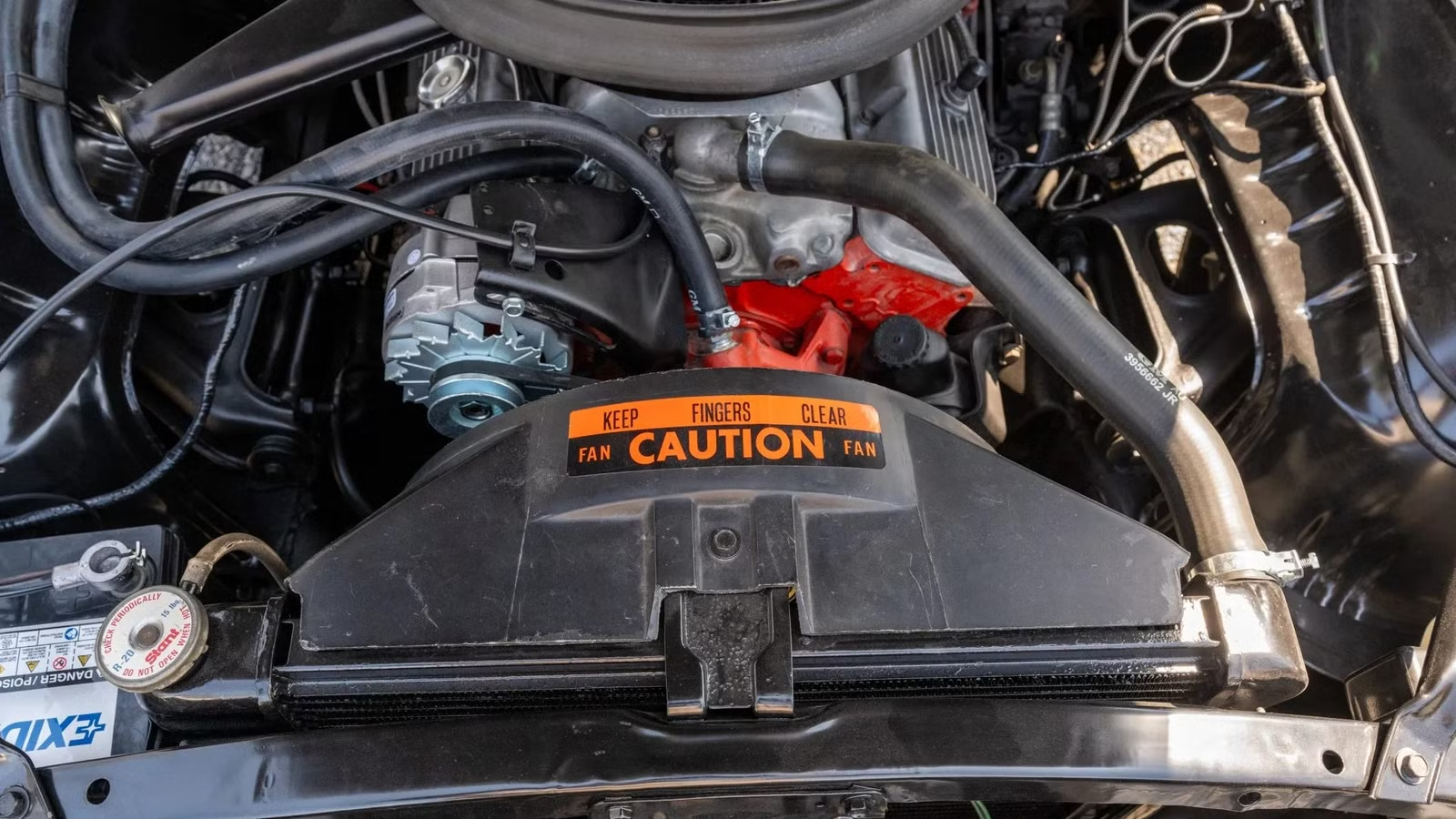
Most American V8s of the late 1960s were built around a simple premise: displacement, torque, and low-end grunt. The bigger the displacement, the better the story. Horsepower peaked somewhere around 5,000 rpm, and above that, things got expensive and fragile. This was the agreed logic of Detroit, and it suited the drag strips and boulevards perfectly well. Chevrolet, however, was about to build something that broke every one of those conventions. Not by abandoning the pushrod V8 formula, but by twisting it into a shape that had no business existing on the same streets as a 454 big-block. The result was one of the most misunderstood engines in American performance history.
When Torque Was King And Revs Were For Europeans

In 1968, the average muscle car buyer wanted the same thing from an engine that a linebacker wants from a meal: mass and impact. The 396, the 428, the 440. Cubic inches were the currency of credibility, and the performance press obliged, filling test pages with torque figures and quarter-mile times that favored low-rpm grunt. A big-block that pulled hard at 3,000 rpm and signed off around 5,500 rpm was the accepted template. Nobody buying a muscle car was asking their engine to run past 6,000 rpm regularly. The hardware simply was not built for it.
High-rpm engines were what you found in Ferraris, in Honda race bikes, in Formula machines that required a mechanical engineering degree to maintain. The idea that an American pushrod V8, built under cost constraints and fitted with production tolerances, could sustain 7,000 rpm without destroying itself was not taken seriously. Detroit made torque monsters. Italy and Japan made screamers. That was simply how the world worked, until a rulebook forced Chevrolet’s hand.
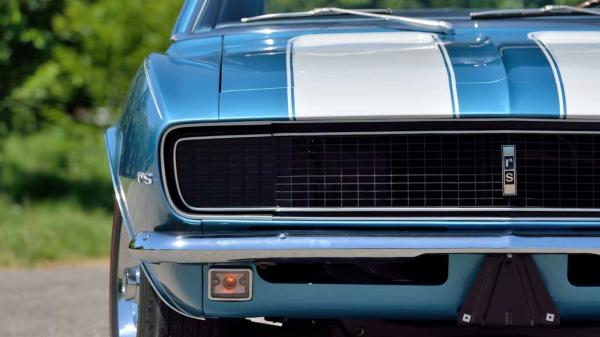

Here’s What The 1967 Chevy Camaro Z/28 Is Worth Today
The ’67 Chevy Camaro Z/28 is the rarest to ever wear the badge and left its competitors in the dust. Expect a price tag to match.
A Displacement Limit That Changed Everything

The Sports Car Club of America ran the Trans-Am series with a hard ceiling on engine displacement. Any manufacturer wanting to compete had to homologate a road car built around an engine small enough to fit inside that box. For Chevrolet, which had spent the 1960s scaling up, not down, this was a genuine engineering problem. Its mainstream performance unit was already too large by a meaningful margin, and a brand-new design was not financially viable. So Chevrolet engineer Vince Piggins did something elegant and slightly mad.
Piggins raided the parts bin. He paired the large bore from one existing block with the short-throw crankshaft from a smaller, older unit. The result sat just inside the rulebook. More importantly, that bore-stroke combination was violently oversquare, meaning the pistons traveled a very short distance relative to the width of the cylinders. Short stroke means less piston speed at any given rpm. Less piston speed means the engine can safely spin higher before the internal forces become destructive. Piggins had not built a new engine. He had assembled the conditions for something that no American production V8 had managed before.
The 1969 Camaro Z/28’s DZ 302: Detroit’s High-Revving Homologation Weapon

|
Model |
Engine |
Power |
Torque |
0-60 mph |
Top Speed |
|---|---|---|---|---|---|
|
1969 Chevrolet Camaro Z/28 |
5.0-liter DZ 302 V8 |
290 hp (factory) / ~357 hp (dyno) |
290 lb-ft |
7.4 sec |
133 mph |
|
1969 Ford Mustang Boss 302 |
5.0-liter 302 V8 |
290 hp (factory) |
290 lb-ft |
6.5 sec |
121 mph |
The car was the first-generation Chevrolet Camaro Z/28, and the engine was the DZ 302. Built across three model years from 1967 through 1969 and never offered in any other Chevrolet model, it combined the 4.00-inch bore of the 327 block with the 3.00-inch stroke of the 283 crankshaft to produce 302.4 cubic inches. Chevrolet officially rated it at 290 horsepower. That number was fiction, and everyone in the industry knew it. Richard Holdener tested a period-correct build for Motor Trend and recorded 357 hp at 6,700 rpm on a modern engine dynamometer, a result that sits squarely within the 350 to 375 hp range that engineers and historians have cited for decades as the real output of a factory-specification DZ 302. The official 290 hp figure existed to suppress insurance premiums and keep the SCCA scrutineers incurious. It worked on both counts.
The Oversquare Formula Behind 7,000 RPM

The bore-stroke math is the whole story, and it is also where the motorcycle analogy earns its keep. A 4.00-inch bore with a 3.00-inch stroke produces a ratio of 1.33:1. That is meaningfully more oversquare than the 327’s near-square geometry, and it is the same geometric logic that makes a high-revving motorcycle engine behave the way it does. Short stroke means less piston travel per revolution, which means lower piston velocity at any given rpm, which means the engine can spin higher before the internal forces become destructive. The 427 big-block ran a 4.25-inch bore with a 3.76-inch stroke, a ratio of 1.13:1, and it made its power below 5,000 rpm because the physics dictated as much.
The DZ 302 was built on entirely opposite premises. The 7.4-second 0-60 and 133 mph top speed that Car Life recorded came from a non-stock car running a dual-carburetor intake; the production Z/28 with its single 780-cfm Holley was a more honest machine, and no less vivid above 5,500 rpm.
Forged Everything: Why the DZ Could Live Above 6,000 RPM

Oversquare geometry does not keep an engine alive at 7,000 rpm on its own. The DZ 302 was built to back up its architecture with hardware to match. The rotating assembly used a forged steel crankshaft and forged connecting rods, with forged aluminum pistons running 11.0:1 compression. The cylinder heads were the high-flow 2.02/1.60-inch Fuelie units, borrowed from the fuel-injected Corvette and capable of moving enough air to feed the powerband where the DZ 302 actually lived. The solid-lifter camshaft ran the 30-30 grind, with 0.485-inch lift on both intake and exhaust and a duration of 346 degrees. That profile punished the idle and the bottom end without mercy. A stock Z/28 was not pleasant to drive slowly, and Chevrolet did not care.
Induction came via an aluminum dual-plane high-rise intake topped with a 780-cfm Holley four-barrel. The result was a powerband that barely registered below 5,500 rpm and pulled hard all the way to 7,000. In the 1969 Trans-Am season, across twelve rounds, the Camaro Z/28 won eight races and claimed the manufacturers’ title. Ford’s Boss 302 won the other four. The gap was not flattering to anyone chasing Penske.
Dodge’s New SRT Flagship Won’t Share A Platform With The Charger
Dodge’s SRT lineup is being completely revived with a new halo car that borrows from an unlikely rival’s playbook.
What the Z/28 Is Worth Today

|
Model |
Fair |
Good |
Excellent |
Concours |
|---|---|---|---|---|
|
1967 Camaro Z/28 (602 built) |
$45,000 |
$90,000 |
$150,000 |
$275,000+ |
|
1969 Camaro Z/28 (20,302 built) |
$40,000 |
$70,000 |
$110,000 |
$200,000+ |
|
1969 Ford Mustang Boss 302 (1,628 built) |
$35,000 |
$65,000 |
$90,000 |
$130,000 |
Total first-generation Z/28 production across 1967, 1968, and 1969 came to roughly 27,000 units, but that number flattens a contrast that matters enormously to collectors. Chevrolet built just 602 Z/28s in 1967. It built 20,302 in 1969. Those are not comparable cars in market terms, and the data says so. The Z/28 market benchmark currently sits at $101,127 based on confirmed sales, with recent results running from $96,000 for a solid 1967 example at Mecum in January 2025 up to $330,000 for a concours RS Z/28 at auction in January 2026. The 1967 has pulled the strongest money at the top of the market consistently, because 602 units is a number that focuses the mind.
The 1969 Ford Mustang Boss 302 is the natural comparison. Ford built its Trans-Am homologation special around the same displacement, the same factory power rating, and the same solid-lifter philosophy. Its current market benchmark sits at $88,659, trending downward, which puts it well below the Z/28 in current market sentiment. Ford built 1,628 examples of the 1969 Boss 302. Chevrolet built 20,302 Z/28s that same year, yet the Camaro still fetches more. That tells you exactly how the market weighs engine reputation against simple rarity.
Ford Built a 425-HP Street Car in the 60s and Almost Nobody Knew It
Ford built a 425-horsepower muscle car in the ’60s that secretly changed NASCAR forever with incredible power and durability.
The Small-Block DNA the DZ Left Behind

The DZ 302 was a commercial footnote and a racing landmark simultaneously. Chevrolet sold around 27,000 Z/28s across three model years while shifting north of 400,000 base Camaros in 1969 alone. The engine never appeared in any other Chevrolet model. It was born to homologate, ran three seasons, and was gone. What it left behind was a specific set of engineering choices that Chevrolet kept returning to. The Gen II LT1, introduced in 1992, carried forward the same core commitments: an oversquare bore-stroke relationship that kept piston velocity in check, higher compression than the market expected, and heads designed to breathe freely at the top of the rev range rather than deliver low-end shove. The Gen IV LS7 that powered the C6 Corvette Z06 and the 2014 to 2015 fifth-generation Camaro Z/28 extended the logic to its furthest expression, running a 7,000 rpm redline in a 7.0-liter V8 with 11.0:1 compression, a 4.125-inch bore, and a forged rotating assembly built to sustain what the DZ 302 had only briefly suggested was possible in a production car.
The DZ 302 did not invent the high-revving American V8. But it was the first one you could actually buy, and it proved the geometry worked inside a pushrod engine built from production parts. A crankshaft from a 283, a block from a 327, cylinder heads from a fuel-injected Corvette, and roughly three thousand dollars over the price of a base Camaro. Quite possibly the best three thousand dollars ever spent on an option code.
Sources: Classic.com, Bring a Trailer

Related posts



Latest Post


No Comments