
How The Coyote V8 Became Ford’s Last Great Enthusiast Engine
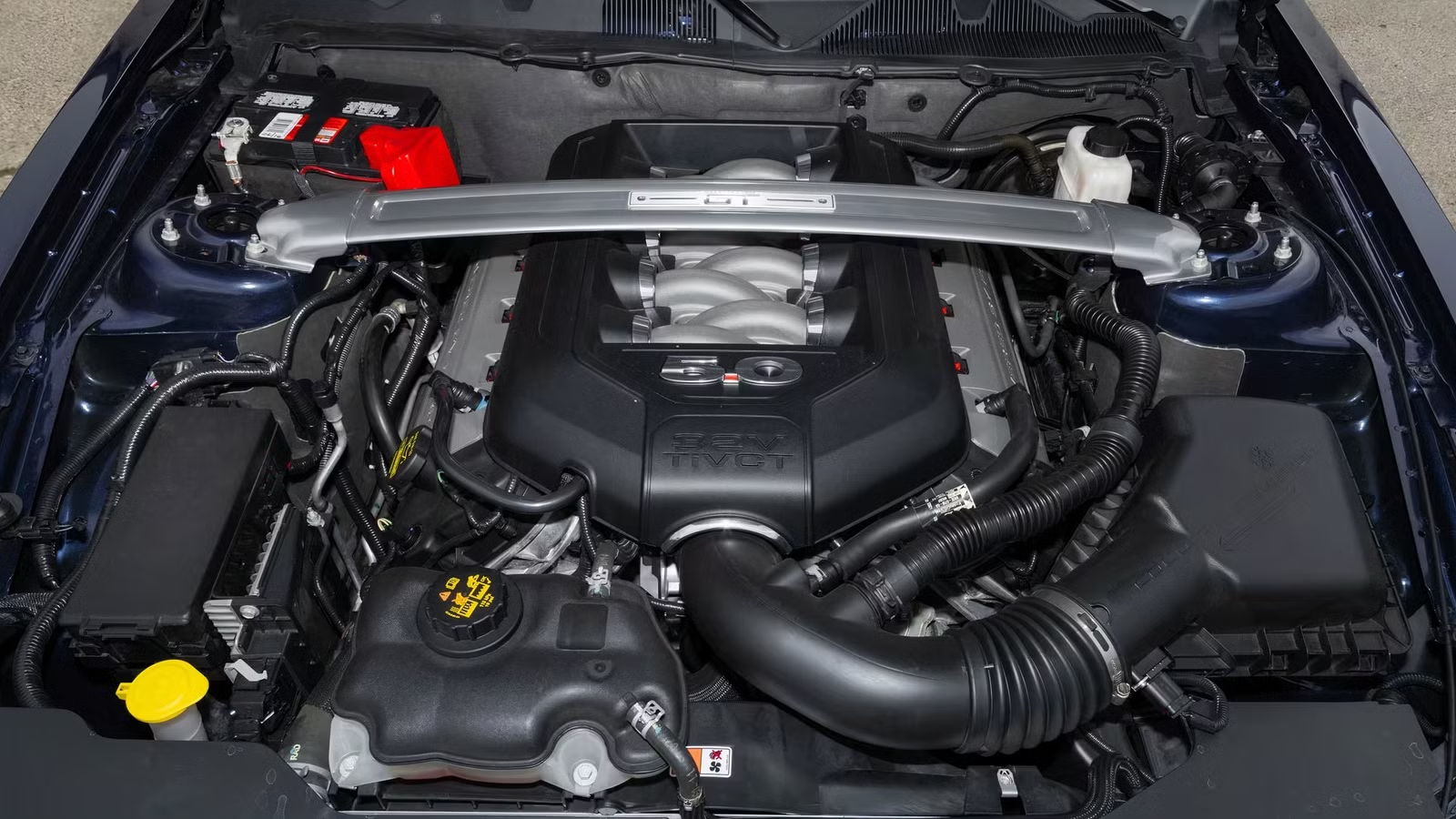
Ford just closed the order book on two of its biggest heavy hitters. In a recent move across their online configurator, the company erased the 5.0-liter Coyote engine option from the top-spec King Ranch and Platinum trims for the 2026 model year. Buyers dropping over $70,000 on a plush leather-lined half-ton are now funneled directly into twin-turbo V6 powerplants instead. It is a stark commercial signal that even the most successful high-displacement working engines are being systematically pushed to the margins of the modern showroom floor.

The broader industry has been dropping traditional displacement in favor of forced induction for a decade, but this quiet shift at the top of the truck food chain feels different. While a rival like Dodge completely walked away from its famous 5.7-liter HEMI V8 in the half-ton market, Ford spent years proving that an overhead-cam V8 could comfortably coexist alongside high-output twin-turbo V6 designs. Now, as corporate average fuel economy math tightens, the window to buy a naturally aspirated 5.0-liter engine straight from the factory floor is rapidly closing.
The Changing Landscape Of American Powertrains
The modern powertrain landscape is dominated by cold mathematical efficiency. Automakers have realized that smaller engines pressurized by turbochargers can pass strict tailpipe tests while putting up impressive numbers on a specification sheet. This shift has completely altered what buyers expect when they step on the gas pedal of a modern working vehicle. What used to be a market driven by deep displacement and mechanical simplicity is now a landscape managed by digital boost controllers and hybrid electric assist.

This mechanical transition has fundamentally reshaped how trucks and performance cars deliver their muscle. Smaller multi-turbo engines hit their peak pull almost instantly at low engine speeds, making them phenomenal tools for towing heavy trailers up steep grades. But that digital efficiency strips away the progressive, rev-dependent power build that made classic American V8s famous. The result is a generation of fast, highly capable vehicles that execute their jobs with cold, industrial precision while leaving pure enthusiast soul behind.
The Shifting Baseline Of Truck And Muscle Car Propulsion

Modern forced induction has won the numbers race, and there is no point in denying its sheer physical utility. A twin-turbo V6 can make massive low-end torque at just 2,000 RPM, allowing a half-ton pickup to haul substantial loads while also delivering far better efficiency numbers when driven lightly on the highway. They are brilliant engineering tools designed to satisfy both regulatory fleet standards and working truck buyers who need raw pulling capacity.
The mechanical tradeoff mostly boils down to tactile feel and long-term mechanical engagement. A forced-induction engine relies on complex plumbing, intercoolers, and boost pressure to generate its power, which also muffles the exhaust note. And though modern-day turbo setups have far less lag, you still lose the sharp, instantaneous throttle response. The linear surge of power that builds all the way to a 7,000 RPM redline is swapped for a flat, artificial torque curve that peaks early and falls off quickly.
The Coyote: 2011 And Beyond

When the 5.0-liter Coyote V8 debuted for the 2011 model year, Ford was in the middle of a massive performance deficit. The aging 4.6-liter and 5.4-liter two-valve and three-valve modular engines were simply outmatched by GM’s LS series and Dodge’s revived HEMI lineup. Ford engineers needed a modern motor that could drop directly into the existing engine bay and compete. Their answer was an ambitious double-overhead-cam design that immediately set a new standard for modern American muscle.
The initial Generation 1 Coyote made a huge splash in the enthusiast community. Packing four valves per cylinder, aluminum construction, and independent variable camshaft timing, the original 5.0-liter motor cranked out 412 horsepower straight out of the box. It also breathed like a high-end European engine while retaining the deep, heavy rumble of a classic domestic V8. Almost immediately, the aftermarket community realized that Ford had built a legendary foundation capable of handling massive power additions.
Four Generations Of Evolution

The structural timeline of the Coyote platform represents fifteen years of continuous, methodical engineering upgrades. Rather than resting on their laurels, Ford engineers repeatedly tore down the engine to improve air intake flow, internal strength, and fuel delivery systems across four distinct build eras.
The Modular Blueprint That Saved The Blue Oval

The Generation 1 architecture is defined by its incredible cylinder head design. Ford engineers focused on intake port airflow, allowing the engine to breathe so efficiently that it outpaced older pushrod designs at high RPMs. They included a high-capacity oil pan as well as a forged steel crankshaft, ensuring the bottom end could survive some tough mechanical abuse. Because enthusiasts need something with room to tinker, overbuilding the lower end instantly revived the Mustang’s competitive edge and desirability on the drag strip and the street.
When the Generation 2 motor arrived for the 2015 update, Ford had been refining the blueprint based on thousands of hours of real-world racing data. Based on this data, they upgraded to larger intake and exhaust valves, revised the camshaft profiles, and incorporated stiffer valve springs directly from the high-performance Boss 302 program. Output jumped to 435 horsepower in the Mustang, while a re-tuned version with lower compression and unique truck cams was dropped into the F-150 to provide rock-solid low-end grunt.
Modern Evolution And The Direct Injection Era

In 2018, the platform underwent its most aggressive and controversial transformation with the launch of the third generation. Ford combined traditional low-pressure port fuel injection with a high-pressure direct injection system, allowing for a higher 12.0:1 compression ratio and eliminating engine knock under heavy load. Output increased past 460 horsepower in standard trim. To increase cylinder bore size without enlarging the physical engine block, Ford ditched iron cylinder liners and switched to a high-tech spray-in plasma liner technology.
Today’s Generation 4 version is the absolute peak of atmospheric V8 engineering. Featuring a dual-intake, dual-throttle-body design that draws cold air from two separate air boxes, the engine breathes with zero restriction at wide-open throttle. Power sits at a healthy 480 horsepower in standard Mustang GT models and hits an incredible 500 horsepower in the Dark Horse. Even in truck trim, the engine cranks out a solid 400 horsepower and 410 pound-feet of torque.
The Real-World Ownership And Reliability Track Record

If you look at other legendary engines, like the 2JZ, a great deal of what makes them so special is not just that they are powerful, but also that they are reliable. Millions of Coyote blocks have rolled off the assembly line over the last decade and a half, racking up hundreds of thousands of daily commuting miles, heavy towing trips, and hard track passes. Long-term owner data across major forums shows a remarkably tough mechanical record, provided owners keep fresh oil in the crankcase and respect service intervals.
The main mechanical debate surrounding modern variants centers on the Generation 3 shift to spray-in plasma cylinder liners. Enthusiasts and engine builders rightly pointed out that removing iron sleeves makes conventional cylinder boring and traditional engine rebuilds virtually impossible if severe wall scoring occurs. In the real world, however, these lineless aluminum bores have proven remarkably tough under standard operating conditions, showing virtually zero cylinder wear even past the 150,000-mile mark.
Decoupling Internet Forum Anxiety From True Mechanical Longevity

Online forums tend to amplify rare mechanical failures into full-blown panic, but long-term data tells a far more comforting story. Early Generation 1 models occasionally suffered from minor ignition coil pack failures or water pump wear around the 80,000-mile mark, both of which are simple, cheap weekend driveway fixes. The dreaded engine tick that pops up on some Generation 3 motors has been extensively analyzed, proving to be an annoying acoustic resonance in the valve train rather than a structural durability flaw.
Routine maintenance on a Coyote V8 is fairly straightforward compared to modern twin-turbo layouts. There are no hot turbochargers baking under-hood rubber hoses into crispy noodles, no complex oil feed lines to leak, and no wastegate actuators to seize up. Spark plugs are easy to change at home with basic hand tools. Parts availability is practically unlimited, and any local mechanic in America could probably service this platform with their eyes closed.
The Used Market Trajectory And Investment Value

Market data from major automotive valuation indices shows a clear trend line for naturally aspirated V8 vehicles. While complex, highly stressed turbo models suffer steep depreciation as their factory warranties expire, clean 5.0-liter vehicles retain exceptional resale value. Buyers know that an atmospheric V8 represents a simpler, more durable long-term proposition on the secondary market.
This resale resilience makes late-model Coyote vehicles a solid investment. Clean, low-mileage Generation 2 and Generation 3 Mustang GTs are already stabilizing on used car lots, showing strong demand from buyers who want pure V8 performance without paying brand-new dealership prices. As manufacturers continue to pare down their V8 offerings, these naturally aspirated machines are moving to collector status rather quickly.
The Buy Window Is Closing

The decision to drop the 5.0-liter V8 from the 2026 F-150 King Ranch and Platinum trims is a concrete warning sign for traditional enthusiasts. Ford is not killing the Coyote entirely just yet, as you can still buy it on lower-tier truck trims like the XL, XLT, Lariat, and Tremor, as well as the Mustang lineup. But the direction of corporate strategy is pretty clear here. Automakers are gradually restricting their high-displacement engines to entry-level work trucks and specialized performance halo models in order to manage strict fleet emissions averages. This fleet arithmetic means that buying a brand-new, factory-warrantied naturally aspirated V8 is an opportunity that will not last forever.
The modern Coyote V8 is certainly the high-water mark of American dual-overhead-cam engine design. It delivers a rare combination of 7,000-RPM muscle car machismo, brutal truck workhorse capability, and proper reliability. The commercial writing is on the wall, and the window to park a brand-new 5.0-liter machine in your garage is actively narrowing. Once these atmospheric V8s disappear from factory order sheets for good, we will not see their like again.
Source: Ford, Edmunds, J.D. Power

Related posts


Latest Post


No Comments