
The Overbuilt Chevy Big-Block Hot-Rodders Ignored For 40 Years
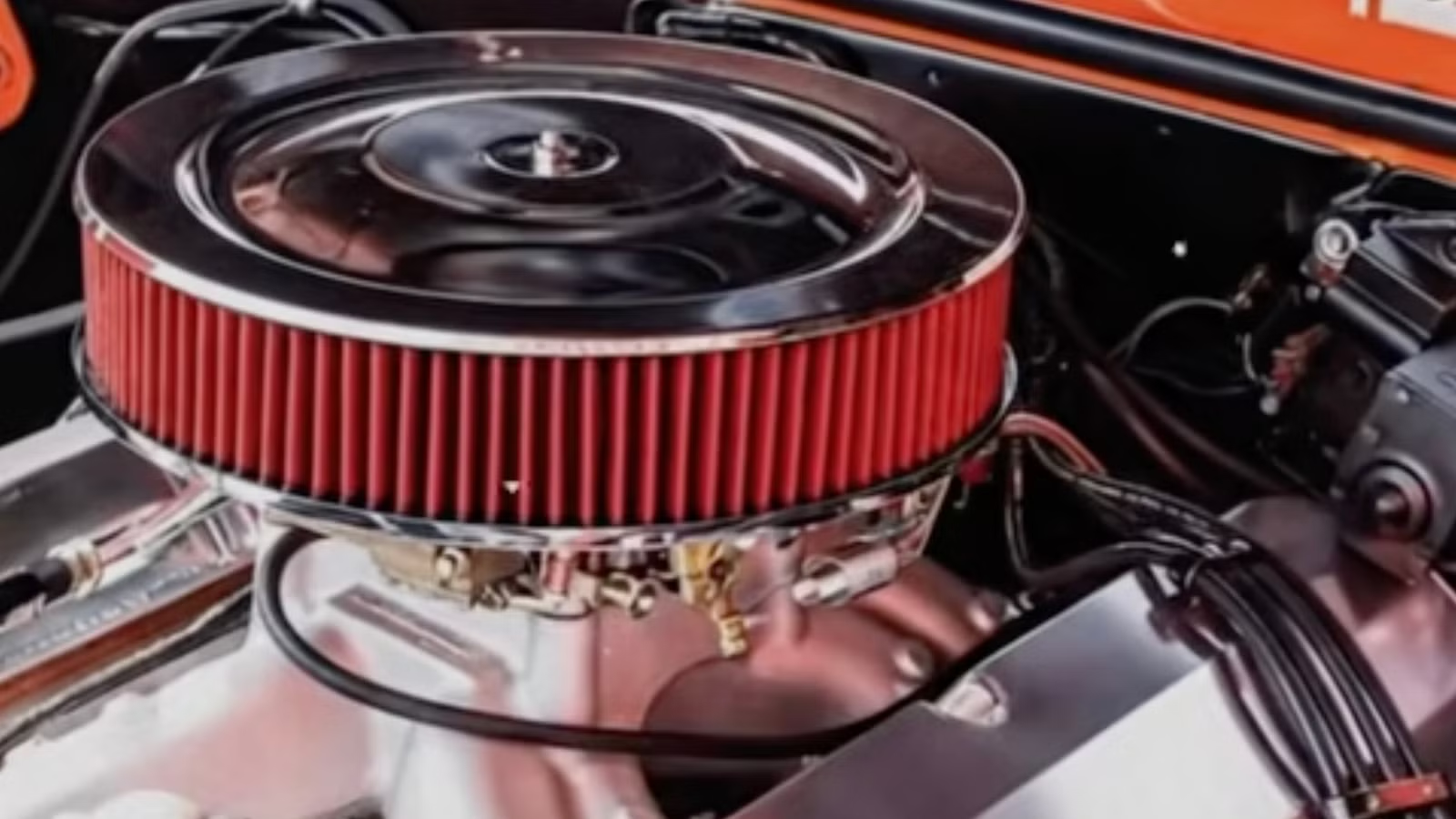
Collectors and Chevrolet fans are probably happy about the fact that the longest-running Chevy big-block V8 engine flies under the radar. Hot rodders ignore this durable, long-lasting option, meaning it’s easier for builders to scoop up. It’s secretly an undervalued swap option with serious muscle car DNA flowing through its cylinders despite not being as widely recognized as its siblings that power high-performance cars. You might want to consider getting a surviving example before word about this torquey beast gets out.
There’s A Black Sheep In The 396 and 454 Engine Family

Total legends have been birthed from the Chevrolet Mark IV engine family. It’s called the Rat or Porcupine motor with love after evolving from the 1963 Mystery Motor race prototypes. This big-block V8 family powers plenty of high-performance cars, including the Chevy Corvette, Chevelle, and Camaro. The Mark IV eventually evolved into the modern General Motors crate engine lineup. Two members of the engine family are particularly famous and highly sought after.
First, we have the Chevy 396 cubic-inch (6.5-liter) big block V8 that delivers up to 425 horsepower and 415 lb-ft of torque. It was most famously placed in the 1965 Chevy Corvette Stingray. This engine helped the Stingray Corvette accelerate from 0 to 60 mph in about 5.6 seconds and cover a quarter mile in roughly 13.7 seconds with a top speed of around 142 miles per hour.

Next, we have the Chevy 454ci (7.4-liter) LS6 big-block V8 engine. It churns out 450 hp and 500 lb-ft of torque. It gained its legendary status when placed in the 1970 Chevy Chevelle SS 454. This engine allowed the car to accelerate from 0 to 60 miles per hour in around 5.3 seconds with a 13.12-second quarter mile and a top speed of 130 miles per hour.

These engines were designed for high-revving muscle power to dominate the racetrack. They have massive displacements and low-end torque to enjoy. Both options have cast-iron deep-skirt blocks and high-flowing rectangular or oval-port head designs. Plus, they have massive valve arrangements.
The Chevy 366 Tall Deck V8 Is Designed For Hard Work
Then the Chevy 366 tall deck V8 marches to the beat of its own drum instead of being designed for muscle cars like its potent big-block siblings. The 366ci (6.0-liter) delivers up to 290 hp and 350 lb-ft of torque. It was built to power medium-duty commercial trucks and school buses. The engine never made it to passenger cars.
This workhorse prioritizes low-end torque and durability over high-speed performance. It has a deck height that’s half an inch taller than the other standard big-block engines in the family. The others have a standard short deck height. Because of the tall deck, it has specific intake manifolds, longer connecting rods, and a forged steel crankshaft. As a result, it doesn’t share as many parts with the standard big blocks.
But the elevated deck provides space for longer connecting rods to improve rod-to-stroke ratio and minimizes friction while reducing cylinder side-wall loading. It has enhanced coolant passages around the cylinders to prevent overheating while idling or pulling heavy loads. The enlarged coolant passages can support heavy-duty water pumps and dual thermostats. Also, the oiling system prioritizes lubrication to the main bearings before reaching the valve train.
Here’s Why Hot Rodders Ignore The 366

The 366 engine gets buried by its commercial and industrial uses. It blends into the background as a boring fleet engine for towing instead of high-speed racing. Also, it’s a bit hefty due to having heavier deck material and more heavy-duty cast-iron components. It weighs just as much as the larger 454 engine but only provides a fraction of the power.
Because the block is taller to make room for longer connecting rods, it can’t be paired with standard big-block headers or intake manifolds without requiring custom spacers or specialized parts. Going for a modern LS-series swap provides access to easier packages and more affordable performance parts.
It also has a smaller bore of 3.935 inches than the 396 and 454 engines that it shares a stroke with. As a result, airflow is limited, the valves are shrouded, and high-RPM horsepower is choked down. But to be fair, the engine is designed for lugging commercial payloads, not for drag strip sprinting.
But The 366 Tall Deck Has Too Many Benefits To Forget
The Chevy 366 tall deck V8 engine was in production from 1968 until 2004. That means it stuck around for 36 years, and it was in production longer than its siblings. The 396 engine was made from 1965 until 1970. Then the 454 engine lasted in production from 1970 all the way up until 2001, giving it a 31-year run time.
Because the 366 was built to withstand industrial stress, it has a reputation for being incredibly reliable. Unlike the standard big-blocks, the 366 has pistons designed with four piston rings to deliver enhanced oil control and compression sealing under consistent heavy loads. Plus, the forged internals and four-bolt main bearing caps easily withstand decades of hard labor as they resist twisting forces of high-load stress.
It has superior bottom end strength compared to its siblings to handle sustained RPM hauling and heavy-duty towing without failing. With its commercial-grade durability, it could last longer than its counterparts as well. Plus, it’s easier to find. The engine was placed in various grain trucks, dump trucks, and buses and can be cheaply sourced from salvage yards.

By the early 2000s, the 366 V8 met its end due to being inefficient and fuel-hungry. It was struggling to meet increasing emission standards and fuel economy regulations compared to modern, computer-controlled diesel engines. Plus, it became financially difficult to maintain the heavy-duty casting alongside lighter options.
Source: Chevrolet

Related posts

Latest Post


No Comments