
The Cheapest Harley-Davidson That Still Feels Properly American
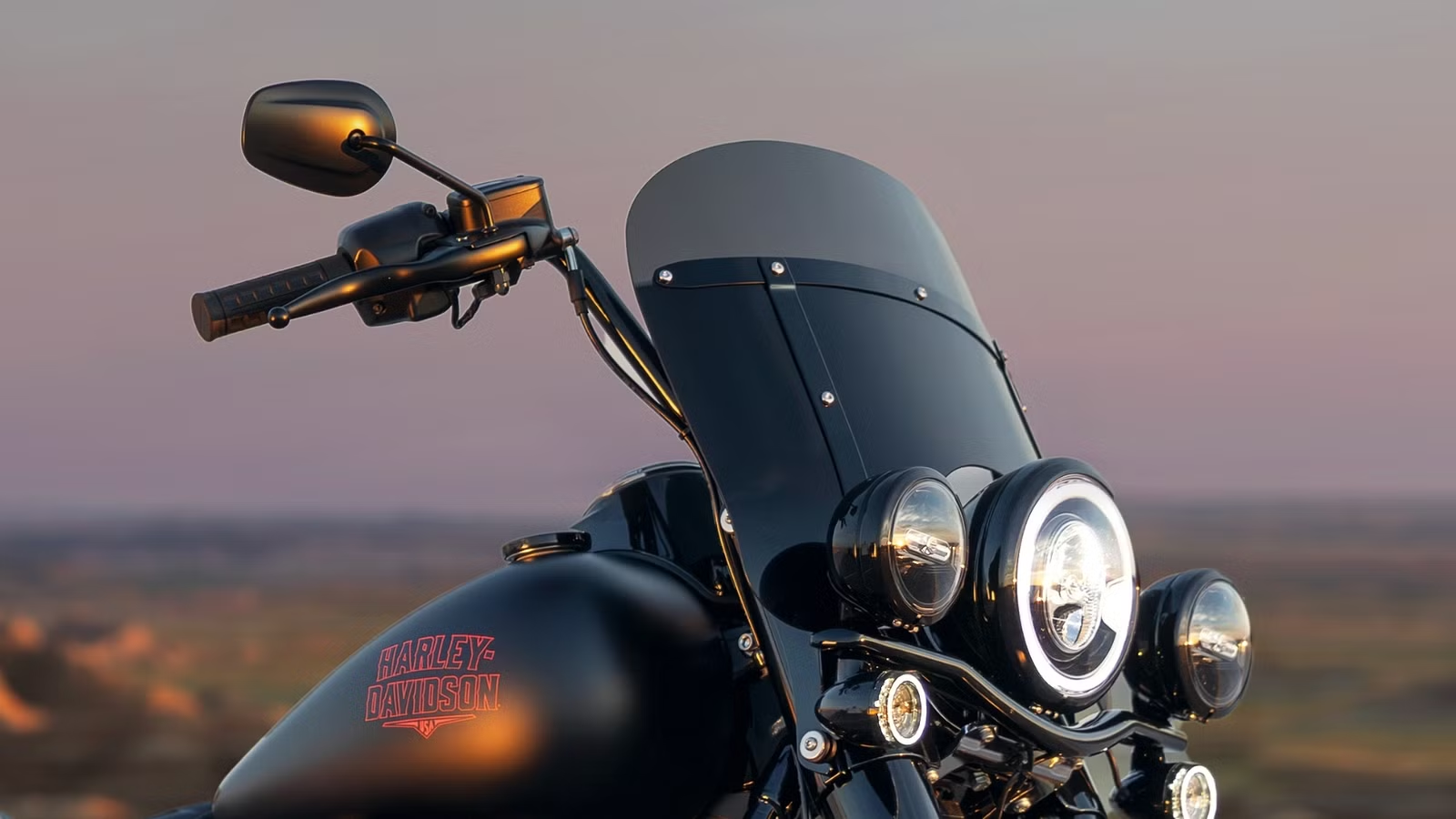
Nostalgia is a powerful drug in the motorcycle world. And every now and then, Harley-Davidson builds a motorcycle that looks like it rolled out of a 1948 garage as a new way to sell that idea in modern times. The newest example of that has now arrived in 2026, featuring almost no chrome, sitting low and dark on laced wheels like something a returning serviceman might have thrown together with a hacksaw and a free weekend. All this while, it wears a modern Softail chassis and hides a full suite of electronics under its stripped skin. Most importantly, the price is lip-smacking compared to other Softails, which is why this might be the cheapest way to get a properly American Harley today.
Modern Cruisers Are Burying The Bobber Under Chrome And Saddlebags

Walk into most American brand dealerships today and the cruisers waiting for you are loaded. Hard saddlebags, floorboards, infotainment screens, and enough chrome to signal from orbit have become the default, and the base price climbs with every accessory. That is a fine formula for riders who want to cover six states in a weekend, but it has quietly pushed the leanest, rawest version of the American cruiser off the showroom floor. If you want a true bobber now, the stripped and slammed silhouette that started the whole aesthetic, you usually build it yourself or pay a custom shop to do it for you. The factory rarely commits to the look without softening it first.
The Postwar Bobber Is Where American Motorcycle Culture Started

The style is not a passing trend. When servicemen came home after World War II, many of them bought surplus Harleys and started cutting off the fenders, lights, and trim to shed weight and sharpen the ride. The result was faster, meaner, and unmistakably personal, and it became the template for American motorcycle culture.
Those riders needed somewhere to go, and in 1947 more than four hundred of them converged on the Black Hills Motor Classic in Sturgis, South Dakota, touring the roads around Spearfish, Lead, and an old mining town called Deadwood. Harley-Davidson has more claim to that history than any other manufacturer, which makes the gap in its own lineup all the more glaring. 2026 finally brings something to celebrate that.

The Harley-Davidson Deadwood Revives That Look For $17,999

That gap is what the 2026 Harley-Davidson Deadwood is built to fill. Revealed in July, the Deadwood is a factory bobber sold only in the United States and Canada. Harley calls it the black sheep of its cruiser lineup, and the label fits. The bike is finished almost entirely in Denim Black, from the powertrain and struts to the risers, controls, fork covers, and headlight, with chrome left only on the lower rocker covers and pushrod tubes to catch the light on the engine’s V. A tuck-and-roll solo seat, a chopped and smoked windshield, and a slammed rear give it the low, purposeful stance the bobber crowd has always chased.
A Stripped Heritage Classic That Costs $2,000 Less

Look past the black paint, and the Deadwood is a Heritage Classic with the touring hardware taken off. It shares the same Softail bones, the same Milwaukee-Eight engine, and much of the same chassis, but Harley deletes the saddlebags, the passenger accommodation, and most of the chrome, then slams the rear suspension for the profile. The interesting part is the price. Rather than charging extra for a special variant, Harley sells the Deadwood for $2,000 less than the roughly $19,999 Heritage Classic it is based on.
This is a bike defined by subtraction, and that is becoming a pattern in Milwaukee, since the recently launched Super Glide pulls the same trick on the Street Bob. The Deadwood also arrives as Harley quietly retires the Icon program of its previous leadership, positioning bikes like this one as part of a new run of limited, lower-priced collector models. All of that helps this be the cheapest ticket for a properly American Harley experience.
The Deadwood Backs Its Looks With Milwaukee-Eight 117 Power

The Deadwood does not skimp where it counts. It runs the 1,923cc Milwaukee-Eight 117 Classic V-twin, the same big-inch engine that powers much of the Softail range, making 98 hp and a thick 120 lb-ft routed through a two-into-one exhaust. Harley tunes it for a flat torque curve that favors easy, low-effort street riding over peak output, which suits a bike meant to rumble between bars and backroads rather than chase top speed.
Topped With A Hardtail Look, Laced Wheels, And A 25.5-Inch Seat

The trick underneath is the Softail frame, which hides its rear monoshock to mimic the clean triangle of a vintage rigid hardtail. From three feet away, the Deadwood looks like it has no rear suspension at all, while you actually have 3.4 inches of travel for your back’s mercy. The slammed setup gives up about an inch compared to the Heritage Classic it borrows from, though.
That drops the rider to a 25.5-inch perch, one of the lowest in the entire 2026 Harley lineup. Black tubeless laced wheels, a five-gallon Denim Black tank wearing only a red-letter logo, all-LED lighting with a seven-inch headlamp and auxiliary fog lamps, and a tank-mounted five-inch gauge that stacks an analog speedometer over an LCD round out the period-correct presentation.
Modern Tech And A Blank Canvas For Customization

Here is where the Deadwood stops pretending it is 1948. Under the stripped bodywork sits a genuinely modern electronics package: cornering ABS, cornering traction control, and drag-torque slip control all governed by a lean-sensing IMU, plus three ride modes in Road, Sport, and Rain. Cruise control, tire pressure monitoring, USB-C charging, and connectors for heated grips are present as well.
The other half of the bobber tradition survives intact, too. A stripped, blacked-out canvas like this one begs to be personalized, and Harley’s parts catalog and the wider aftermarket give owners endless room to make it their own, which is exactly where a rider’s bond with a bike like this tends to form.
The Deadwood Is A Purpose-Built Bobber, Not A Bargain

It is worth being clear-eyed about what $17,999 buys here. On paper, the Deadwood seems to give you less motorcycle than the two-up Heritage Classic. There are no bags to load, no seat for a passenger, and an inch less suspension travel, so a rider cross-shopping on features alone will feel shortchanged. But that misses the point, because the subtraction is the product.
Nobody buys a bobber to carry luggage. They buy it for the stance, the attitude, and the straight line it draws back to the surplus Harleys that built this culture, and the Deadwood delivers all of that straight from the factory, at a lower price. For the rider who wants the postwar look without spending a winter in the garage to earn it, this is the most convincing factory bobber Harley-Davidson has built, and its limited-run billing only sharpens the appeal. Just do not expect it to pack for the trip.
Sources: Harley-Davidson

Related posts

Latest Post


No Comments