
The BMW Bike That Balances Passion With Precision
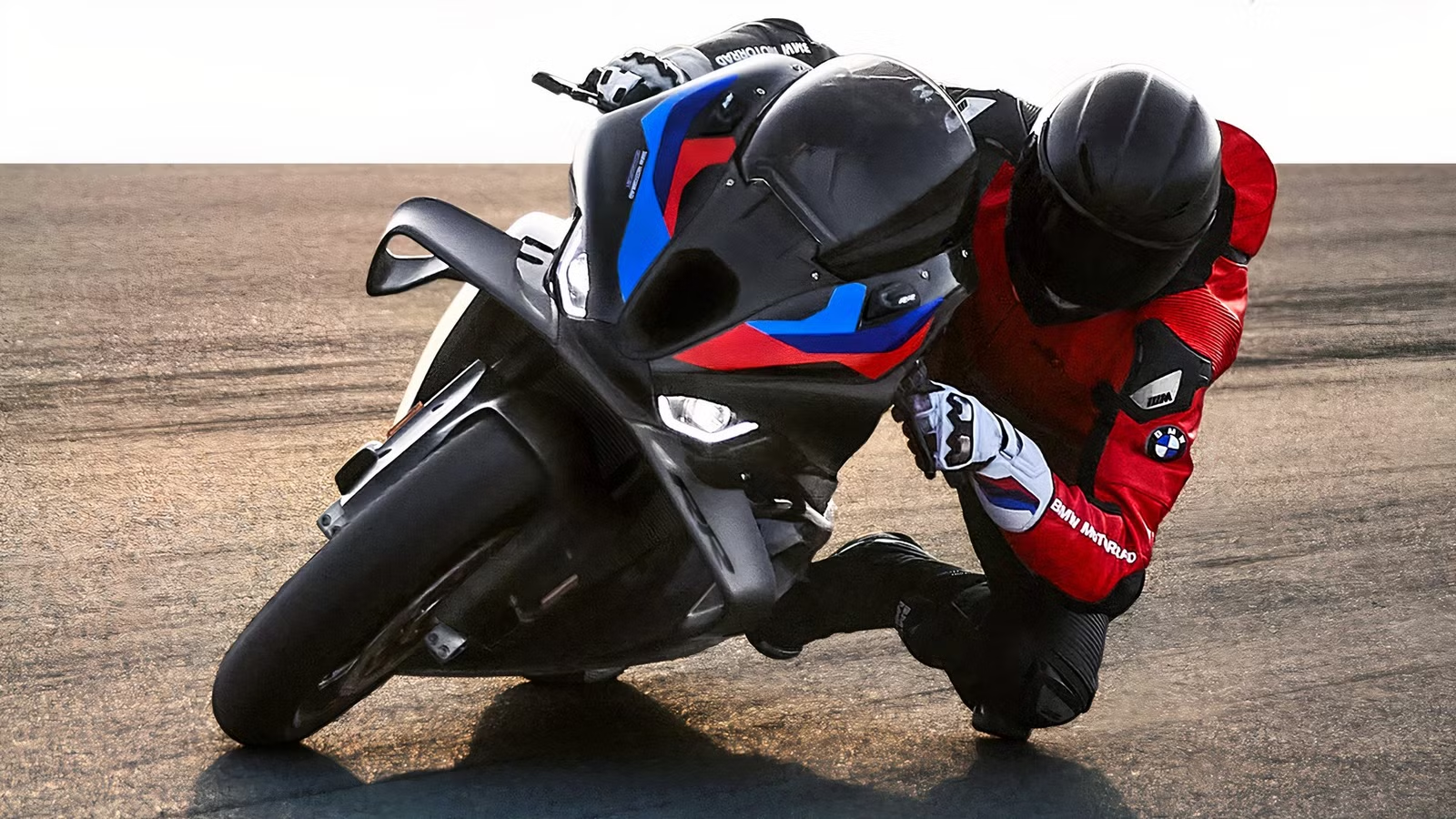
Modern superbikes have pushed performance to astonishing levels, with 200-plus horsepower and sophisticated electronics becoming the norm. But outright power is only part of the equation. The faster a motorcycle becomes, the more important it is to control every pound of performance it produces. Every component, from the engine and chassis to the suspension, aerodynamics, and electronics, must work in harmony to give the rider confidence at the limits.

The goal is a machine that translates rider input into action with zero hesitation, minimal drama, and unwavering confidence. This pursuit of precision is what separates an exceptionally fast motorcycle from a genuinely complete superbike, and few machines embody that philosophy quite like the BMW we’re going to talk about here.
Passion And Precision Requires High-End Components All Over
Creating a motorcycle capable of combining brutal acceleration with pinpoint control requires more than just a powerful engine. It demands carefully engineered hardware components. The pursuit of greater performance has pushed manufacturers like BMW to bring increasingly sophisticated technology from professional racing to production motorcycles. Lightweight chassis, advanced aerodynamics, sophisticated electronics, and MotoGP-inspired engineering are no longer exclusive to factory race bikes. Instead, they are making their way onto road-legal machines that can tackle a racetrack one moment and then ride home the next.
Race-Bred Technology Is Changing What A Road-Legal Superbike Can Do


The fine line between a track machine and a street-legal superbike has never been thinner. Technologies once reserved for factory-backed race bikes, including carbon-fiber wheels, aerodynamic winglets, slide control, launch control, and race-derived chassis geometry, are now available on some production motorcycles.
The result is a road bike whose engineering goes far beyond simply mimicking the appearance of a race machine. Every weight-saving measure, chassis adjustment, aerodynamic element, and electronic system serves a purpose, whether it is improving acceleration, braking, cornering, or rider confidence. Few motorcycles take this approach as far as BMW’s most extreme road-going model.
The BMW M 1000 RR Blends Track-Bred Passion With Bavarian Precision
Starting MSRP: $35,395

The motorcycle in context is the pinnacle of BMW Motorrad’s superbike lineage – the M 1000 RR. Introduced in 2020 as the first motorcycle to wear BMW’s prestigious M badge, it took the foundation of the S 1000 RR and pushed its performance credentials. The purpose was to be a road-legal, WorldSBK-homologated superbike rather than simply a more expensive S 1000 RR. Its WorldSBK race debut followed in 2021, reinforcing the idea that this was designed to blur the boundary between a production motorcycle and a genuine race machine. For 2026, the M 1000 RR gains a new M Motorsport frame and electronic refinements.

With a starting MSRP of $35,395, it sits firmly in the premium superbike class, while the fully equipped versions with the M Track Package reach up to $42,390. More than a numbers-driven exercise, the M 1000 RR is designed around a clear objective – delivering the level of precision, control, and performance expected from a machine developed with the racetrack at its core.
A High-Revving Four-Cylinder Engine Built For Pure Motorsport Excitement

At the heart of the BMW M 1000 RR is a high-revving 999cc inline four-cylinder engine engineered to scream all the way to a stunning 15,100 RPM redline. Featuring BMW’s proprietary ShiftCam technology, which continuously varies valve timing and stroke on the intake side, this motor delivers an astonishing 205 horsepower at 13,000 RPM and 83 pound-feet of torque at 11,100 RPM.
Combined with a six-speed transmission and BMW’s Shift Assistant Pro (a bidirectional quickshifter), the M 1000 RR delivers seamless, clutchless upshifts and downshifts that keep the rider focused on the apex. This isn’t just a powerful engine; it’s a race engine with lights and a license plate. You’ll see 189 mph on the dash if you keep it pinned, so this is one of the rare few machines that don’t follow the gentleman’s agreement.

In fact, the motorsport connection goes far beyond statistics. The engine shares structural blueprints directly with BMW’s WorldSBK factory race team, utilizing lightweight forged 2-ring pistons, optimized cylinder head geometry, and titanium valves. A full titanium exhaust system further cuts weight, while the quick-action throttle provides the instantaneous response expected from a motorcycle engineered to perform at the track.
Electronics And Chassis Dynamics Make All That Performance More Usable

Power is meaningless without control, and BMW’s electronics suite ensures the M 1000 RR’s 205 horsepower remains manageable even for riders who aren’t factory racers. BMW has equipped the M 1000 RR with a sophisticated six-axis IMU and an innovative steering angle sensor. This setup powers cutting-edge electronic aids like Slide Control and Brake Slide Assist, allowing experienced track riders to set up controlled drift angles into and out of corners with total confidence.

Supported by seven distinct riding modes (Rain, Road, Dynamic, Race, Race Pro 1-3), Dynamic Traction Control (DTC), ABS Pro, Launch Control, and a race-configurable shift pattern, the M 1000 RR puts factory-level tuning directly at the rider’s fingertips via a crisp 6.5-inch TFT display. Moreover, the chassis is equally race-focused. An aluminum bridge frame (now the M Motorsport frame as standard) provides optimal rigidity and flex balance, while the upside-down front fork and full floater pro rear suspension deliver precise feedback and stability.
Cutting-Edge Aerodynamics and Carbon Fiber Engineering Inspire Confidence

Aerodynamics is one of the clearest examples of how the M 1000 RR turns speed into precision. It features state-of-the-art aerodynamic engineering developed and refined in BMW’s high-speed wind tunnels. Highlighting the bike’s front fascia are the M Winglets Evolution 3.0 that generate up to 66 pounds of downforce at the front wheel, even at lean angles, providing 33 percent more downforce than the previous model. This extra grip allows riders to carry more speed through fast corners and brake later with confidence.

Complementing the winglets is an array of carbon fiber components and race-derived chassis hardware. Carbon fiber appears throughout the M 1000 RR, especially when equipped with the optional M Track package. The M Carbon wheels lower gyroscopic forces, while the carbon bodywork, carbon tail-hump, and M Billet components (brake and clutch levers, rider foot pegs) add both visual drama and functional weight savings. Braking is handled by BMW’s race-proven M brake system, enhanced with M Brake Ducts that channel airflow to cool the calipers by up to 10 degrees during track sessions.
The BMW M 1000 RR Proves That WorldSBK Technology Can Belong On The Street
The M 1000 RR isn’t just BMW’s fastest production motorcycle; it is a clear example of how closely racing technology can be integrated into a road-legal motorcycle. By bringing together motorsport-derived hardware, sophisticated electronics, and meticulous Bavarian engineering, BMW Motorrad has built a motorcycle that proves passion and precision are mutually inclusive. When stacked against its fiercest European rivals, the M 1000 RR occupies a unique position in the elite superbike landscape.

The Ducati Panigale V4 R takes an equally uncompromising approach, pairing a 998cc V4-derived engine with extensive racing technology. Aprilia’s RSV4 Factory follows a different formula, combining its 1,099cc V4 with a finely developed chassis and advanced a-PRC electronics, making it a formidable track-day weapon. The BMW’s appeal, however, comes from how naturally its individual elements work together. Its 205-horsepower engine provides the performance, its WorldSBK connection adds genuine racing pedigree, and its hardware and electronics help turn that performance into something the rider can confidently exploit. That cohesion is ultimately what makes the M 1000 RR such a compelling flagship superbike.
Source: BMW Motorrad

Related posts



Latest Post


No Comments