
The BMW Adventure Bike That Quietly Does Everything Well
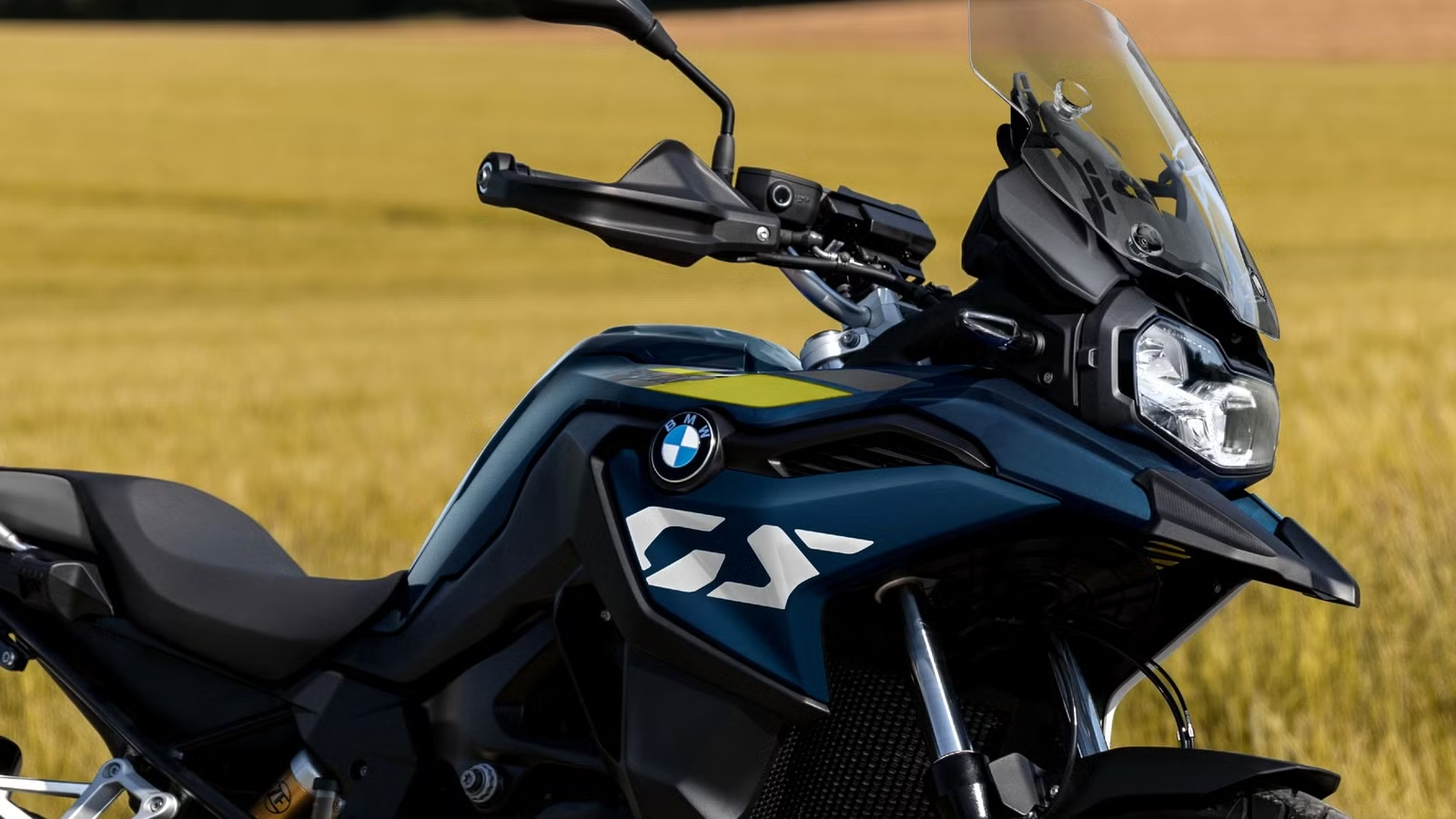
The past few years have brought a proper overhaul to BMW’s bread-and-butter GS lineup. Not only did the flagships receive an overhaul (switching from the 1250 to 1300 platform), but we also got a new entry-level F 450 GS, replacing the largely unsuccessful G 310 GS recently. As a result, the Bavarian brand’s ADV lineup is quite vast today.

As much as we dig the choice, the inevitable side effect is that some bikes get less attention. BMW’s cheapest midweight ADV is a prime example of this. It quietly does everything well, but fails to grab headlines or eyeballs due to its simple nature.
BMW’s GS Adventure Bike Lineup Is Larger Than Ever In 2026
Not long ago, the GS lineup started with the G 310 GS, flowed into the F 750, F 800, and F 850 GS. Then came the flagships: the R 1250 GS and R 1250 GS Adventure. Today, though, the cubic capacities have risen across the board to meet new emission norms, resulting in a larger overall lineup capacity-wise that now starts from 450cc rather than 313cc.


The F 450 GS is the new entry into BMW’s ADV world, powered by a new parallel-twin engine. This has made all the right headlines in recent times, and global reviews only back up the impressive package. At the opposite end is the flagship R 1300 GS duo. These have a new 1,300cc boxer powerhouse and remain the most popular ADVs by the brand. That’s backed up by the sales numbers (they sell the most in the entire BMW lineup).

Between these two is the midweight trio, all of which have the 895cc parallel-twin engine. In this space, it’s the F 900 GS and F 900 GS Adventure that make all the headlines. This is down to their increased rugged appeal and near-class-leading performance. That takes the attention away from their do-it-all sibling, however, which is arguably a more logical F GS for most of us.
The BMW F 800 GS Can Do Everything Well, Despite Being Overlooked

We’re talking about the F 800 GS. It’s arguably the most vanilla GS in the lineup today, serving as the ‘jack of all trades, master of none’. So you don’t get spoke wheels (even as an option), exotic colorways, or serious off-road prowess. This is why most GS fans don’t consider it in the beginning. But look deeper, and you realize that a 19-inch front wheel for occasional off-road stints, a torque-loaded parallel-twin engine, and likable features are all packaged as standard. That means the 800 GS will happily do commuting, touring, hitting the canyons, or exploring mild trails.
A Sub-$11,000 MSRP Helps The F 800 GS Make Its Case Stronger

Its do-it-all tendencies are convincing enough, but the F 800 GS makes its case stronger via a competitive MSRP. It starts at $10,995 for the Light White colorway, with the Triple Black and Style Sport costing $295 more, respectively. That makes the 800 a sizable $3,400 cheaper than the F 900 GS. It also helps this slot well among less powerful and loaded rivals like the Suzuki V-Strom 800 and Yamaha Tenere 700. Speaking of loaded, the F 800 GS has a likable base package for the price. Let’s dive into it.
An 895cc Engine With Over 65 LB-FT

The engine is arguably the highlight here. This is BMW’s popular parallel-twin powerhouse (with the 270-degree crank) we see on multiple bikes like the F 900 XR, F 900 R, and the F 900 GS duo. Here, the mill is in its most usable tune, producing 87 horsepower and 67 pound-feet. Both numbers peak at just 6,750 RPM, meaning you’ll have ample kick at all times.
This also helps promise a fuel efficiency of 55 miles per gallon–a couple more than the 105-HP F 900 GS. You also get a larger four-gallon fuel tank than the F 900 GS’ 3.8-gallon unit, meaning more overall riding range. All the power reaches the wheel via a six-speed transmission, driven by a chain.
Simple Underpinnings That Focus On Versatility First

The two F 900 GS models serve as the extreme kids in the lineup, featuring a 21-inch front wheel and long-travel suspension. But the F 800 GS takes a more neutral approach, just like the do-it-all R 1300 GS. So you get a 19/17-inch alloy wheel combination, paired with a bridge-type steel chassis and a simple suspension setup.
The latter comprises telescopic forks and a monoshock, both with 6.7 inches of travel. Only rebound and preload are adjustable at the rear, which is a slight bummer. Twin 305 mm front discs with two-piston Brembo calipers and a rear 265 mm disc with a single-piston caliper make up the brakes.

The overall neutral approach also makes the F 800 GS friendlier for the masses dimensionally. The saddle height is low at 32.1 inches, while the wheelbase is tight at 61.3 inches—both measuring less than the F 900 GS. However, its curb weight is 500 pounds, probably due to the extra fuel capacity. This is still in the ballpark of its rivals like the V-Strom 800.
A Feature List Comprising All The Necessities

Although this is the cheapest midweight GS, the feature list is comparable to its F 900 siblings. A 6.5-inch TFT is front and center, armed with BMW Motorrad Connectivity. It also serves as the gateway to the rider aids, comprising cornering ABS (or ABS Pro as BMW calls it), dynamic traction control, and two ride modes. Topping this is a likable set of creature comforts like heated grips, cruise control, USB ports, adjustable levers, and all-LED lights. BMW mentions these as ‘standard’ inclusions in 2026, although these were previously part of the options list.
If you choose the Triple Black and Style Sport colorways, you also get a taller, adjustable windscreen. Lastly, we also want to give a shoutout to the design. Unlike the distinct-looking 900 GS, the 800 GS still has the likable OG GS elements. The geometrical headlight shape is one, while the angular side fairings and front beak are other notable bits. These remind us of the ultra-popular R 1250 GS.
Source: BMW Motorrad

Related posts


Latest Post


No Comments