
9 Things We Don’t Love About Classic Mopar Muscle Cars
Here at HotCars, we love us some classic Mopar muscle cars, more than anything else from the entire Golden Age. Well, at least some of us, with a general feeling here that Dodge and Plymouth muscle cars were the coolest, fastest, and baddest things on the streets, which continue to wow us today. We are, however, not so wrapped up in fanboying and fangirling that we think Mopar could do no wrong and, in fact, there are some things about classic Mopars we’re not totally crazy about. That being said, we’d take any one of the rides listed below with less than desirable features over an AMC, Ford, or GM muscle car. Well, at least some of us would. We recognize that some of these may be a bit controversial, but there is a method to our madness, and you can always rip us a new one in the comments section.

9
Vinyl Roofs
Not Hardtop Enough
For some reason, Chrysler, and really all automakers in the Golden Age, thought that a textured vinyl hardtop was cool for a muscle car, but they were mistaken. It’s a feature that might add some pseudo luxury to an upscale full-size car, but on a muscle car it just looked weird. Exhibit #1 is that turquoise 1968 Dodge Charger R/T pictured above with the white vinyl roof, which manages to make the most gorgeous classic era car look like a dorky family ride. The next picture in our gallery of a painted roof ’68 Charger R/T, which is the greatest three-quarter hero shot of all time, proves the wimpifying effect of the vinyl top. The next set of pictures puts a Panther Pink 1970 Dodge Super Bee with a white vinyl roof up against a Sublime car that is literally sublime, and the contrast is even more evident. Black vinyl tops are a little less obnoxious, but definitely not as visually pleasing as a straight hardtop coupe.
8
Weenie Wheels
Sick Rims That Were Actually Sick

A dude wearing some Doc Martin steel-toe boots is infinitely more intimidating than a guy in Birkenstock sandals with wool socks, and the same principle holds true for muscle cars, as lame wheels pull all the aggressiveness out of the look. We lined up a bunch of 1969 Dodge Charger Daytonas for an apples-to-apples comparison. The first car has some kind of turbine-style wheel coverings that are the antithesis of cool and look like they want to be on a station wagon. Next, there is a Daytona with Kelsey-Hayes W23 Cast Aluminum Center Road Wheels, which were not only fugly but also were recalled because the design caused the lugs to loosen. The third Daytona has body-color steel wheels with chrome dog-dish hubs which, again, is not super cool-looking. Lastly, we have a ’69 Daytona with some chrome five-spoke Magnum 500 wheels, which makes all the previous cars look like weeniemobiles.
7
225 Slant-Six
Too Wimpy For Muscle Beach
Don’t get us wrong, because the Chrysler 225 Slant-Six was a solid and reliable engine that we fully appreciate, but it had no business going under the hoods of muscle cars, which it actually did. B-Body beasts like the Plymouth Belvedere and Dodge Coronet could be severely downgraded with a Slant-Six, and even the second-gen Charger could be optioned with one. A 3,285-pound Charger with a single-barrel 225 six-cylinder making 145 horsepower and 215 lb-ft of torque was a 19.0-second car, which is an insult to its bold, ferocious design. Just as bad, the 1970 Dodge Challenger could also be optioned with a 225 Slant-Six, which was slightly “quicker,” crawling the quarter-mile in 18.9 seconds. That fourth picture in our gallery is a white ’70 Challenger, like the hero car from the Barry Newman chase classic Vanishing Point, but with a Slant-Six, that car couldn’t have outrun a moped towing a dumpster.
6
Bland Paint Codes
Coma-Inducing Colors
Starting in 1969, Chrysler introduced the High Impact paint codes that included legends like Plumb Crazy and Sublime, but even before that, Dodge and Plymouth rides had access to some seriously cool colors. Unfortunately, they also offered some of the worst paint options that sucked all the fun out of otherwise kick-ass cars. That first pic is of a 1968 Road Runner in Sunfire Yellow, which sounds cool but is pale and boring, plus it has a black vinyl top, making it look even worse. The next car is a 1968 Barracuda Formula S, allegedly in silver, but is roughly the same color as some fuzzy mold on that piece of cheese you forgot about in the fridge. From there, we have a Light Green ’69 Charger R/T that is approximately the same hue as vomit. That cream-colored 1970 Challenger R/T gets even less attractive with its red interior. Finally, we have a million-dollar ’69 Daytona in Copper, which is actually just brown, and wow, there couldn’t be a less exciting color for one of the most dynamic cars ever built.
5
Post-’71 Detuned Big-Blocks
Malaise Era Letdown
In 1972, the 383 Magnum, 440 Six-Pack, and 426 Hemi were discontinued, and there will be more on that last one in just a sec, but the remaining big-blocks were severely detuned, making a mockery of Mopar muscle. For ’72, the once mighty 440 Magnum V8 went from 375 horsepower down to just 280 ponies, turning the Charger from a 13-second ride to an almost 15-second car. The Chrysler 400 V8 essentially replaced the 383, 440 Six-Pack, and 426 Hemi, but not in a good way. At 255 horsepower and 340 lb-ft of torque, a ’72 Road Runner 400 with an automatic took 7.0 entire seconds to go from 0-60 and besmirched the nameplate with a 15.2-second quarter-mile. The Charger, Challenger, Road Runner, and ‘Cuda all still looked as cool as ever in ’72, but thanks to the detuned big-blocks, this was truly the year that Mopar lost all of its muscle.
4
Floral Tops
WT Actual F
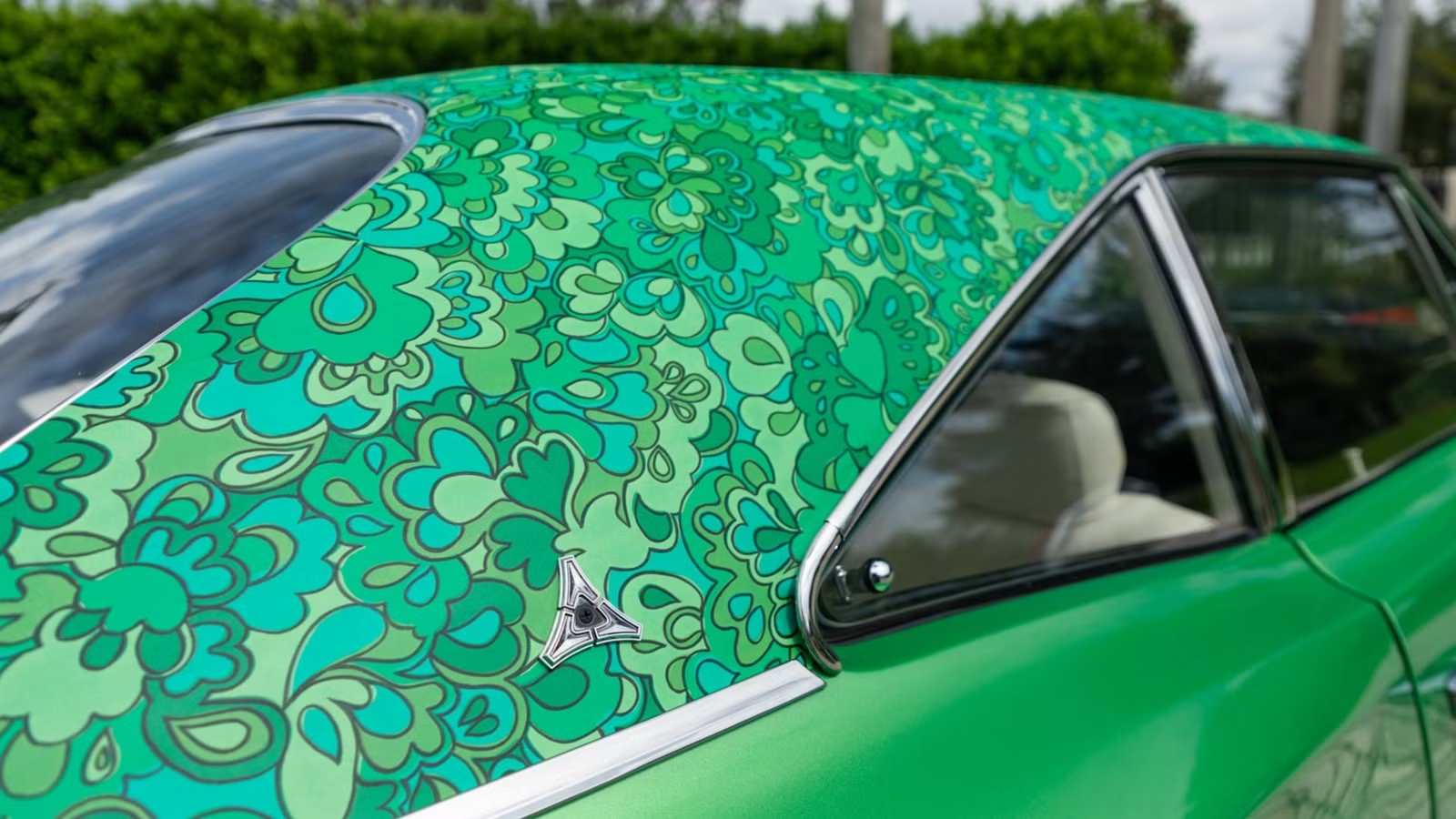
Our aversion to vinyl tops is already established, but it’s nothing compared to how much we dislike the short-lived floral tops of 1969. Chrysler was trying to tap into the hippie “Flower Power” movement of the late ’60s as well as attract female buyers, so they came up with a vinyl printed top with a tapestry of cartoonish flowers. Alternately called the “Mod Top,” this was actually an option for some killer muscle cars, like that ’69 Super Bee A-12 Six-Pack pictured above. Making matters worse, this option could be accompanied by similar floral work in the interior, including seat and door panel inserts. It was definitely a weird marketing idea, considering that neither hippies nor women represented a big demographic for street machines. This is one of those things where some fans may feel in retrospect that it’s so dorky that it’s cool, but it really isn’t. A serious street brawler shouldn’t have a roof that looks like a poster promoting the Woodstock festival.
3
Skinny Tires
There’s More Room In Those Wheel Wells
The perfect set of wheels for a 1969 Road Runner or Super Bee A12 Six Pack/6BBL is black steel with chrome lugs, but for some reason they were leaving the factory with skinny little tires. Looking at the first picture, you can see how much more room is available in the wheel wells, and it actually sucks all the aggressive stance out of the B-Body badass. Wider tires equals more traction, so for something that was designed to kick ass on the streets, skinny tires seem like they’re trying to sabotage the mission. From an aesthetic point of view, fatter tires just look cooler, as the skinny ones make an otherwise wicked ride look kind of wimpy. The second set of pictures with contrasting 1970 Coronet R/Ts proves that beyond a shadow of a doubt. The first Dark Green Hemi has some thin body-colored wheels and looks kind of unimportant, while the second Plum Crazy 440 has some fat mags, giving it an aura of danger, violence, and relevance.
2
Resto Mods
Literally Sacrilegious
We don’t actually have a problem with someone taking a Slant Six, 318, or post-’71 340 classic Mopar and dropping a better engine in it, but we’re not crazy about the custom and retro mod trend of turning these beauties into low rider pimp mobiles. A 383 or above, however, should not be messed with, but there are so many that have been desecrated. That ’69 Road Runner custom pictured above started out life as a 383 car and was transformed into one of the ugliest things we’ve ever seen, which BTW, someone dropped $379,500 on at Mecum Las Vegas 2025. The next car, which isn’t quite as hideous except for the wheels, is a bona fide 383 ‘Cuda that was ruined, and the car after that is a real deal 440 ’69 Charger R/T that was debased, but for some reason kept the original copper paint and vinyl top. The last one is a ’70 Challenger 383 R/T that isn’t an eyesore except for the wheels, but was robbed of its originality. These are not the cars that should be getting cut up and built, when there are so many less cool Mopars out there ripe for the picking.
1
Death Of The Hemi
Only The Good Die Young
That red 1970 Charger R/T pictured above is exactly the kind of Mopar muscle car we love. It’s a Hemi-powered, four-speed manual with pistol grip shifter, painted roof, and dealer-option fat Cragar SS wheels, which is Golden Age Perfection. Our problem here isn’t this magnificent Mopar, but rather that it was just one year away from the discontinuation of the 426 Street Hemi. The 425 horsepower, 490 lb-ft 426 Hemi V8 defined the classic muscle car era and made Mopars equipped with it the fastest and most fearsome cars on the road. Its loss was the final nail in the coffin for the muscle car, and it’s something that fans still mourn 45 years later. The only solace here is that 1972 ushered in the Malaise Era of detuned engines, so if the Hemi would have continued on, it would have been a sick farce of its former dominance, with less compression and a single four-barrel carb. Fred Gwynne’s character in Pet Sematary said, “Sometimes dead is better,” and with a possible weak sauce 426 Hemi, it’s probably best that it was discontinued.
Sources: Chrysler, Mecum

Related posts


Latest Post


No Comments