
The Affordable Honda Motorcycle That’s Perfect For A First-Time Buyer
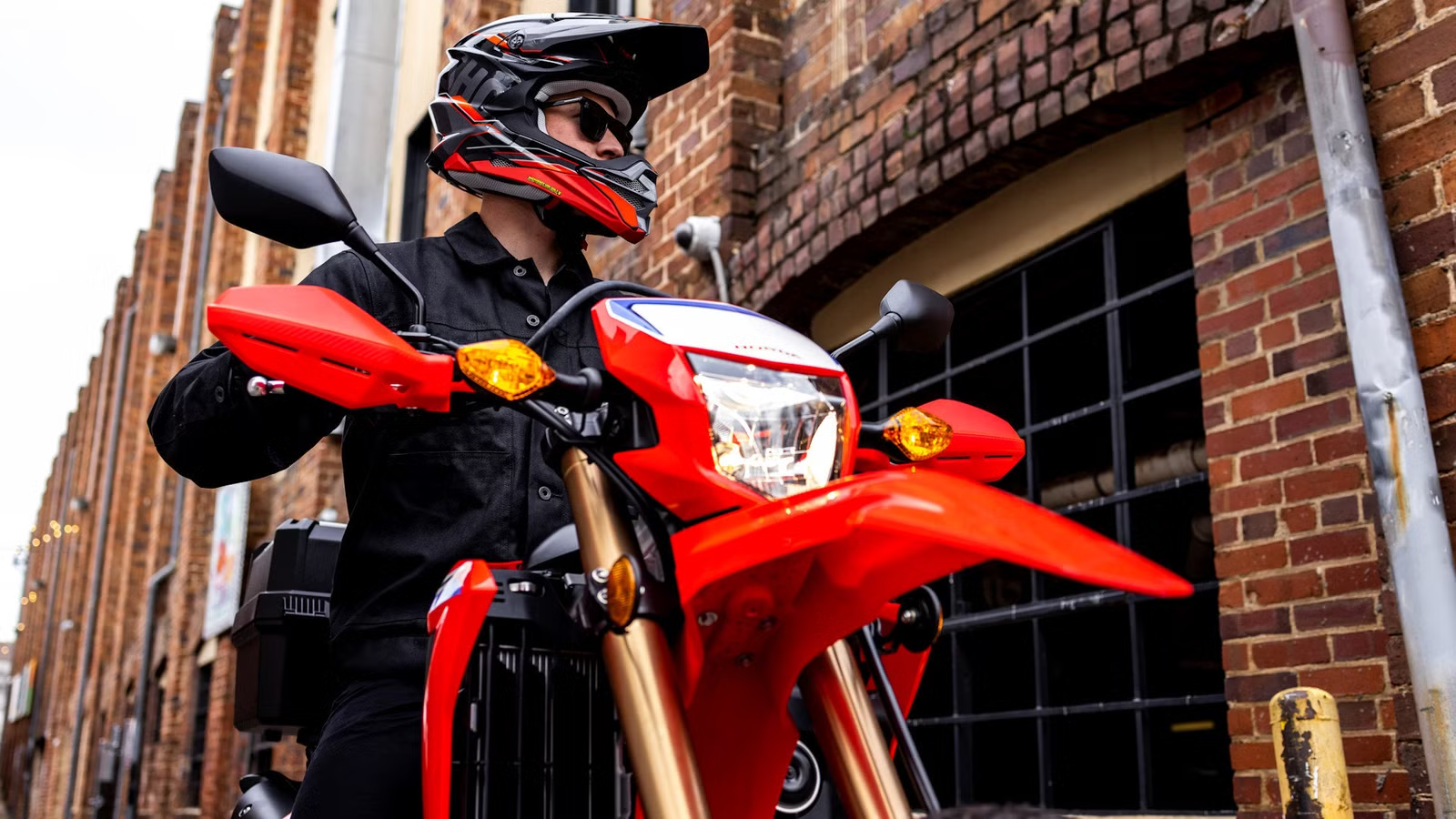
Picking your first motorcycle is one of the most exciting — and overwhelming — decisions a new rider faces. With so many categories competing for your attention, it’s easy to get pulled toward something that looks great but punishes inexperience. That’s exactly why dual-sports deserve a serious look from anyone just starting out. Riding across different types of terrain builds skills faster than any single-surface bike can, and if you’re still unsure whether you’re a dirt-trail explorer or a weekend canyon carver, a few months on a dual-sport will answer that question for you.

Honda offers a wide range of dual-sport bikes that cater to different skill levels. The XR150L is a great entry-level option for those with no desire to do any highway riding, and the CRF300LS offers a slightly lower seat height. But a new rider will benefit more from a safety feature like ABS than a lower seat height — and that’s exactly where the CRF300L ABS comes in.
The Honda CRF300L ABS Is Perfect For A First-Time Buyer
MSRP: $5,749
Honda is by no stretch of the imagination alone in this space. Japanese brands have long dominated the entry-level dual-sport market, but KTM has also entered the fray with its 390-based Enduro R model — though its long-term availability may depend on how the brand resolves its ongoing financial challenges. Existing competitors from Japan are all competitively priced, but some of the stiffest competition comes from within Honda’s own lineup.

The CRF300LS was introduced explicitly targeting the beginner market with its lower seat height. For some reason, Honda was not able to include ABS, which we feel is a missed opportunity. The XR150L is without doubt the most approachable dual-sport, but much like mini moto bikes, it is not something that can — or at least should — be used on the highway. The 300 has no issues getting up to highway speed, although it just isn’t all that comfortable for sustained periods. The same could be said for any dual-purpose motorcycle, though.

If wind blast is a big concern, there is the Rally version, which offers some wind protection — but that’s also just one more thing that can break when you fall or drop the bike. If you have your heart set on a sports bike or cruiser, the CBR300R and Rebel 300 are there, but dropping either of those will hurt resale value. For a new rider, the durable dual-sport is the way to go. The low weight and slim overall design further strengthen the case for the CRF.
Rivals
- KTM 390 Enduro R
- Kawasaki KLX300
- Yamaha XT250
- Suzuki DRZ-4S
The CRF300L Offers Approachable Performance
Output: 27 Horsepower

|
Engine |
Max Power |
Transmission |
|---|---|---|
|
286cc single-Cylinder, liquid-cooled |
27 HP |
6-speed |
One thing that confuses many people new to motorcycling is the fact that the CRF300L looks a lot like the CRF450RL enduro bike. In reality, the two bikes couldn’t be further apart. While the 450 is essentially a wild dirt bike with lights bolted on, the 300 is docile and approachable. Unfortunately, the visual similarity has led to some pretty awful experiences for new riders who assume spending more will get them a better product.
That product will actively try to hurt them. With a throttle akin to an on/off switch and more power than most experienced riders can really handle off-road, it’s a recipe for disaster. The 300, on the other hand, is designed with new riders in mind: throttle response is smooth and power delivery is entirely manageable. It has what we would call ‘enough’ power to be tolerable on the street, and actually more than enough for off-road use.
It is an ideal bike for exploring and will help new riders build confidence wherever they ride. While it might seem like a simple training tool in stock form, it also benefits from an extensive aftermarket. It’s very easy to tailor this bike to your needs, with options ranging from simple luggage racks all the way up to big-bore kits that can elevate the performance once you’re ready for the next step.
The CRF300L Is One Of The Best Beginner-Friendly Motorcycles On The Market
The Fun Way To Learn

|
Wheelbase |
Seat Height |
Ground Clearance |
Fuel Capacity |
Weight |
|---|---|---|---|---|
|
57.2 inches |
34.7 inches |
11.2 inches |
2.1 gallons |
311 lbs |
Since Honda introduced this bike as a 250 some years ago, the biggest complaint from new riders has been its tall seat height. In many ways, that figure isn’t a very reliable indicator — a ‘laden’ seat height measurement (which Honda doesn’t publish) would be far more meaningful. The CRF300L is chronically undersprung, which actually works in shorter riders’ favor, as the suspension compresses a significant amount under load.
It likely ends up closer to 32 inches once compressed. So, as long as you’re willing to ‘hop’ on, it shouldn’t be much of an issue. Being undersprung is a double-edged sword, of course. While it improves accessibility, the bike will bottom out more easily off-road if you weigh much more than 150 pounds. For beginners, though, this isn’t a real concern.

It might bottom out occasionally while you’re getting to grips with off-road riding, but the only time this will become a genuine problem is when your skill level has improved to the point where you’re already thinking about an upgrade anyway. Keeping the CRF300L long-term is also very much a viable option, since aftermarket suspension solutions are available and will raise the ride height slightly. So much can be said about the benefits of learning to ride on a dual-sport, but there’s no denying that choosing a Honda brings a level of peace of mind other manufacturers simply can’t match. Not only are the bikes reliable, but the dealer network is so extensive that getting the bike serviced or repaired is genuinely convenient. For those who want to learn how to wrench on their own bike, there are certainly simpler options — but for those less mechanically inclined, the CRF300L offers unrivaled ease of ownership.
Source: Honda Powersports

Related posts


Latest Post


No Comments