
AMC Built An Inline-Six That Flat-Out Refuses To Die
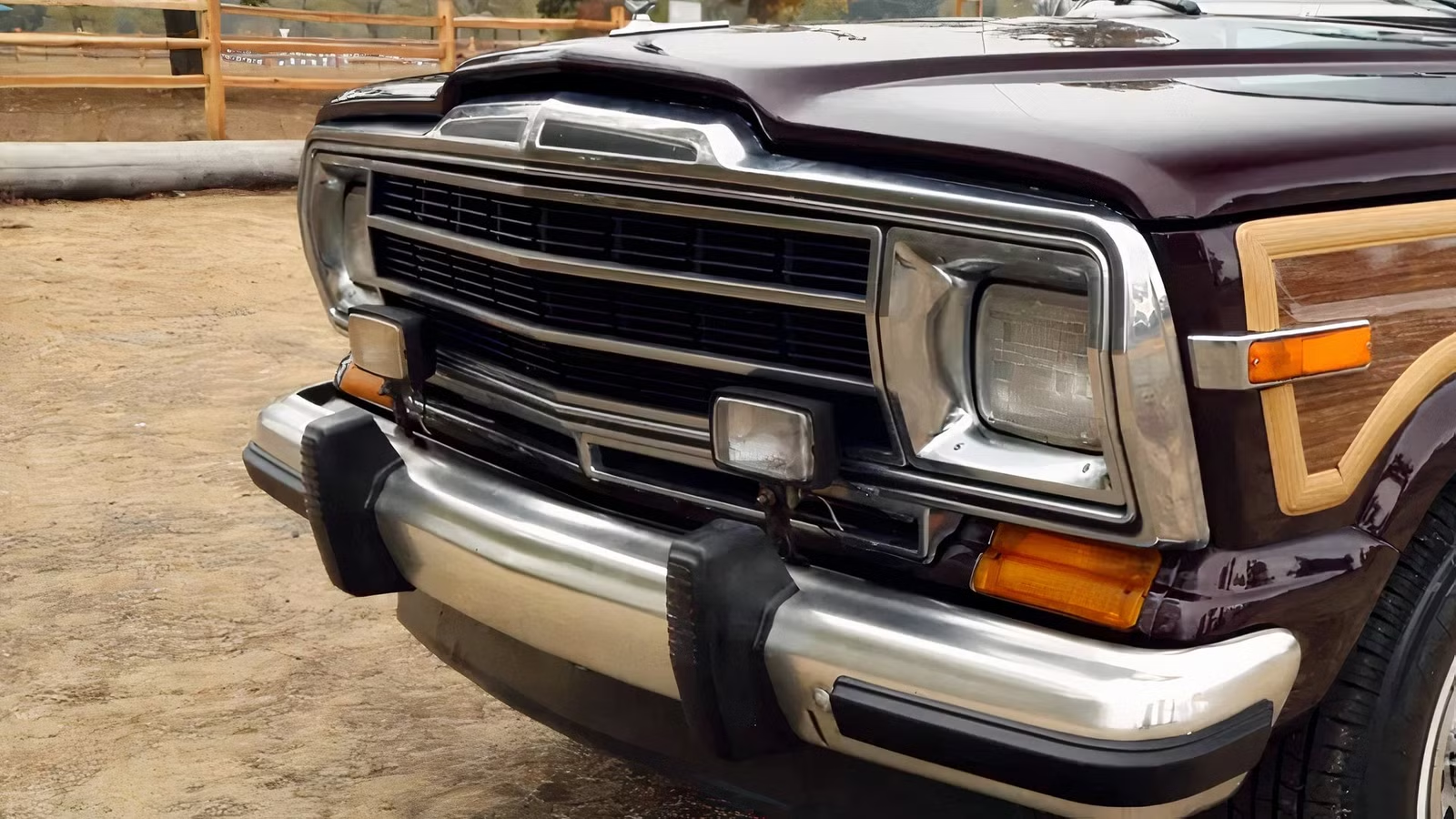
If you pop the hood of almost any modern vehicle, you are bound to look at a marvel of modern engineering. Today’s engines are highly sophisticated, with the widespread use of direct injection, variable valve timing, twin-scroll turbochargers, and complex hybrid systems, all made to improve performance, fuel economy, and still comply with stringent emissions. However, all of this comes with a catch: They are not as reliable as they age, and a minor issue can sometimes affect an entire system, leading to a big repair bill.

But it wasn’t always this way. Decades ago, the automotive world operated differently. Cars were simple, but the parts they were built with were simply over-engineered to last for decades. We talk about the bulletproof JDM engines, but America also had its own engine that was built to last. This engine was based on an architecture from the 70s, but flat-out refused to die and powered a generation of rugged SUVs. Decades after its inception, its foundational layout is actively reshaping the luxury and performance cars hitting the market today.
Why Most American Inline-Sixes Didn’t Survive The Modern Era
To understand the sheer defiance of this specific engine, you have to look at the landscape of the late 1970s and 1980s. For decades, the inline-six (or straight-six) engine was the literal backbone of American automotive transport. Ford had its 240 and 300 cubic-inch straight-sixes, General Motors relied heavily on its trusty 250, and Chrysler’s “Slant-Six” gained an almost mythical status for its ruggedness. These engines were loved because they were simple, cheap to manufacture, and inherently balanced. They also had a long lifespan and were used in many applications.

However, as the car market shifted toward smaller front-wheel-drive cars, the straight-six faced a packaging problem. An inline-six is long and requires a long engine bay, which defeats the purpose of these smaller cars. Detroit automakers quickly realized that the compact V6 engine was the best option. A V6 could be crammed into the engine bay of a compact sedan, a minivan, or a small SUV with ease. One by one, the traditional American straight-sixes were systematically phased out, abandoned in favor of the more compact V6.
They Traded Reliability For Efficiency

The death blow for the classic straight-six wasn’t just physical size but also its weight. There was an industry-wide pivot toward making everything lightweight. The late 1980s and 1990s also brought aggressive corporate average fuel economy (CAFE) standards and tighter tailpipe emissions regulations. Domestic automakers could no longer justify putting 500-pound, cast-iron chunks of industrial machinery under the hood of regular vehicles. To lose weight and eke out marginal fuel economy gains, the industry rushed into the development of aluminum-block, overhead-cam V6 designs. Unfortunately, this transition often sacrificed long-term durability.
These early-generation aluminum engines were plagued by delicate head gaskets, complex multi-valve timing setups, and tighter thermal tolerances. If a modern aluminum V6 overheats even once, the head could warp and ruin the engine. The old cast-iron blocks, by contrast, could swallow a bad water pump, run dangerously low on coolant, boil over, cool back down, and happily drive to work the next morning. But by the mid-1990s, almost every major domestic manufacturer had traded that unyielding, heavy-duty durability for the packaging convenience and marginal efficiency of the V6. Except for one company.
10 Most Durable Inline-Six Engines Ever Built
Refined, reliable, and powerful, these inline-six engines hold a special place in enthusiasts’ hearts.
AMC Accidentally Created An Engine That Survived A Corporate Takeover

American Motors Corporation (AMC) was always the scrappy underdog of the American auto industry. Operating with a fraction of the budget of GM, Ford, or Chrysler, AMC had to be incredibly resourceful. They couldn’t afford to develop entirely new engines every decade, so they perfected what they already had. By the mid-1980s, AMC was in a dire financial situation, but it had a saving grace: the Jeep brand. In 1987, Chrysler CEO Lee Iacocca orchestrated the acquisition of AMC, primarily to get his hands on the highly profitable Jeep lineup and the revolutionary, unibody Jeep Cherokee XJ.
When Chrysler executives took control of AMC, they fully intended to clean house. Corporate takeovers usually result in the immediate termination of old and redundant products. Chrysler already had its own successful engine families, including a brand-new 3.3-liter V6 under development. The AMC straight-six should have been dumped, but it wasn’t. Its survival wasn’t a matter of sentiment or preservation; it was earned on the merits of sheer engineering brilliance that Chrysler simply could not replace or replicate.
The 258 Cubic-Inch Inline-Six Was Worth Saving

AMC’s 258 cubic-inch (4.2-liter) inline-six had been around since 1971 and was a true mechanical workhorse. It was immensely strong, featuring a heavy cast-iron block and cylinder head, and a massive seven-main-bearing crankshaft that made the lower end virtually indestructible. While the 258 was legendary for its low-end torque and bulletproof nature, by the mid-80s, the carbureted engine was desperately lacking in power and refinement. They needed a modern powerplant for their revolutionary Cherokee XJ, but AMC engineers didn’t throw away the 258. Instead, they used its robust architecture as a canvas to build a new engine.
Led by engineer Chuck Mashinter, the new engine was bigger, shortened the stroke slightly to make it rev more freely, and had an entirely new cylinder head. Crucially, they ditched the carburetor and designed an advanced electronic fuel injection system. The result was a new inline-six in 1984 that was developed in just 26 months. When Chrysler took over in 1987, they quickly realized that this “old” AMC motor completely outclassed their own engineering projects in terms of pure low-end truck-like torque and structural rigidity.

These Forgotten Six-Cylinder Engines Make Modern Motors Look Tiny
From Oldsmobile’s absurd 11.6L straight-six to Hudson’s NASCAR-built 308, these historic giants prove displacement once ruled the road.
The AMC Inline Six That Chrysler Couldn’t Kill

The AMC 4.0-liter inline-six debuted in 1987, producing an impressive 173 horsepower and 220 lb-ft of torque. To put that in perspective, Chevrolet’s larger 4.3-liter V6 made around 160 hp at the time. More importantly, the 4.0-liter made its peak torque very low in the RPM range, making it the perfect engine for off-roading, towing, and crawling over obstacles.
Chrysler kept the engine in production from 1987 all the way until 2006. Think about that for a second: a corporate powerhouse like Chrysler retained an engine from a defunct, bankrupt competitor for nearly two decades. They even invested millions into updating it over the years, upgrading the fuel injection to their own proprietary Mopar sequential system in 1991 (the “High Output” version), which now made 190 hp and 225 lb-ft of torque. Further refinements were also made for better noise, vibration, and harshness (NVH) mitigation in 1996.
It Powered Jeeps For Generations And Outlasted Its Rivals

The 4.0-liter became the literal heart and soul of the Jeep brand during its golden era. It was the definitive engine option for a staggering list of legendary off-roaders:
- Jeep Cherokee (XJ): The boxy, iconic SUV that arguably kickstarted the modern compact SUV craze.
- Jeep Wrangler (YJ & TJ): The definitive open-air off-roaders; a 4.0-liter Wrangler TJ is still one of the most sought-after 4x4s on the used market.
- Jeep Grand Cherokee (ZJ & WJ): A larger, more premium family cruiser.
- Jeep Comanche (MJ): AMC’s sleek, unibody pickup truck.
While the 4.0-liter was busy building the Jeep legend, its competitors were dropping like flies. Ford retired its classic 300 inline-six in 1996, moving exclusively to V6 and V8 platforms. Chrysler tried multiple times to phase out the 4.0-liter in favor of their own newer overhead-cam engines, such as the 3.7-liter PowerTech V6. Yet enthusiasts and fleet buyers continuously demanded the old iron-block straight-six because they knew it could take a level of abuse that would send newer V6 engines straight to the scrapyard.

See Why The Hurricane Straight-Six Could Be The Start Of A New Era Of Muscle Cars
With up to 1000 hp possible, the engine could even spawn a new Hellcat variant in the future, as a new video suggests that this is only the beginning.
This Inline-Six Was Extremely Reliable

What exactly makes the AMC 4.0-liter so incredibly reliable? It comes down to its simplicity and robust build quality. Let’s get a little technical here: Because it is a non-interference engine, if the heavy-duty timing chain ever stretches or skips (which is incredibly rare), the pistons will not strike the valves, meaning a timing failure won’t instantly destroy the engine. The cast-iron block means it handles heat exceptionally well, and the engine’s low-revving nature means components undergo far less friction and wear over time than a high-strung V6.
The forums are filled with verified stories of how these engines can hit a Million Miles or even 500,000-mile versions with simple regular service. It became a favorite for government fleets, park rangers, and rural mail carriers. These vehicles would idle endlessly, face extreme weather, and severe neglect, yet they just kept running.
It Was Easy To Own And Maintain
Beyond its refusal to break, the AMC 4.0-liter is celebrated because it is very easy to work on. The engine bay of a 4.0-liter Jeep Cherokee or Wrangler is spacious. Everything is easily accessible: the spark plugs sit in a perfect line right at the top of the engine, and the alternator is right at the front. According to data from reports from RepairPal, the annual maintenance baseline for a Jeep Cherokee sits at an incredibly manageable $520 per year, which could even be way less if you’re handy.
Parts are widely available, dirt cheap, and interchangeable across decades of vehicle models. A water pump or an alternator for a 4.0-liter can be bought at almost any auto parts store in North America for less than a hundred dollars, and a basic socket set is often all that is required to perform the swap in an afternoon. It is the ultimate DIY-friendly engine.

10 Inline-Six Engines That Make V8s Seem Underpowered
These are the top ten I-6 engines that make V8 muscle car owners jealous.
Why This Engine Layout Matters More Today

In 2006, the final AMC-designed 4.0-liter rolled off the production line, dropped into a Jeep Wrangler TJ. Tightening environmental regulations finally caught up with it; its design simply couldn’t meet modern, ultra-low emissions standards. It seemed like the era of the American straight-six was dead and buried, outside of a few European manufacturers like BMW.
But if you look at the automotive market today, there’s a shocking plot twist. The inline-six layout is experiencing a massive comeback. Manufacturers across the globe are abandoning the V6 architecture and returning to the straight-six.
- Stellantis (Jeep/Ram’s parent company): Recently debuted the twin-turbocharged “Hurricane” inline-six to replace their legendary Hemi V8s.
- General Motors: Developed the highly successful 3.0-liter Duramax inline-six turbo-diesel for their full-size trucks.
- Mazda: Top-tier luxury models use an inline-six.
- Mercedes-Benz & Land Rover: Both have completely replaced their older V6 engine families with silky-smooth, mild-hybrid inline-six options.
The reason for this modern comeback mirrors exactly why AMC stuck with the layout decades ago: perfect mechanical balance, smooth power delivery, and space on the sides of the engine block, which modern engineers now use to mount massive turbochargers and hybrid emissions equipment.
The Return Of The Inline-Six Makes AMC’s Legacy Impossible To Ignore

As modern automotive giants spend billions of dollars marketing their “revolutionary” new straight-six engines, the legacy of American Motors Corporation becomes impossible to ignore. AMC proved to the skeptical automotive industry that the inline-six wasn’t just a compromised layout meant for industrial tractors or cheap base-model sedans. They proved that a properly developed straight-six could serve as a world-class benchmark for low-end torque, durability, and versatility.
AMC as a corporate entity has been gone for nearly forty years, dissolved into the pages of automotive history. Yet, every time a modern luxury SUV or a heavy-duty pickup truck has a modern straight-six under the hood, it pays silent homage to the die-hard legacy of AMC’s engine. They built a cast-iron 4.0-liter powerhouse that didn’t just survive its own era; it defined the very blueprint that the rest of the world is still trying to replicate.
Sources: Stellantis, Dodge, Chrysler, AMC, Repairpal.

Related posts






Latest Post


No Comments