
The 800-HP Ford Supercar You’ll Never Get to Drive
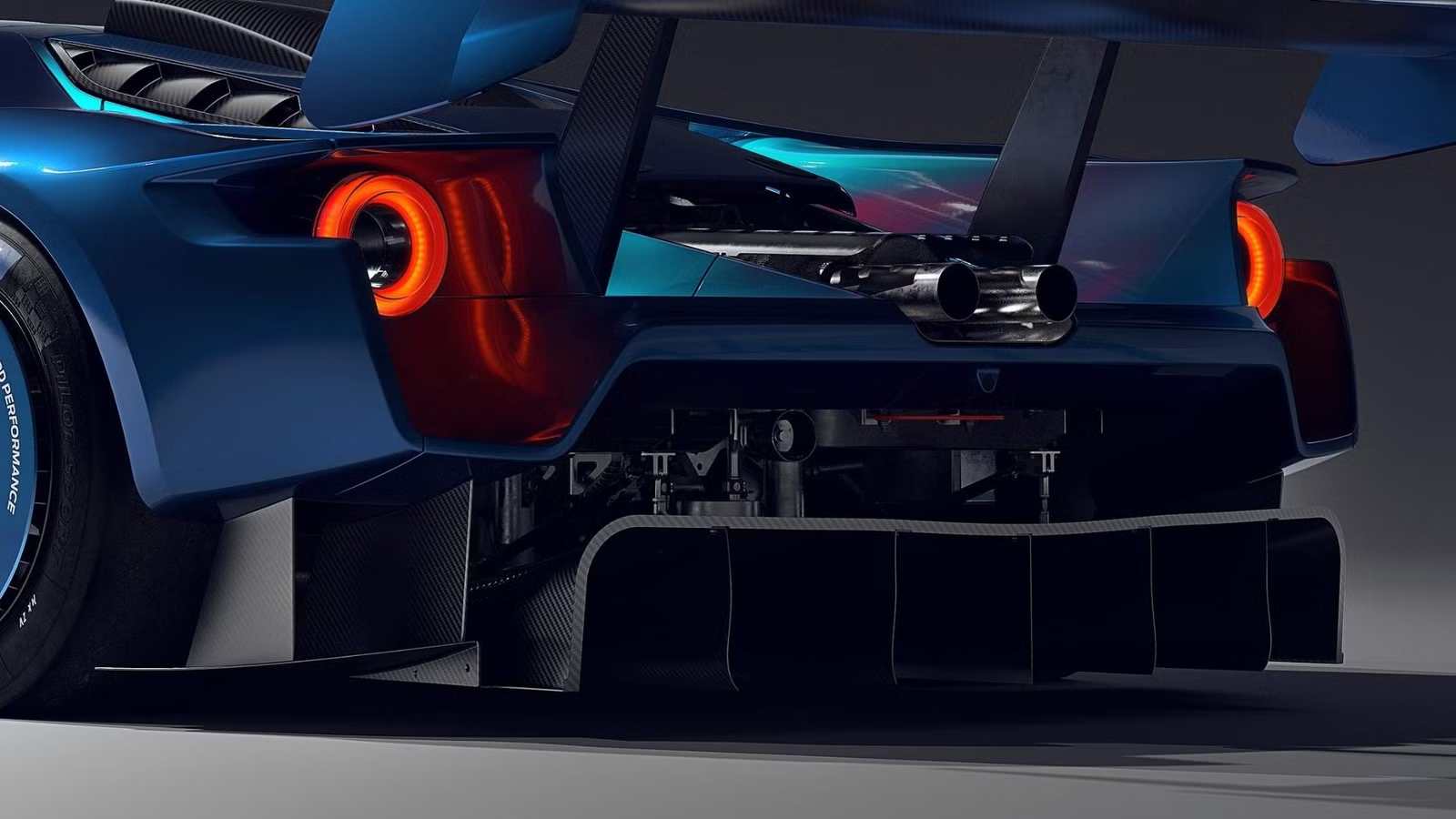
The Ford GT Mk IV is not a farewell edition with some stripes and a plaque. It’s a track-only, 800-horsepower supercar that Ford and Multimatic deliberately engineered past the point of road-legal compliance, ending the GT nameplate’s third generation with the most hardcore version ever built instead of a softened send-off.

The Mk IV ditches bumper-height rules, emissions requirements, and every other public-road regulation that shaped the second-generation GT. What’s left is a 67-unit, $1.7 million machine built purely to go fast, with no pretense of ever touching a public street.
What Ford Sacrificed To Build The Ultimate GT
The second-generation Ford GT, built from 2016 to 2022, still had to answer to crash standards, emissions limits, and ride-height rules to carry a license plate. The Mk IV answers to none of it. Ford and Multimatic threw out road compliance entirely in favor of a carbon-fiber “Long Tail” body that’s longer, wider, and lower than the road car’s, with a front splitter and rear diffuser shaped purely around airflow rather than pedestrian-safety or bumper regulations.

That tradeoff is the whole point. Mark Rushbrook, Ford Performance’s global director, said the original 1967 GT Mk IV “held nothing back for max track performance,” and the new one follows the same brief. Free of road-legal constraints, the aero package generates 2,400 pounds of downforce at 150 mph, climbing to 4,500 pounds at 200 mph. No street-legal GT, and arguably no street-legal production car, gets close to that number.
A Bespoke Twin-Turbo EcoBoost That Beats The Road Car’s Engine

The Mk IV isn’t just running the same 3.8-liter twin-turbo EcoBoost V6 from the road-going GT with a tune. It’s a unique powertrain, with larger turbochargers and reworked internals, that pushes output past 800 horsepower. Power routes through a sequential racing transmission and a limited-slip differential, hardware lifted straight from competition use rather than adapted for street driveability.
Strip away the compromises a road car demands, and you get a chassis and powertrain combination that actually outperforms Ford’s own GT GTE race car, in part because the Mk IV isn’t bound by the same racing regulations that cap what a homologated GTE entry can do. It’s a strange position for any manufacturer: building something more capable than the race car it’s based on, specifically because nobody’s checking a rulebook.
The Lightest GT Ever, Built For 67 Owners Only

Ford says the Mk IV is the lightest Ford GT built, undercutting even the featherweight GT Carbon Edition, thanks to the new carbon body and the total absence of road-car equipment like sound deadening, airbags, and emissions hardware. Every pound removed went straight back into improving power-to-weight ratio.
Production is capped at 67 units, a direct nod to Ford GT40 MkIV’s overall victory at the 1967 24 Hours of Le Mans, with each car priced at $1.7 million. Ford’s now-expired no-resale clause on its track-only models means early buyers could flip these for a serious premium once theirs arrives. For a company that built its GT reputation on beating Ferrari at its own game six decades ago, ending the modern GT era with a car too extreme for its own road rules feels like the only fitting way to close the book.

Related posts





Latest Post


No Comments