
The Velour-Lined Mercury Hiding Ford’s Last Cobra Jet 351 That Only 2,793 Buyers Ordered
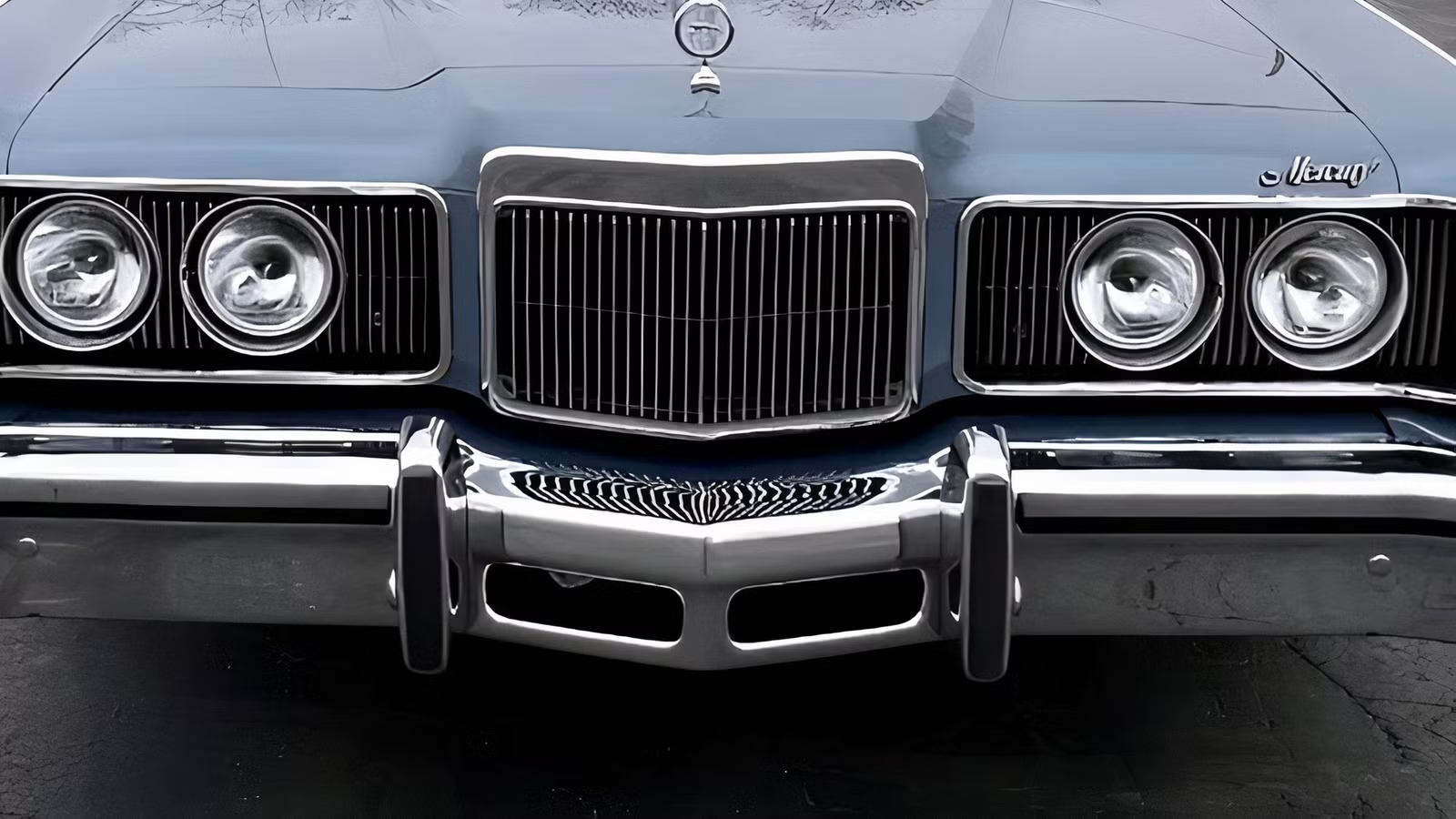
What happens when you take a perfectly ordinary luxury cruiser, line it with as much wood and velour as you could possibly shove inside it, anoint its exterior with lots of chrome, and shove the final variant of a world-class muscle car engine under its hood? Well, you get a Mercury boardroom in the year 1974. At that time, the first muscle car war was in the midst of meeting its tragic end, but that didn’t mean there weren’t some good times to be had right before judgment day came.
The Cougar: Mercury’s Mustang, Until it Wasn’t

For a brand that prided itself on being the middleman between Ford and Lincoln, Mercury’s Cougar two-door luxury car started at one end of the spectrum, ultimately winding up on the exact opposite. Its first generation, launched in 1967, really did look like an upscale version of the Ford Mustang that underpinned it. When you think about it, the Mustang itself was derived from the smaller Falcon, which shows you exactly how “original” most of Ford’s lineup really was in the era.
These early Cougars were the first Mercs explicitly styled like European sports coupes; they were also the first Mercs with hidden headlights, the first to win Car of the Year for a major legacy automotive publication, and the first FoMoCo product of any kind to have an electric sunroof. They were also some of the most famous cars to use the fire breathing 390, 427, and 428-cubic-inch FE big block V8s outside of the Mustang and the Torino. By all accounts, Gen-I Cougars were certified classics on the same level as its Mustang counterparts, but its second generation was a very different beast indeed.
Visually, it leaned far more into the luxury cruiser angle, directly marketed as an alternative to GM A-body luxury coupes like the Oldsmobile Cutlass Supreme. Still sporting the option of a 429-cubic-inch motor, this time in a 370-horsepower Super Cobra Jet form, you could also have one of two 351-cubic-inch plants, one based on the torquey Windsor architecture, and the other a rev-happy Cleveland motor. Far cushier and softer than Gen-I Cougars, Gen-IIs served their purpose, and even had a certified banger in the form of a Cleveland-powered Cougar XR-7. Yet, as far as changes go, more was soon to come in 1974, including the option of Ford’s last great performance engine before the dark times.

The 351 Q-code Cobra Jet: One Last Hurrah for Ford Muscle Engines

Alright, first things first, the transition from gross horsepower, measured outside the car on a dyno stand with open headers, to net horsepower, inside the car with accessories mounted, does skew numbers a bit. New emissions and smog control equipment didn’t help matters either. Seriously, those early EGR valves and smog pumps might as well have been squeezing an engine by the throat in those days. And yet, that didn’t stop the Cleveland-based 351 Cobra Jet V8 from sticking around just a little bit longer.
Especially in special order Q-code form, 351 Cobra Jets of these years were some of the last great muscle car engines produced by the Big 3 for decades. Using lower compression than typical, Q-code builds used true 4V (4-venturi) open-chamber cylinder heads with huge intake ports to help the engine breathe. It meant that, a bit like Mopar HEMIs of the period, Q-code Cobra Jets could really breathe high up in the rev range. Far more than a low-end torque monster, the power band in these Q-code Cobra Jets was far more usable across the rev range. Of course, these motors weren’t immune from being choked half to death by primitive emissions equipment. In its most powerful form, they produced only 246 net hp.
For context, some modern cars that make roughly that same amount of power include the Toyota Camry, the Subaru Outback, and a high-trim Hyundai Kona. Not exactly vehicles that inspire a “top of the line performance car” vibe by any stretch. Still, a Q-code Cobra Jet 351 was among the most powerful American V8s left standing by 1974. Not that it would last for very long in this form, but just long enough for one last, truly wonderful swan song.
1974 Mercury Cougar XR-7: Exit Stage Right, At 5,000 RPM

The Cougar underwent a profound change in 1974. Gone were its unibody Mustang underpinnings; in their place was a body-on-frame architecture borrowed from the Ford Torino. Ostensibly, this signaled the Cougar’s formal exit from the muscle car space. Or at least, it would have, had it not been for the choice of engine available to it. The chassis was longer, as was the 215.5-inch body sitting on top of it. The front grille was petite and regal-looking, and the Landau vinyl roof and rear opera windows almost looked Lincoln-like in appearance.
All these little things added up to make the Cougar XR-7 Mercury’s flagship luxury vehicle for 1974. Under the hood, the choice of a 335-series 400-cubic-inch V8 or a 460-cubic-inch V8 from the 385-series was the two most popular engine choices. Given how large the 2.2-ton Cougar was, that stands to reason. Even so, the Q-code 351 Cobra Jet was still there, practically hidden under custom order codes and dealership handshake deals that were hardly ever noticed by people not actively seeking it out. Simply put, people usually saw how massive the new Cougar was, and immediately figured the available big blocks were the best choice.
It’s the likely reason why, of the 91,670 units of the Cougar XR-7 sold in 1974, only 2,793 of them came equipped with the 4V 351 Cobra Jet Q-code motor. That works out to roughly three percent of the entire production volume for that year, an almost inconsequential figure. As it happens, that small run turned out to be the most valuable, the most desirable, and the most sought-after Cougar XR-7s sold that fateful model year. Depending on who you talk to, it was the year the first great muscle car renaissance came to its abrupt, sad, and mildly pathetic end. After a decade or so of chasing cubic displacement and raw, gross horsepower like it was everything that mattered, the way it ended was equally and oppositely mediocre.
Rare, Valuable, and a True Muscle Car Unicorn

Because the first and second-generation Cougars take up so much of the limelight in the online auction space, it’s genuinely rare to see a third-generation Cougar XR-7 roll past the auction block these days. Finding even a non Q-code 351-powered example is a real treat in 2026. Doubly so if it’s optioned out with the performance rear axle and Ford’s Traction-Lok limited-slip differential. In good condition with just a few chips and scratches on all-original paint, these Cougar XR-7s, without a Q-code 351, can still fetch decent money online. That includes $18,900 for one example we found, and that was a fairly ordinary one. If you’re lucky enough to find a Q-code, figure on paying at least double that, if not more, if it’s in spectacular or fully-restored condition. It’ll never be on the same level as Cougars before it, but it is a piece of history nevertheless, and there’s simply no debating it.
Source: Worldwide Vintage Autos, The Cougar Club of America

Related posts

Latest Post


No Comments