
The 5.3L Vortec: Chevy’s Longest-Lasting Pickup Truck Engine Ever
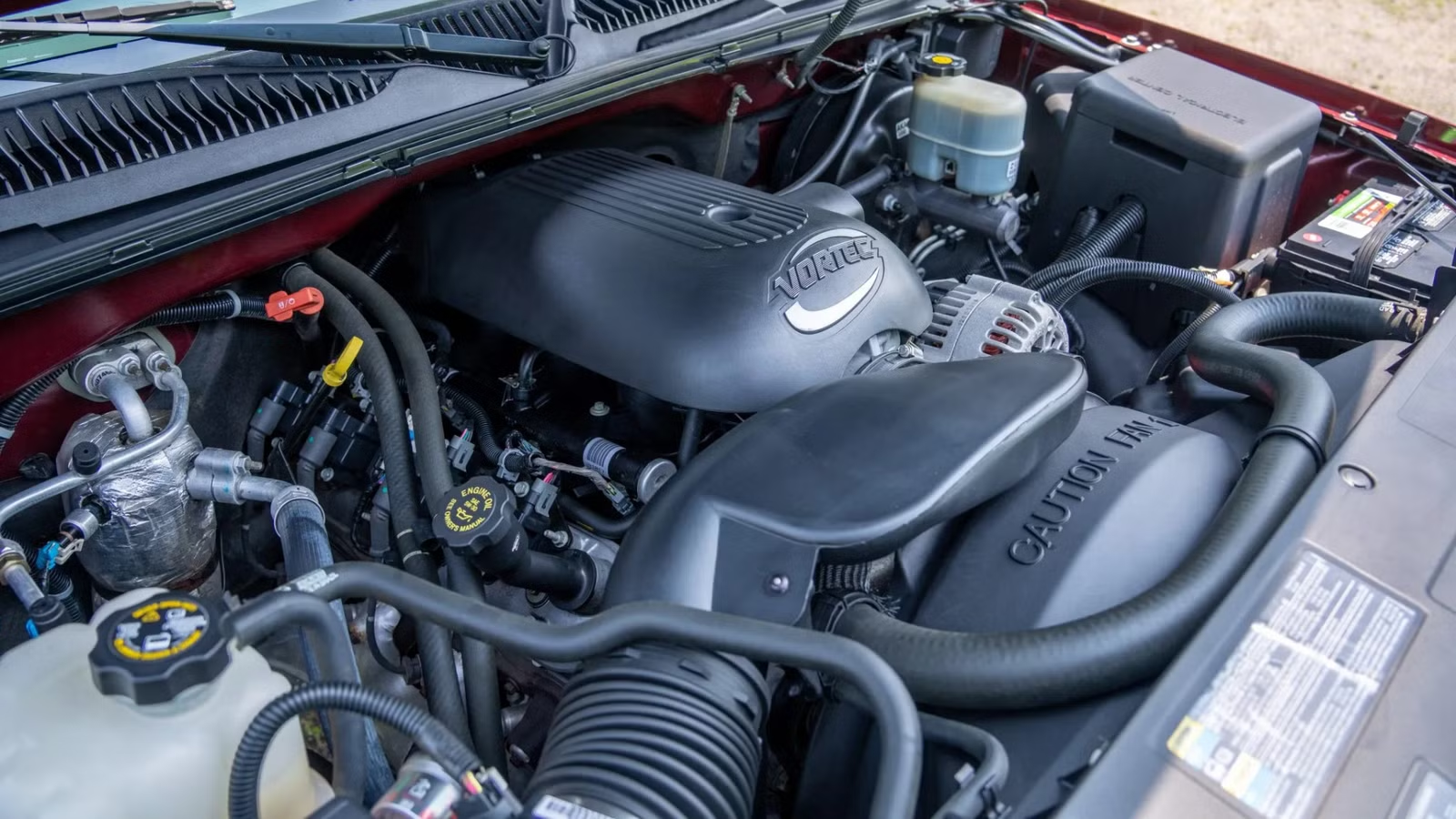
Ask any long-haul trucker or fleet manager which engine they’d trust with a million miles, and the answer comes back the same way it always has: a Chevy V8. Pickup truck engines come and go with every product cycle, but a rare few transcend their era — becoming the kind of hardware that outlasts the trucks built around them, the owners who bought them, and sometimes even the roads they were driven on. These are the engines that don’t just perform; they endure.

They weren’t built to win stoplight drag races or pack the flashiest tech. Instead, they were designed with a simpler mission in mind: get the job done, every single day, for as long as it takes. And one Chevy engine, more than any other, has become the benchmark for that kind of durability. Read on, because you’re about to meet Chevy’s longest-lasting truck engine.
Meet Chevy’s Longest Lasting Engine: The 5.3L Vortec V8
When Chevrolet introduced the 5.3L Vortec V8 in the late 1990s, the goal wasn’t to build the flashiest engine on the market. The aim was something more meaningful: an engine that could do everything a truck owner needed, and do it for decades.

Part of GM’s new LS-based small-block family, the 5.3L Vortec first appeared in the 1999 Chevy Silverado 1500. According to Hemmings, it quickly became the backbone of GM’s pickup and SUV lineup. Over the years, it powered everything from Tahoes and Suburbans to Avalanches and even police interceptors.
Chevrolet 5.3L Vortec Specs
|
Displacement |
5.3L (325 cid) |
|
Production |
1999-2007 |
|
Cylinder Block Material |
Cast Iron (LM7/L59) Aluminum (LM4/L33) |
|
Cylinder Head Material |
Aluminum |
|
Fuel Type |
Gasoline |
|
Fuel System |
Port Fuel Injection |
|
Valvetrain Layout |
OHV |
|
Compression Ratio |
9.5:1 (LM7/L59) 9.9:1 (L33 HO) |
|
Horsepower Output |
275-325 hp |
|
Torque Output |
315-350 lb-ft |

The 5.3L Vortec was built for balance. Its cast-iron block versions could handle hard towing and hauling, while the aluminum block versions saved weight for SUVs and half-tons. Across multiple generations — including LM7, L59, LM4, L33, LY5, LC9, and others — the 5.3L Vortec delivered between roughly 275 and 325 hp and between approximately 315 and 350 lb-ft of torque.
More importantly, it did this reliably. Chevy produced millions of these engines between 1999 and 2014, and they became some of the most common V8s on American roads. What makes the 5.3L Vortec so impressive isn’t just its output, though — it’s its endurance. This engine proved that you didn’t need exotic tech or over-engineered complexity to build something bulletproof.

According to a study by iSeeCars, the average lifespan of a 2000 Chevrolet Suburban — one of the most popular 5.3L Vortec applications — is 168,130 miles. However, Motor Reviewer notes that with regular oil changes and basic maintenance, it’s not uncommon to see a Silverado or Suburban rack up 300,000 miles and, in some cases, cross the million-mile mark. It’s this kind of durability that turned the 5.3L Vortec from a workhorse into a legend, and why so many truck owners still swear by it today.
A Look At The Specs And Performance Of The 5.3L Vortec V8

The Chevy 5.3L Vortec didn’t stay frozen in time. Over its 15-year production run, it went through two distinct generations, each refining the formula while holding fast to what made the engine a legend: durability and versatility.
The first-generation 5.3L Vortec, designated Gen III as the third generation in Chevy’s small-block engine lineage, debuted with the Silverado 1500 in 1999. It carried the DNA of GM’s LS small-block design while keeping things straightforward with cast-iron blocks and aluminum heads. Over time, variants like the L59 with flex-fuel capability and the high-output aluminum-block L33 demonstrated just how flexible the platform could be.
Gen III 5.3L Vortec (1999-2007)
|
RPO Code |
Production Years |
Block |
Horsepower |
Torque |
|
LM7 |
1999-2007 |
Iron |
270-295 hp |
315-335 lb-ft |
|
L59 |
2002-2007 |
Iron (Flex-Fuel) |
285-295 hp |
325-335 lb-ft |
|
LM4 |
2003-2005 |
Aluminum |
285 hp |
325 lb-ft |
|
L33 (HO) |
2005-2007 |
Aluminum (High-Output) |
310 hp |
335 lb-ft |
In 2007, the second-generation 5.3L Vortec arrived as the Gen IV. GM equipped it with updated electronics, active fuel management with cylinder deactivation, and variable valve timing on select versions. These updates nudged horsepower and torque upward, but the core reliability stayed the same. Whether you bought a Tahoe, Suburban, Avalanche, or Silverado, the 5.3L remained the workhorse V8 at the heart of Chevy’s lineup.
Gen IV 5.3L Vortec (2007-2014)
|
RPO Code |
Production Years |
Block |
Horsepower |
Torque |
|
LY5 |
2007-2009 |
Iron |
320 hp |
340 lb-ft |
|
LC9 |
2007-2014 |
Aluminum (Flex-Fuel) |
315-320 hp |
335 lb-ft |
|
LH6 |
2005-2009 |
Aluminum |
300-315 hp |
335 lb-ft |
|
LMG |
2007-2014 |
Iron (Flex-Fuel) |
315-320 hp |
335 lb-ft |
Taken together, these engines defined Chevy trucks for nearly two decades. No matter the block material or fuel setup, every 5.3L Vortec was built around the same philosophy: enough power to get the job done, without sacrificing the long-life reliability that turned the 5.3L Vortec into one of the most respected truck engines ever built.
How The 5.3L Vortec Became A High-Mileage Hero

The real measure of an engine’s greatness isn’t found in glossy brochures. What truly turns an engine into a legend is its ability to keep racking up miles long after the new-car smell is gone. Few powerplants have proven their staying power like the 5.3L Vortec, and the stories behind some of these high-mileage Chevy trucks have cemented its reputation as a road-going hero.

Take Tommy Bush’s 2007 GMC Sierra 1500, for example. According to a GM-Trucks forum post where he shared his story, Bush covered 17 states and logged 160,000 to 170,000 miles every year while working as a parts coordinator who practically lived behind the wheel. By the time his odometer maxed out at 999,999, he’d already crossed the million-mile mark. While the original 5.3L Vortec was swapped out at 409,000 miles due to a bad valve, his Sierra proved just how durable and serviceable the Vortec platform really is — going on to cover another 600,000 miles on its second 5.3L engine.

An even more remarkable story involves a 2002 Chevy Avalanche. The truck, driven by a World War II veteran named Fred, reportedly racked up over 703,000 miles with its original 5.3L Vortec still under the hood. According to the High Mile Club, the truck accomplished this without ever needing new spark plugs or wiring replacement. Fred, who regularly made long road trips between Maryland and Georgia, kept his Avalanche running with nothing more than basic maintenance and routine oil changes. While stories like these may sound unbelievable, they’re part of a growing pattern of Chevy trucks pushing far past the 200,000-mile mark.
These trucks were never supposed to be trailer queens or pampered collectibles. They are simply daily drivers that keep showing up, mile after mile — proof that the 5.3L Vortec wasn’t just built for performance, but engineered for the long haul, earning its place as one of the most respected high-mileage engines in Chevrolet history.
Other Chevrolet Engines That Simply Refuse To Die
While the 5.3L Vortec V8 has proven itself as Chevy’s longest-lasting engine, it isn’t the only powerplant in the lineup that simply refuses to call it quits. Two other legendary Chevy engines that deserve recognition are the 6.0L Vortec V8 and the 6.6L Duramax Diesel V8.
The 6.0L Vortec V8

If the 5.3L was Chevy’s balanced workhorse, the 6.0L Vortec was its heavy-duty cousin. Introduced in the early 2000s as part of GM’s LS-based small-block family, this engine was built for big jobs.
Found in 2500 and 3500 series Silverados, Suburbans, and GMC Sierras, it offered more displacement and torque for serious towing and hauling. Depending on the variant — LQ4, LQ9, or LY6 — the 6.0L produced between 300 and 360 horsepower, with torque climbing as high as 380 lb-ft.
According to Motor Reviewer, these engines often rack up over 300,000 miles in work trucks that spend their lives under load, making them a favorite among fleets and heavy-use owners.
The 6.6L Duramax Diesel V8

When GM needed a diesel that could go toe-to-toe with Ford’s Power Stroke and Ram’s Cummins, the 6.6L Duramax was the answer. First launched in 2001 and co-developed with Isuzu, it quickly built a reputation for stump-pulling torque and exceptional longevity.
Used in Silverado HD and Sierra HD models, it has been offered in multiple versions, including LB7, LLY, LBZ, LMM, LML, and L5P. According to GM Powered Solutions, output has grown from 300 hp and 520 lb-ft of torque in early production to over 400 hp and more than 900 lb-ft in current form.
Many Duramax-powered trucks have surpassed 500,000 miles, with a few well-documented cases clearing the million-mile mark. It remains one of Chevy’s most iconic long-haul engines.
In the end, the 5.3L Vortec proves why Chevy engines have earned their reputation for lasting a lifetime. From high-mileage legends to everyday workhorses, the 5.3L Vortec stands as a reminder that true greatness isn’t flashy — it’s an engine that keeps going long after the odometer gives up.
Sources: ChevyTrucks.org, GM Powered Solutions, GM-Trucks, Hemmings, High Mile Club, iSeeCars, MotorReviewer

Related posts


Latest Post


No Comments