
The Forgotten Pontiac That Mixed Trans Am Power With Grand Prix Comfort
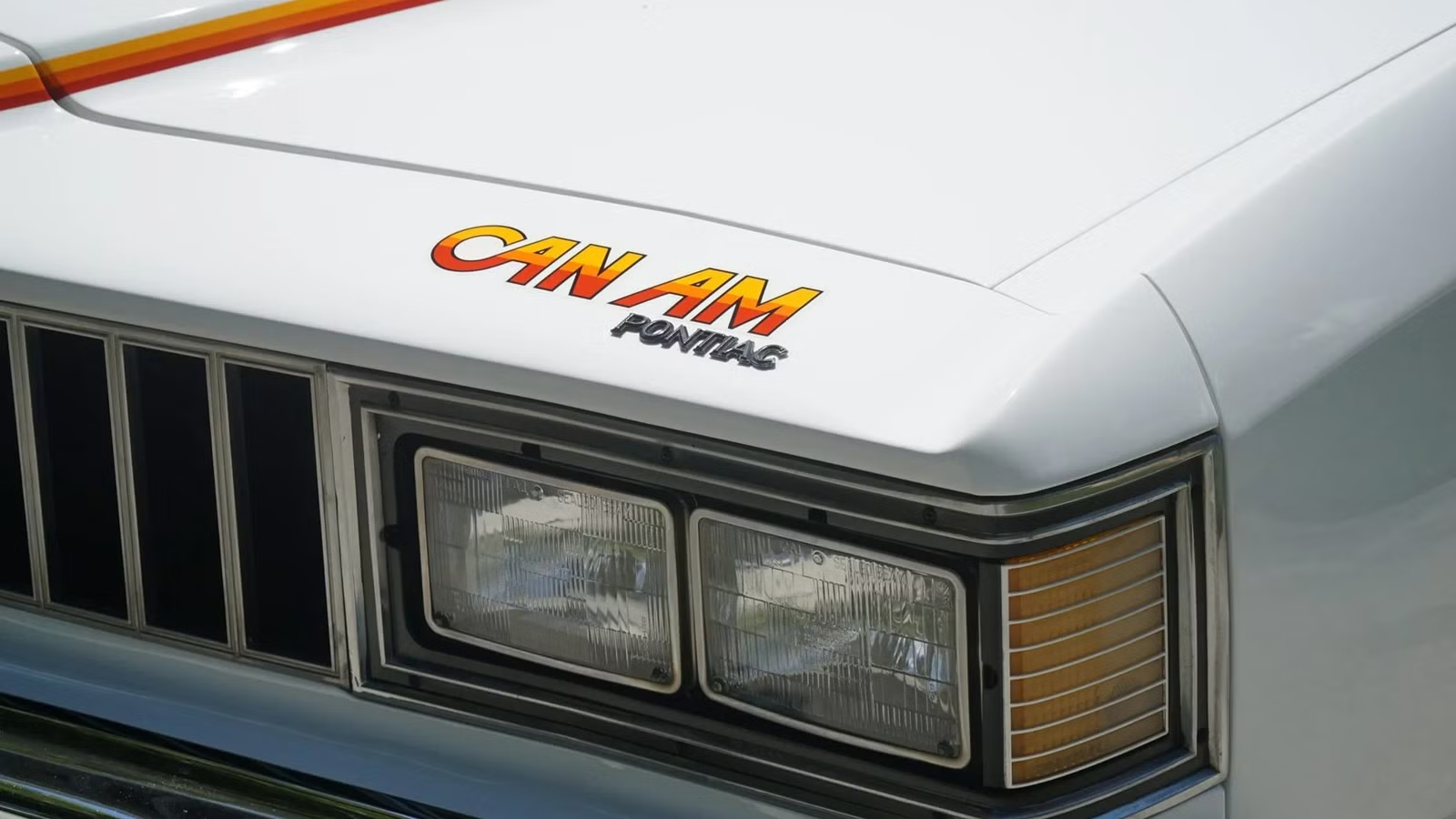
By 1977, the mighty American V8 and its power had been curbed by federal emissions regulations, increasing insurance premiums on high-displacement vehicles. Compounded by the oil-crisis hangover, the American performance scene was in a chokehold. Detroit was forced to develop performance packages with decal kits and visual theater rather than real performance under the hood. Behind closed doors in Michigan, a group of rebels refused to let American muscle die a quiet death. They executed a plan to take two icons, mash them together, and create a completely new segment of American muscle.
The 1970s Performance Compromise

In the golden era of American muscle, buying a car was a straightforward, uncompromising choice. You paid for straight-up performance, and that’s what you got. The ride quality was harsh, and there was no noise insulation. The muscle cars of the time were built purely for performance, with no thought given to fuel economy.
By the late 1970s, the muscle car space was split into two extremes. On one side were the loud, aggressive, drag strip-ready street fighters like the Firebird Trans Am, with minimal interiors, stiff suspension, and a cramped cockpit.
On the other hand were the quiet, insulated luxury coupes with ultra-plush seating and woodgrain designs like the Grand Prix, but these cars had heavily detuned engines. For enthusiasts who wanted the best of both worlds — performance and luxury — there was nothing on offer, and any choice meant compromising on something.

Pontiac’s Parts Bin Special

Pontiac recognized this opportunity and decided to pull off a parts-bin special that would fit the purpose. Developing a new chassis from scratch was not realistically feasible, as it would have been too expensive to justify to the accountants. Pontiac engineers cleverly merged three distinct personalities into one using existing production lines.
They selected the mid-sized A-body LeMans Sport Coupe as their base, took the firepower and the shaker hood scoop from the Trans Am, and moved it over to the Grand Prix line to create a driver-focused luxury cabin layout.
Jim Wangers and the Secret Assembly Deal

Automotive marketer Jim Wangers spearheaded the idea; he had previously championed the original 1964 GTO package. Motortown Corporation was an automotive modification company in Michigan that worked closely with Jim Wangers to handle the final assembly. They outsourced the body modifications and graphics package to Motortown to save time and bypass internal corporate red tape, bringing the coupe to market as soon as possible. This concept gave birth to a new sub-segment of car called “Muscle Touring.”
The 1977 Pontiac Can Am

The result of this alliance was the 1977 Pontiac Can Am. It was exclusively finished in Cameo White with orange, yellow, and red tri-color graphics. The Can Am made an unmistakable visual statement. Underneath the hood, it got the firepower to match the show: the high-output W72 400-cubic-inch V8 engine.
It produced 200 horsepower and 325 lb-ft of torque, a respectable figure in an era when cars were struggling to reach 200 hp. It did 0 to 60 mph in 10 seconds flat and ran the quarter mile in 17 seconds at 84 mph, a respectable time for a grand sports car that offered room and luxury at the time. All this power was mated to a 3-speed TH400 automatic transmission that put the power down with ease.
Pontiac expected a niche audience and imagined only enthusiasts would show interest, so they greenlit a modest production run; as the car hit the market, demand exploded — according to historical production records, orders rapidly exceeded 10,000 reservation requests.
The Broken Tooling Scandal

Tragedy struck the assembly line when, around the 1,000 to 1,377 unit mark, the fiberglass mold used by MotorTown Corporation to form the Can-Am’s rear ducktail spoiler broke. Instead of waiting for a replacement mold to be fabricated, GM corporate made an unthinkable decision at the time.
They abruptly canceled the entire Can-Am program. Industry historians point out that the broken mold was just a convenient excuse. The real reason was that the Trans Am was widely successful following the pop culture fame it gained from the film Smokey and the Bandit; as parts were shared between those two cars, it created a shortage of V8s for the Trans Am.
At the same time, the Grand Prix was setting record sales numbers; parts were taken off it too to put on the Can-Am. The broken spoiler mold was used as an excuse to kill the Can-Am to prioritize higher margins from other cars.
High-Torque Muscle Wrapped in Luxury

Unlikethe typical car of that era, which relied heavily on cosmetic decals and visual appearance to suggest performance, the 1977 Can-Am was surprisingly quick and refined for long-distance highway driving. The W720 engine was engineered with real performance-focused hardware like 6X-4 high-compression cylinder heads, aggressive camshafts, and a specially calibrated 800-cfm Rochester Quadrajet four-barrel carburetor. Although the performance of every car was choked in this era, the Can-Am was one of the fastest cars of its segment.
The interior of the coupe felt completely different than the typical raw muscle machine you would find on the streets. The seats were plush Grand Prix buckets surrounded by a wrap-around dashboard finished in faux African mahogany wood grain. The instrument panel featured a Rally gauge package with an integrated clock; the cabin had thick acoustic carpeting throughout, and insulation blocked road noise at highway speeds.
To manage the 3,800-pound curb weight, Pontiac equipped the Can Am with its Radial Tuned Suspension (RTS) package; it featured heavy-duty front and rear anti-roll bars, firmer spring rates, variable-ratio power steering, and front disc brakes. These upgrades made the Can Am a stable and genuinely enjoyable car to drive, both in the corners and on the highway.
Pontiac’s Ultimate “What-If”

The 1977 Pontiac Can Am is one of Detroit’s greatest “what-if” stories. It proved that raw muscle and luxury could be combined to create a great automobile. This was years before the sports sedan and grand tourer were popularized with the concept of taking a big V8 and wrapping it in leather.
Less than 1,400 examples were built before the project was completely shut down. This makes the Can-Am an incredibly rare car on the classic market today. A true rebel of its power-choked era that stands out as an exception — a car that combined the soul of a race-ready street machine without compromising on comfort and luxury.
Source: Hemmings, Hagerty, Bring a Trailer, Pontiac

Related posts






Latest Post


No Comments