
The 425-HP Hemi Wagon America Never Officially Got To Drive
Apart from a light spattering of trucks and tanks between 1940 and 1945, the American automotive presence in Europe has been, let’s say, pretty light. Heck, there were times when American OEMs would buy European automakers just to get a taste of one of the juiciest car markets in the entire world. Still, occasionally, an American automaker, like Chrysler, will try to send one of its flagships overseas, probably just to see what happens.
Chrysler in Europe: A Complicated History

At one point, Chrysler was one of those American automakers that sent vehicles and equipment en masse to Europe during World War II. During the war, Chrysler manufactured everything from M3 Sherman tanks and B-29 bomber engines to radar units, army staff cars, and even field communications equipment. After the war, the company acquired a stake in the French Simca group in 1958, eventually controlling over 60 percent of the company by 1963. This was pretty much the only bright spot in Chrysler’s European operations, as the Simca Horizon became one of the most popular vehicles in all of France.
Elsewhere, Chrysler acquired the Spanish automaker Barreiros and the struggling British Rootes Group, and even revived the legendary French Talbot in an attempt to stitch together a cohesive pan-European operation. Suffice it to say the rest of Chrysler’s European experiment was a chaotic financial disaster. By 1978, Chrysler would wind up selling the entire division to Peugeot for a single dollar.

For the rest of the 20th century, Chrysler avoided the European market like the plague, looking on in envy as Ford and GM raked in the dough with their own localized European subsidiaries. But fast forward to the mid-2000s, and parent company DaimlerChrysler found themselves facing a very different kind of logistical headache on the continent.

Austrian Assembly And German Hardware

Owing to its partnership with the group that owns Mercedes-Benz, Chrysler endeavored to re-enter the European market using an ostensibly American car running hardware underneath that was very much German indeed. Built on the jointly designed LX platform, which used the rear subframe, suspension, and five-speed automatic gearbox from the W211 E-Class, the car was designed to have as much curb appeal in Europe as it did in America.
The only problem was simple: Chrysler’s presence in Europe had been nonexistent since it sold its dedicated division to PSA back in 1978. Establishing a new dedicated base of operations, complete with trained manufacturing professionals and all-new factories, would have left DaimlerChrysler hemorrhaging money before it even got off the ground. Instead, DaimlerChrysler looked to a tried-and-true partner to handle production without building everything from scratch. They contracted Magna Steyr to assemble the vehicles at their advanced manufacturing facility in Graz, Austria. It was the same factory where the W211 E-Class was produced, as well as models from VW, Saab, Audi, Jeep, BMW, Mini, and Aston Martin at various points over the years. If there was any fabricator that could expedite Chrysler’s return to the European market, it was Magna Steyr, and they duly put together a solution to bridge the gap.
Magna Steyr would manufacture the LX-based Chrysler 300 sedan, complete with the choice of a Mercedes-sourced three-liter V6 diesel engine or the American-spec 5.7-liter Gen-III Hemi V8, plus upgraded suspension to combat the rigors of tighter, winding European roads. Dubbed the 300C in European production, the model offered an alternative to European executive sedans like the BMW 5 Series and the Alfa Romeo 166. In a move that would make Americans jealous, the 300C would even get a wagon variant based on the US Dodge Magnum, called the 300C Touring. Better still, Magna Steyr took that long-roof platform and went full nuclear with it.
The Chrysler 300C Touring SRT8: Like Nothing Else on European Roads

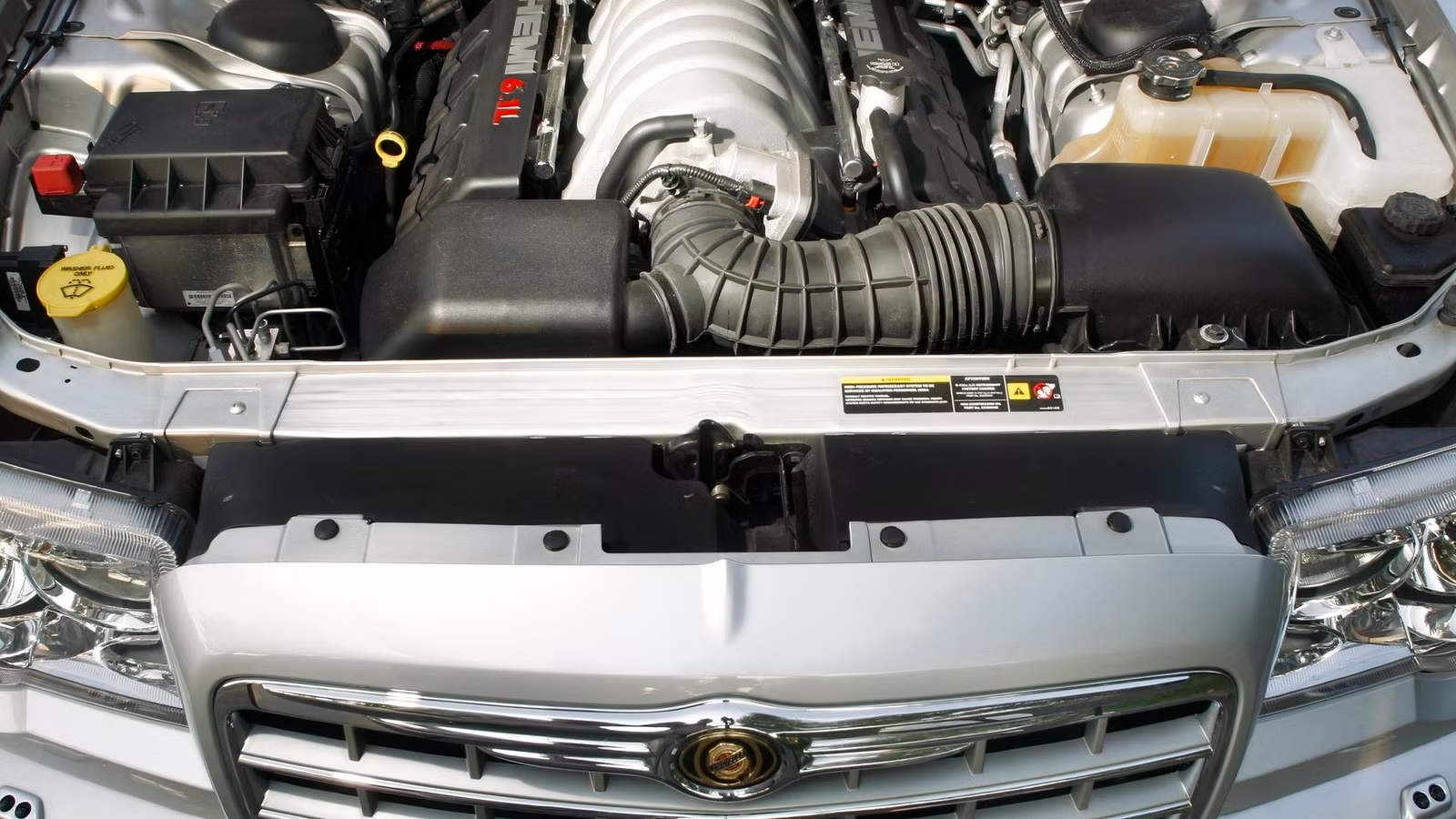
For reasons that can only be attributed to “because they could,” the team in Graz took the Magnum-based 300C Touring and fitted a 6.1-liter Hemi V8 pumping out 425 hp and 420 lb-ft of torque. This V8 brute could blitz the 0-60 mph sprint in just 5.1 seconds. Publications couldn’t quite agree on its absolute limits, with various outlets publishing blistering 13.1-second quarter-mile sprints while others reported it at closer to 13.6. Meanwhile top speed runs varied between the factory’s electronically limited 168 mph and unregulated runs kissing 170 mph.
When it came time to stop, massive four-piston Brembo calipers clamping down on 360mm front rotors hauled the 4,300-pound behemoth from 60 to 0 mph in just over 110 feet. Yet, despite being able to terrify sports car owners on the Autobahn, it offered a cavernous 27.2 cubic feet of cargo space, expanding up to 71.6 cubic feet with the rear seats stowed away. In terms of practicality, the 300C Touring rivaled traditional, sensible family haulers like the Volvo V70 and the Audi RS6 Avant. Of course, the SRT8 had an exhaust note that left the competition feeling soft by comparison.

Not that many 300Cs were built this way. In its inaugural production year of 2006, a grand total of 150 units left Austria with the 6.1-liter Hemi. From 2006 to 2010, fewer than 600 300C Tourings were produced at Magna Steyr with the 6.1-liter Hemi V8. That’s opposed to thousands with the 5.7-liter Hemi or the Mercedes-Benz diesel engine. Suffice it to say, it’s a real rarity.
In the End, Chrysler Still Failed in Europe

Despite the undeniable brilliance of the Magna Steyr partnership and the sheer brute force of the 300C Touring SRT8, Chrysler’s grand European renaissance didn’t last. By 2007, the DaimlerChrysler marriage ended in a messy divorce, and Chrysler ultimately failed to establish a long-term foothold in Europe outside of a handful of Jeeps and minivans.
Even today, almost two decades later, the 300C Touring SRT8 stands as a brilliant, roaring anomaly: a fleeting moment when an American automaker managed to out-muscle the European wagon elite on their own turf, one that ultimately didn’t last.
Source: Stellantis/Chrysler

Related posts




Latest Post


No Comments