
The Forgotten Buick 400 That Made The GS Brutal Before The 455 Buried It
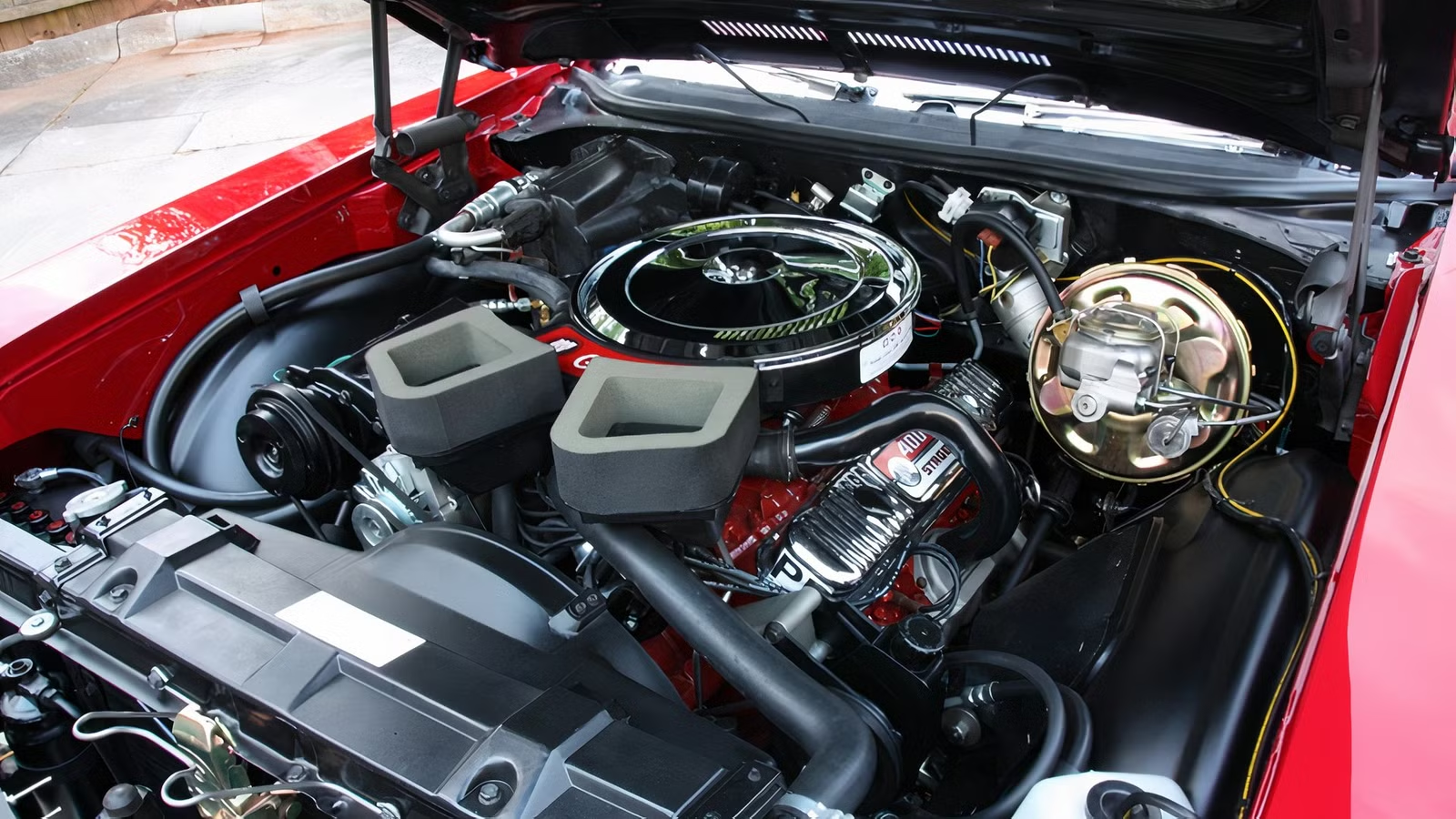
Every gearhead who’s into American muscle will talk at length about how brilliant the big-block V8s of the late 1960s to the early 1970s were. When they talk about those engines, they’ll usually think of ones made by Chevrolet or Chrysler. They may completely forget that, around the same time, Buick was also producing some monster engines. One of those monster Buick units has now fallen by the wayside, in terms of people remembering it. But, during the late 1960s, it really was a high-performance beast.
The Late 1960s Was A Time When Automakers Were Really Pushing The Boundaries With Engine Performance

The late 1960s was a time when American Cars were being pushed to the absolute limits of how they could perform. All the major American automakers were involved in the horsepower wars of that era. That even included some brands you wouldn’t necessarily associate with performance. One of those was Buick. Back in the 1960s, Buick had a reputation for making genteel cars that your grandpa might drive. But, the introduction of one particular engine turned things around. How did that happen? Well, it was due to a quirk that happened within General Motors during those horsepower wars…
The Different Brands Of General Motors Were Competing With Each Other In The Horsepower Wars
As the horsepower wars we’ve already mentioned went on, General Motors didn’t really attempt to regulate competition between its brands. The only limit it set was that mid-sized cars couldn’t have engines that were bigger than 400 cubic inches. Apart from that, all the brands were allowed to go crazy and come up with their own high-performance engines. This is something that Buick took full advantage of. Buick’s engineers knuckled down, and came up with a genuine alternative to the high-performance big-blocks that Chevrolet was building under the same GM umbrella. This was Buick’s own, unique version of a big-block, and it actually ended up being a genuine competitor to those Chevy engines instead of just being an alternative!

The Buick 400 V8 Is A Forgotten Torque Monster That Went Against Buick’s Grandpa Car Reputation

The Buick 400 V8 is possibly one of the least-known of the classic big-block V8s. But, for its time (it first emerged in 1967), it was absolutely one of the most impressive. The 400 was the smallest-displacement version of a new family of big-block engines, which were designed to replace the Nailhead V8s from the 1950s. These engines retained the 4.75 inch cylinder bore spacing of the Nailhead, but everything else was different and more modern. The 400 was more efficient than the equivalent Nailhead V8 it replaced, with larger valves and ports and a semi-wedge-shaped combustion chamber replacing the Nailhead’s pent-roof design. It also got a 4-barrel Rochester Quadrajet carburettor. All these modifications resulted in seriously impressive numbers. The Buick 400 V8 produces 340 horsepower, and a monstrous 440 lb-ft of torque. While the horsepower isn’t as high as the 375-425 that the Chevrolet L78 396 had at the time, the Buick V8 easily beat the Chevy V8’s 415 lb-ft of torque.
With all that power, it’s not surprising that the 400 ended up becoming the muscle car engine of choice for Buick. The most well-known use of this engine was in the Buick GS 400, a high-performance model based on the Buick Skylark.
It Got Even More Of A Performance Boost Thanks To A Tuning Package

The 340 horsepower and 440 lb-ft of torque that we’ve already mentioned wasn’t even the peak of the Buick 400 V8’s performance. Thanks to an upgrade package that was available from the factory, you could turn this engine into even more of a Chevy-beater! This package was known as the Stage 1 upgrade, and it included a range of high-performance upgrades to the standard engine. This included a recalibrated version of the 4-barrel Rochester Quadrajet carburettor, a higher-lift camshaft, bigger intake and exhaust valves, heavy-duty valve springs and a cold air induction system. The distributor timing was also changed for better performance, and a higher-performance dual exhaust was fitted. Buick GS 400s that had the Stage 1 upgrade got a bump up to 345-350 horsepower (as rated by the factory), while torque stayed the same. Those figures are actually thought of as being under-rated – several estimates have put the GS 400 Stage 1’s actual power at 390-400 horsepower.
It Only Had A Short Production Run

With an engine this great, you’d expect it to have stayed in production for a good while. That wasn’t the case, though. The Buick 400 V8 only lasted from 1967-1969. After that point, it was replaced by the much bigger 455 V8 as Buick’s top engine. The 455 then ended up becoming the big-block Buick V8 every talks about, and the 400 fell by the wayside. The introduction of the 455 engine also meant the Buick Gran Sport gained a new variant (the GS 455) that had an even wilder attitude. This became one of the definitive Buick muscle cars, taking attention away from the old GS 400 and away from the old 400 V8 as a result.
Why Did The Buick 400 Become Obsolete So Quickly?
With the Buick 400 V8’s sudden demise, you can’t help but wonder why that happened. That’s especially considering how good of an engine it was for its time. Well, there are a couple of logical reasons why the 400 ended up getting dropped. One of them is to do with how the engine itself was designed. The other is to do with a change in GM’s internal politics that, in one fell swoop, erased much of its reason for existing.
It Had An Odd Design, With Some Mechanical Limitations
When you take a look at the actual design of the Buick 400 V8, you’ll notice a couple of oddities. The biggest one has to be the bore and stroke of the engine itself. It’s a short-stroke design, deliberately done so that an engine with big-block power wouldn’t be bigger than 400 cubic inches. That was done due to an internal policy within GM at the time that barred small and mid-sized platforms from having engines bigger than 400 cubic inches. By cleverly designing the engine in this way, it meant that it could be used in the A-Body Buicks like the Skylark and the GX without falling foul of the internal policy.
Another major design quirk of the 400 has something to do with the oil pump. The oil pump was integrated directly into the front timing cover, which was made of aluminum. This was actually a design flaw with the engine – if that front timing cover warped, it would cause the engine to lose oil pressure.
GM Ended Its Displacement Limit Policy On Mid-Sized Cars After The ’60s

Perhaps the biggest reason why the 400 ended up being discontinued is due to the internal GM policy it had been partly designed to circumvent being canned. From 1970, GM finally axed the 400 cubic inch displacement limit and allowed mid-sized cars like the A-Body Buicks to use bigger engines. That not only meant that Buick could fit 430 and 455 cubic inch V8s to those mid-sized cars, but it also meant that Chevrolet could stuff massive engines into cars like the Chevelle SS and the C3 Corvette. With an internal policy that was intended to stop smaller models from being overpowered now completely abandoned, the weird engineering of the Buick 400 V8 just didn’t make sense anymore. There was no longer a need for a short-stroke V8 that would have been limited in what it could do. It made a lot more sense to build bigger, more normally-engineered V8s instead for those top performance variants.
Sources: Buick, Chevrolet

Related posts






Latest Post


No Comments