
The Motorcycle That Engineers Loved But Buyers Forgot
The motorcycle industry has always rewarded the bold — but boldness alone has never been enough. For every Honda CB750 that rewrote the rulebook or Suzuki GSX-R750 that redefined the sportbike, there’s a machine that arrived loaded with genuine engineering brilliance and left dealerships largely untouched. These bikes mark their own kind of before-and-after moment — not for the industry, but for the engineers who built them and the handful of riders who understood what they were looking at. The Suzuki Hayabusa proved that pushing boundaries could pay off handsomely. But what happens when a manufacturer pushes in a direction nobody asked them to go?

Why Advanced Motorcycle Technology Doesn’t Always Translate Into Sales

There’s a fine line between advanced and avant-garde. Consumers want an improvement on what exists, but not so dramatic an improvement that the price is pushed well beyond comparable offerings — that imbalance kills demand fast. It’s a difficult equilibrium to strike, and one that manufacturers have occasionally got badly wrong.
Take the Suzuki RE5. Released in 1974, it was the only rotary Wankel-engined bike produced by a major Japanese manufacturer. The engine had proven itself in the car world and offered genuine benefits — less vibration, freer-revving character — but it also brought poor fuel economy and higher oil consumption. It was more expensive than comparable motorcycles like the CB750, and two years after launch, Suzuki quietly scrapped it.
Manufacturers need to create something that lets consumers connect the dots between the shortcomings of what exists and how the new product fixes them. Honda identified poor reliability, kick-starts, and dated engineering, and addressed all three with the 1969 CB750 and its refined Japanese manufacturing. Suzuki recognized that sportbikes were heavy and inefficient, and answered with a dramatically lighter 1985 GSX-R750. Yamaha saw brake dive and front-end stability as problems worth solving and, in 1993, released a bike with forkless suspension to tackle them.
Yamaha GTS1000: The 1,000cc Motorcycle With Revolutionary Forkless Suspension

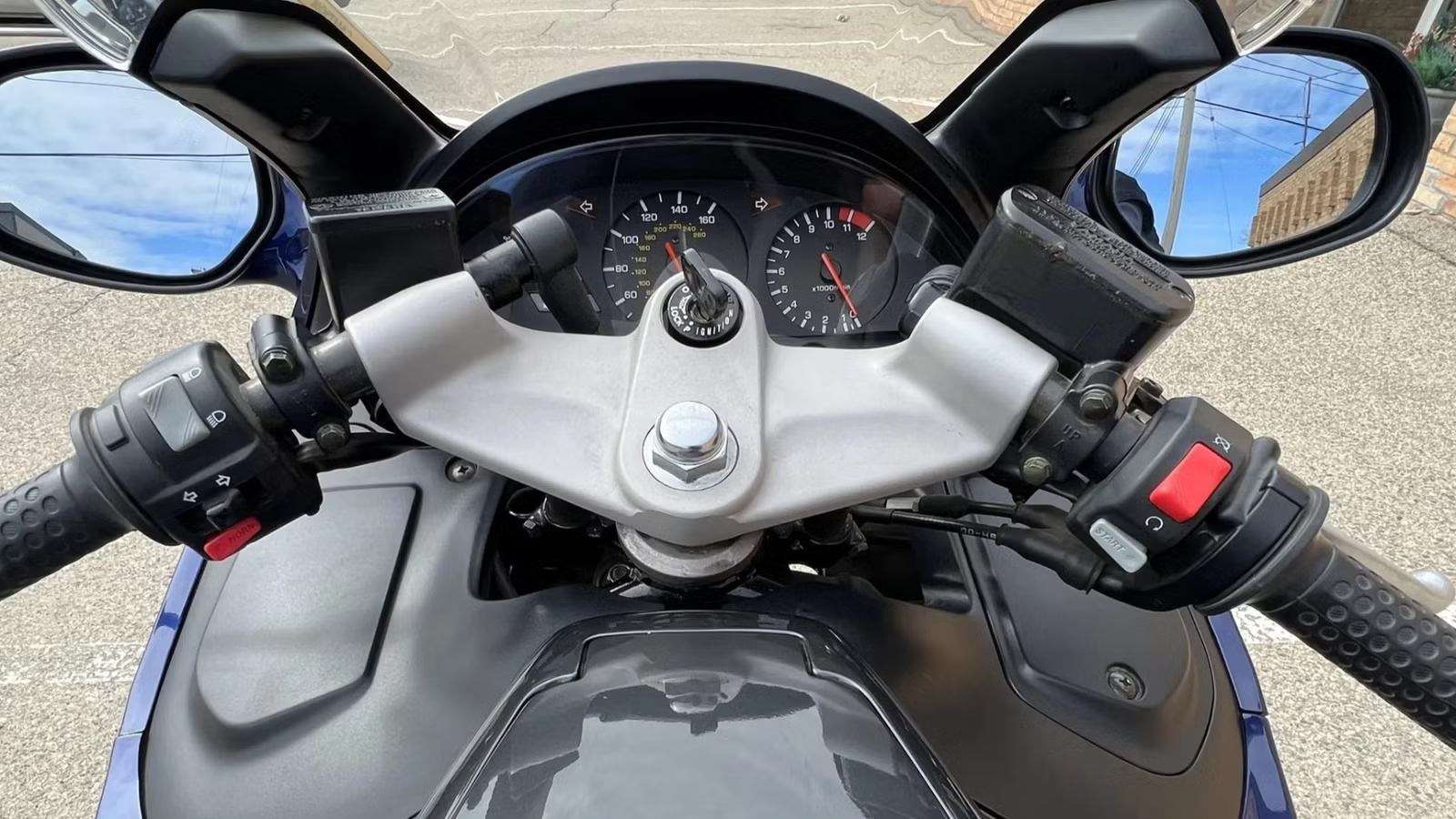
First released in 1993, the Yamaha GTS1000 was intended to be the brand’s “halo” bike — the most technologically advanced motorcycle of its era, with a number of innovations, chief among them the forkless front suspension. Yamaha turned to former motorcycle racer James Parker’s RADD, Inc. (RADD standing for Rationally Advanced Design Development) and licensed his front swing-arm suspension system. The concept was that a swing arm would eliminate brake dive, reduce unsprung weight, and improve steering feel by preventing road forces from feeding directly up through the handlebars into the rider’s hands.
It wasn’t the first bike to use this approach. The layout had appeared on race machines — Honda and Elf had both experimented with it during the 1980s, with British rider Ron Haslam winning the 1986 Macau Grand Prix on the Elf-3 — as well as on road bikes like the Bimota Tesi 1D in 1990 and the Britten V1000 in 1991. The GTS1000 shared the Britten’s more frameless philosophy as well.
|
Engine |
Power |
Torque |
Weight |
|
1,002 cc liquid-cooled four-stroke |
102 hp @ 9,000 rpm |
78 lb-ft @ 7,000 rpm |
553 lbs dry / 604 lbs wet |
The engine also came from an existing Yamaha, this time borrowed from the hugely popular FZR1000. Detuned to around 100 horsepower, it improved on the FZR’s setup by using fuel injection in place of carburetors, delivering better fuel efficiency, improved reliability, and cleaner emissions.
How The Yamaha GTS1000’s Forkless Suspension Changed The Riding Experience

The GTS1000’s radical front suspension wasn’t just an engineering exercise. It fundamentally changed how motorcycle behaved on the road. Separating steering from suspension meant that braking forces and road imperfections had less influence on the handlebars, allowing the front wheel to maintain its line even under hard braking.
Contemporary road tests found that the system worked particularly well when braking into corners. Riders could apply the front brake over uneven surfaces without the usual suspension dive or the associated changes in the steering geometry. The motorcycle also remained remarkably composed through fast corners and bumpy roads. There were some unfamiliar characteristics as well. The front end offered less feedback than conventional forks. Limited steering lock also made parking-lot maneuvers less convenient.
But for all its considerable technological ambition, the GTS1000 simply didn’t connect with buyers. It lasted only two years before being pulled from the United States market, and continued in other markets until 1999 — a total lifespan of just six years. Price was a significant factor: at $12,999 at launch, it cost more than some cars of the era and substantially more than rival Japanese sportbikes. Then there was the weight. Tipping the scales at over 600 pounds wet, it was far from nimble.
Why The Yamaha GTS1000 Remains One Of The Most Unusual Motorcycles Ever Built

While its sales record leaves much to be desired, the GTS1000 wasn’t a complete failure. The RADD suspension and Omega chassis never made a return appearance, but ABS and fuel injection — both showcased on this bike — spread across the motorcycle world and are now standard features on machines at every price point.
Whether the GTS1000 can truly be called “ahead of its time” is a question without a clean answer, given that its particular vision of the future arguably never arrived. Even so, it is genuinely appreciated today, and the skepticism that greeted it at launch means surviving examples are rarer — and more collectible — than its brief production run might suggest.
Ultimately, the GTS1000 is a reminder that not every innovation is a winner and not every alternative is an improvement. Innovation doesn’t exist in a vacuum: technological progress is only half the equation, and without corresponding demand, even the most sophisticated machine will gather dust. But that doesn’t mean Yamaha was wrong to try. As Thomas Edison put it, “I have not failed, I’ve just found 10,000 ways that won’t work.” The GTS1000 didn’t work — but Yamaha were the ones bold enough to find out.
Sources: SlashGear, Suzuki Cycles, BMW Blog, Motorcycle Classics, Cycle World, Motorcyclist, Cycle World

Related posts


Latest Post


No Comments