
Honda Bets A Compressor Lets Its 900cc V3 Stand Up To A 1,200
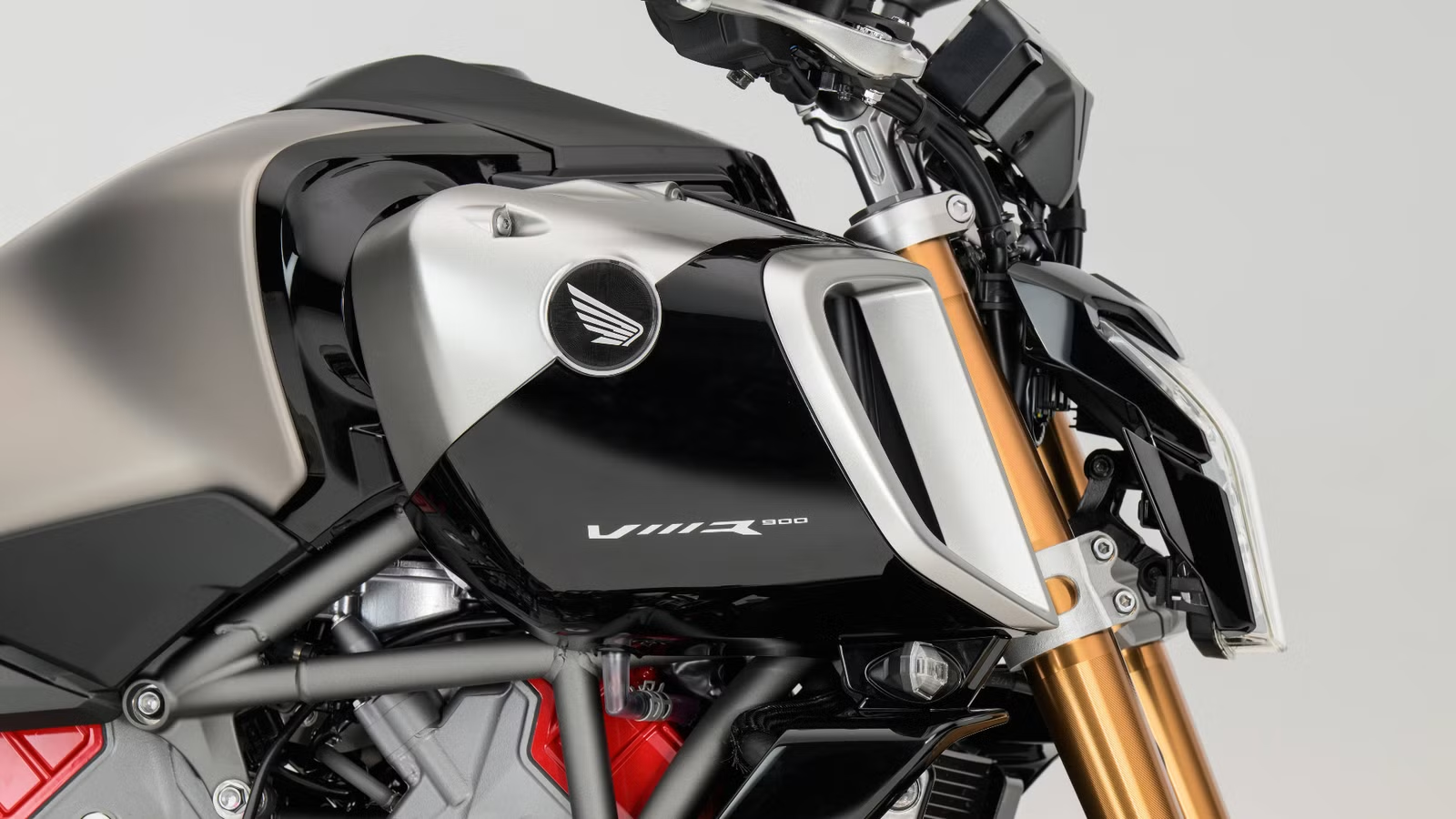
One side of the tank looks like it needs more air than the other, a large intake bulges out on the right, while a much smaller opening sits on the left. That unusual design offers a clue to a bigger engineering challenge beneath the bodywork. Engineers want to extract the easy pulling power of a 1,200cc engine from just 900cc, without forcing riders to constantly chase high revs. Making that happen requires more air, smarter boost control, and some clever packaging. And the solution could change how smaller performance engines deliver their power.
Why Getting 1,200cc Performance From A Smaller Engine Is So Difficult

Engine displacement matters because bigger engines generally move more air. Under similar conditions, a naturally aspirated 1,200cc engine draws in roughly one-third more air per combustion cycle than a 900cc engine. More air allows more fuel to burn, creating greater force. Engineers can make smaller engines produce impressive horsepower by improving airflow and increasing engine speed. However, matching the low-rpm torque of a bigger engine presents a tougher challenge. Riders notice that difference when accelerating in a higher gear without downshifting.
Forced induction offers a solution. A compressor pushes additional air into smaller cylinders, allowing the engine to burn more fuel and produce greater torque. However, compressors also create heat, add weight, and complicate packaging. Engineers must carefully manage how the extra power arrives, especially on a motorcycle. The goal is strong, predictable acceleration without forcing riders to keep the engine screaming.
Kawasaki’s H2 Shows The Promise And The Limits Of Mechanical Boost


Kawasaki has already demonstrated the potential of forced induction with its supercharged Ninja H2 family. The H2 uses a centrifugal supercharger connected to the crankshaft through a mechanical gear system. Its impeller spins at approximately 9.2 times crankshaft speed, reaching nearly 130,000 rpm. That helps the engine produce exceptional power, but the compressor’s speed remains tied to engine speed. Actual boost pressure also depends on airflow and throttle conditions, making the relationship more complicated than a simple increase in rpm.
Turbochargers take another approach by using exhaust energy to drive a compressor. They avoid the H2’s mechanical connection but can suffer response delays while exhaust flow builds. An independently driven compressor offers another possibility. What if engineers could increase compressor speed whenever the rider demanded more torque, regardless of crankshaft speed? That could make strong acceleration available much earlier in the rev range.
Honda’s V3R 900 E-Compressor Makes The 900cc Feel Like 1,200cc

The Honda V3R 900 E-Compressor aims to answer that question. Honda unveiled its planned-production motorcycle at EICMA 2026, following a complete prototype shown at EICMA 2025. The latest version introduces the definitive production design – its liquid-cooled, 900cc engine uses an unusual 75-degree V3 configuration, with two cylinders facing forward and one facing backward. Honda wants this compact engine to deliver performance comparable to a naturally aspirated 1,200cc unit, despite having 300cc less displacement.
The secret lies in what Honda describes as the world’s first electronically controlled compressor for motorcycles. An electric motor drives the compressor instead of a mechanical connection to the crankshaft, as found on Kawasaki’s H2. This allows Honda to regulate compressor operation and intake pressure independently of engine speed. The system can supply additional air at low rpm when the rider demands stronger acceleration. Honda’s advantage could come from controlling precisely when boost arrives rather than simply producing more of it. The company promises immediate, substantial low-rpm torque, although independent road tests have yet to verify that claim.

The compressor also explains the unusual bodywork. Honda positioned it behind the steering head, creating a packaging challenge around the intake system. The large right-side opening accommodates the airbox, while the smaller left-side duct supplies cooling airflow to the electronic control unit. Those different requirements give the motorcycle its deliberately asymmetrical appearance. One side clearly spent more time at the gym, but the uneven design serves a practical purpose.
Titanium, A Trellis Frame, And The Hardware Behind Honda’s New Flagship

Honda has introduced several premium components for the planned-production model, including a titanium fuel tank, exhaust headers, and muffler. Titanium combines strength with relatively low weight, making it useful for offsetting some of the additional hardware required by forced induction. The electric compressor, its motor, and associated equipment inevitably complicate the motorcycle’s design. However, Honda hasn’t disclosed the V3R’s actual weight, so it’s impossible to know how effectively these lightweight components balance the added equipment.
A tubular steel trellis frame supports the motorcycle, while the engine contributes structural rigidity as a stressed member. Other highlights include a single-sided swingarm, an inverted front fork, and radially mounted front brake calipers with petal discs. Honda’s new Flagship Wing emblem signals the motorcycle’s premium positioning. The enhanced Honda RoadSync system also brings an improved interface and AI-assisted voice controls. Those features add modern convenience, although the electrically boosted V3 remains the main attraction.
The Real Test Is Whether Honda’s 900 Can Deliver On Its 1,200cc Promise

Honda’s biggest claim remains unproven. Can its electrically boosted 900cc V3 genuinely match the performance of a naturally aspirated 1,200cc engine? The company hasn’t published horsepower, torque, curb weight, price, or an official launch date. Proper comparisons will require measured power and torque curves, real-world throttle response, and acceleration tests. Peak horsepower alone won’t settle the debate. The real achievement would be delivering effortless pulling power throughout the rev range, particularly where smaller engines traditionally struggle.
The compressor also raises questions about heat, energy consumption, and sustained performance. Honda says its design doesn’t require an intercooler, but independent testing must establish how effectively the complete system works. The motorcycle’s planned-production status suggests the manufacturer intends to bring the technology to customers, although availability remains unconfirmed. Until verified figures emerge, comparisons with specific 1,200cc rivals would be premature.
Still, if Honda delivers big-engine torque with the size and character of a smaller V3, its unusual approach could give performance motorcycles an exciting new direction.
Source: Honda, Kawasaki

Related posts

Latest Post


No Comments