
The 2005 Suzuki Superbike BMW Reverse-Engineered To Build The S 1000 RR
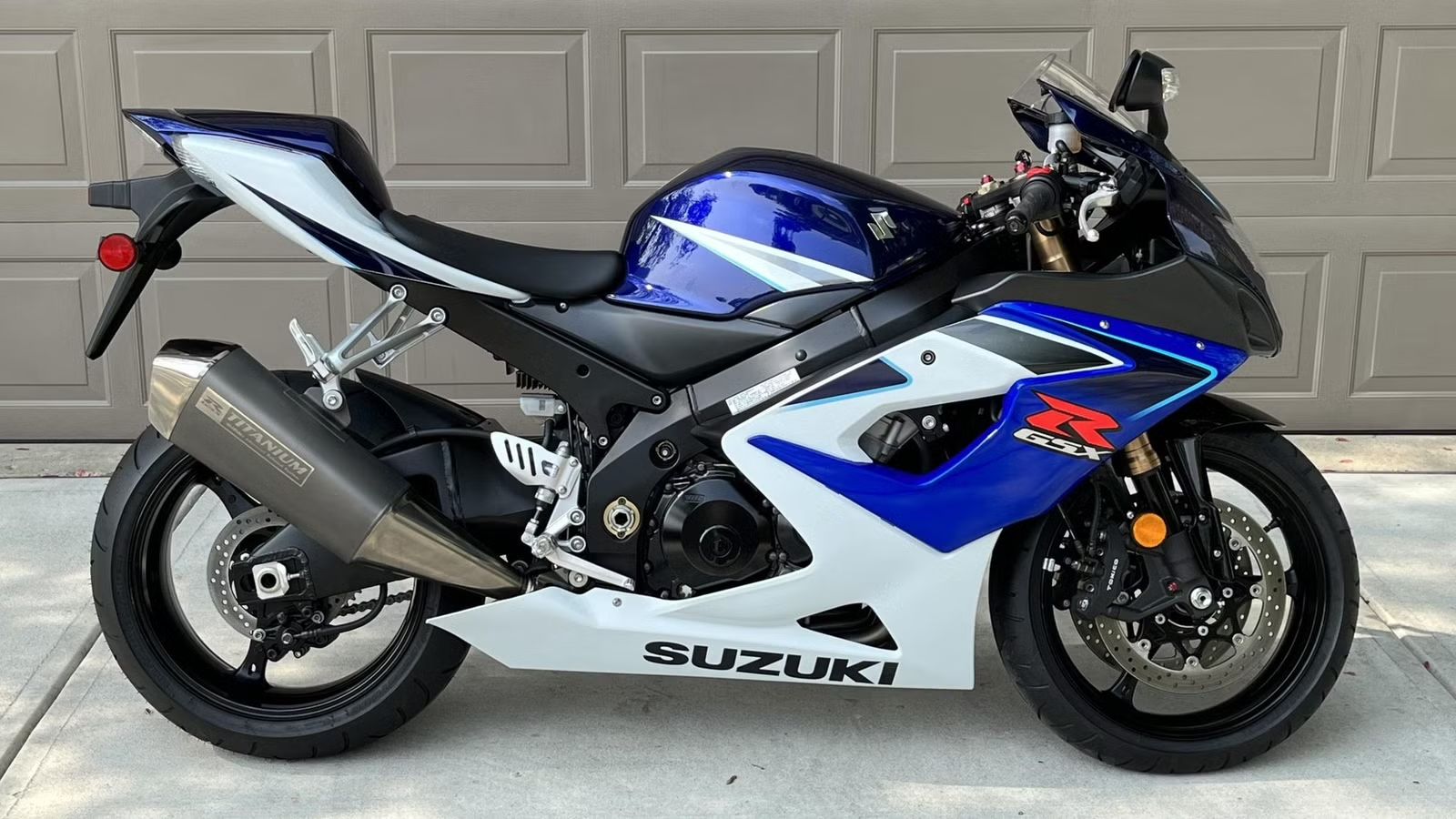
Imagine making a bike so influential that BMW benchmarks it to produce its first-ever liter-class superbike, which turned out to be a groundbreaking bike in its own right. That’s exactly what Suzuki achieved with its 2005 superbike. Widely regarded as one of the most groundbreaking superbikes ever made, it rewrote the rulebook with its class-leading performance and handling. Here’s everything you need to know about this legendary Suzuki sports bike that helped shape the BMW S 1000 RR and other superbikes that followed.
The Bike Traces Its Roots To The First True Supersport Motorcycle

Back in 1985, Suzuki launched the GSX-R750, often considered the first true supersport, paving the way for the legendary 1992 Honda CBR900RR Fireblade. To mark the bike’s 40th anniversary, Suzuki released a documentary about the GSX-R sport bike’s development from 1985 to the 2000s, giving us a glimpse into the challenges the development team faced. That’s important context to understand what makes the 2005 Suzuki superbike so influential, enough for BMW to essentially reverse-engineer it to develop the ultimate superbike of the 2010s: the BMW S 1000 RR.
Suzuki’s Fight To Keep The Weight Low

The original GSX-R750 was groundbreaking. It featured an oil-cooled engine that was an evolution of the GS750’s lump, dating back to 1976. This engine was hung in an innovative aluminum double-cradle frame, which helped the bike achieve a welterweight of just 395 pounds. This remarkable power-to-weight ratio made the GSX-R750 a proper track weapon, earning the bike first- and second-place finishes in the 24 Hours of Le Mans that year. In fact, 10 out of 24 bikes to finish that race were GSX-R750s. The bike also claimed half of the top ten positions in the Suzuka 8 Hour endurance race.

By the early ‘90s, the oil-cooled engine began to struggle with heat management in top-level competition. So, Suzuki was forced to abandon tradition and switch to a water-cooled mill for the 1992 model. This decision had a ripple effect, as the addition of the radiator and fan forced the steering head forward, which reduced the frame’s torsional rigidity. Now, Suzuki had to add reinforcements to the frame, which made the bike significantly heavier by over 60 pounds. Thus began Suzuki’s fight to keep the GSX-R’s power-to-weight ratio intact.


With the competition catching up in the mid-’90s, Suzuki was forced to make yet another difficult decision: let go of the traditional double-cradle frame for a twin-spar one, a Yamaha invention. The GSX-R750 also underwent a major transformation during this time, featuring the most compact and lightweight water-cooled engine in its class. A combination of these factors finally allowed the GSX-R750 to shed weight; the 1996 model weighed the same as the first generation, and it dropped even more by 2000.
Then came the liter-class era, and to keep up with the competition, Suzuki launched the 2001 GSX-R1000, based on the GSX-R750 that debuted a year earlier. This featured a 998cc long-stroke inline-four, virtually identical to the R750 powerplant’s dimensions. As a result, Suzuki managed to keep the weight down; it was only 8.9 pounds heavier than the R750. As good as this bike was, it did have some issues. So, Suzuki got to work on the 2005 model that would fix all the issues.
2005 Suzuki GSX-R1000 K5: A Legend Is Born

In 2005, Suzuki launched the completely revamped GSX-R1000, called the K5 for MY05 and K6 for MY06, an engineering marvel of its time. This bike featured a new 999cc inline-four engine with a bore and stroke of 74.3 x 59mm and a 12.5:1 compression ratio, and this mill was 4 pounds lighter than the previous model and only 1cc larger. That weight saving came from lighter titanium valves, lighter pistons, and strengthened crank and rods; it also featured chrome-nitride-coated rings inside the SCEM-lined cylinders.

By all means, the K5 engine was a significant step-up from the K3 and K4 models, producing 175 horsepower at 11,000 RPM and 87 pound-feet of torque at 9,000 RPM. The engine was mated to a six-speed transmission with a back-torque-limiting clutch system, a first for the GSX-R1000 model. A standard titanium silencer further helped keep the weight down. The bike also got a brand-new twin-spar frame that was lighter than ever, reducing the total length by 1.6 inches and the wheelbase by just 0.02 inches.
Best Power-To-Weight Ratio In The Class

The result was a liter-class sports bike with an incredible power-to-weight ratio. The K5 was the lightest bike in the class, tipping the scales at just 365 pounds dry, a whole 30 pounds lighter than the legendary original GSX-R750. The power-to-weight ratio, along with the uniquely linear power delivery, courtesy of the long-stroke engine, made the bike incredibly easy to ride and go fast on. In fact, a K6 (a 2006 model unchanged from the K5) recorded a 0-to-60 miles-per-hour time of just 2.35 seconds, making it among the quickest bikes ever made.

What made the entire package even better was that it was among the last true analog superbikes ever made. There was no ride-by-wire, ride modes, traction control, or ABS. The bike put you in control, and, according to reviews at the time, its riding experience was unmatched by any rival. With the K5, Suzuki finally undid a decade of compromises on weight, clawing back to the top of the segment. And this was right before electronic rider aids reworked what superbikes felt like, and stricter emissions norms added more heft to bikes.
The GSX-R1000 Lost That Appeal With The Next-Generation K7 Model

By the time Suzuki launched the GSX-R1000 K7 in 2007, tighter Euro 3 emission standards had already come into effect. This forced Suzuki to change the bike’s engine configuration; the K7 got a 998.6 cc engine with a narrower bore. Sure, it produced more power at 182 horsepower, but it peaked at a dizzying 12,000 RPM. The bike also gained 14 pounds due to its new exhaust system designed to meet emissions regulations. Suzuki claimed to have refined the aerodynamics, along with a faster-revving engine and larger throttle bodies, to offset the additional weight, but the K7 lacked the soul of the K5.
BMW Reverse-Engineered The K5 To Build The Ultimate Superbike

At the time, the Suzuki GSX-R1000 K5 was the perfect superbike architecture. The K5 engine was celebrated for its compact size, broad torque spread, and durable internal architecture. The K5 was also exceptionally light. It’s no wonder that BMW Motorrad decided to benchmark it while developing the S 1000 RR. BMW never officially admitted to it, but it’s an open secret that BMW bought multiple K5s to dissect and analyze their geometry, power delivery, and chassis dynamics.


In fact, if you look closely at the 2009 BMW S 1000 RR, you’ll see various similarities between the two. The BMW superbike’s bore and stroke were tailored to achieve similar high-revving characteristics. Experts also claim that the powerplant’s internal design language was inspired by the K5 platform. Moreover, the bike had near-identical wheelbase, steering head angle, and swingarm pivot points, as well as a similar engine placement in the frame.
|
Specs |
2005 Suzuki GSX-R1000 K5 |
2009 BMW S 1000 RR |
|---|---|---|
|
Engine Type |
Inline-four, DOHC, 4 valves per cylinder |
Inline-four, DOHC, 4 valves per cylinder |
|
Displacement |
998.6cc |
999cc |
|
Bore x Stroke |
74.3 x 59 mm |
80 x 49.7 mm |
|
Compression Ratio |
12.5:1 |
13.0:1 |
|
Frame Type |
Aluminum twin-spar |
Aluminum twin-spar |
|
Rake |
23.75 degrees |
23.9 degrees |
|
Trail |
3.8 in |
3.77 in |
|
Wheelbase |
55.3 in |
56 in |
BMW Motorrad Was A Technological Leap, Though

That’s not to say the S 1000 RR was merely a copy of the K5 Gixxer. Instead, BMW took what was already perfect and refined it further to develop what is often considered the ultimate superbike of the last decade. And there were plenty of differences between the two, too. To start with, BMW used an over-square engine design rather than a long-stroke one, which allowed the revs to climb much higher and faster.

The BMW S 1000 RR shattered the superbike mold quite like the K5 did back in its day. The BMW superbike produced 193 horsepower at a time when its nearest competitors hovered around 170 to 180 horsepower. It also had an astonishing power-to-weight ratio, tipping the scales at just 403 pounds. It featured cutting-edge electronics for the time, including lean-sensitive ABS, Dynamic Traction Control (DTC), and ride-by-wire throttle maps. The S 1000 RR was also the first motorcycle to offer an optional quickshifter.
The Suzuki GSX-R1000 K5 Is A Collector-Grade Bike Today

Given the influence the K5 has had on the liter-class segment, it’s bound to become a collector’s item one day. Fortunately, it remains plentiful on the used market at a fairly affordable price. Kelley Blue Book estimates its typical listing price at $4,995. According to J.D. Power, you can get your hands on an excellent-condition model for $6,695 and a very good-condition model for just $4,515. The latter is cheaper than a brand-new GSX250R, by the way.
Things To Watch Out For

Influence aside, the K5 Gixxer offered incredible performance for a bargain, so it eventually found its way into the hands of inexperienced riders. At the same time, the bike is now over two decades old. So, you need to thoroughly inspect the bike and watch out for some common issues. For starters, look for crash damage and avoid heavily modified examples. Completely stock models will be hard to find, but try to find something as close to stock as possible.
The bike had two recalls: a cracking frame and a faulty front brake master cylinder. Confirm that the recalls have been honored. Also watch out for leaking gaskets on the fuel pump. Outside of these, the K5 is as reliable as any other Suzuki, though you should still expect age-related issues to arise here and there. These include leaking fork seals, rust spots, rattling panels, and similar issues common on older bikes.
A Blip In Superbike History

The Suzuki GSX-R1000 K5 represents a blip in motorcycling history as one of the best analog superbikes ever made. It existed at a time when Suzuki could undo a decade of weight-related compromises and push the performance envelope without being restricted by stricter emission norms or weighed down by modern electronics. For many enthusiasts, the K5 is about as perfect as a superbike can get. For those who grew up with S 1000 RR posters on their walls, the Beemer will represent the same thing.
Source: Suzuki Cycles, BMW Motorrad, J.D. Power, Kelley Blue Book, online forums

Related posts

Latest Post



No Comments