
The 2.0L Toyota Turbo Four That Matched A Foxbody 5.0 Mustang In 1986
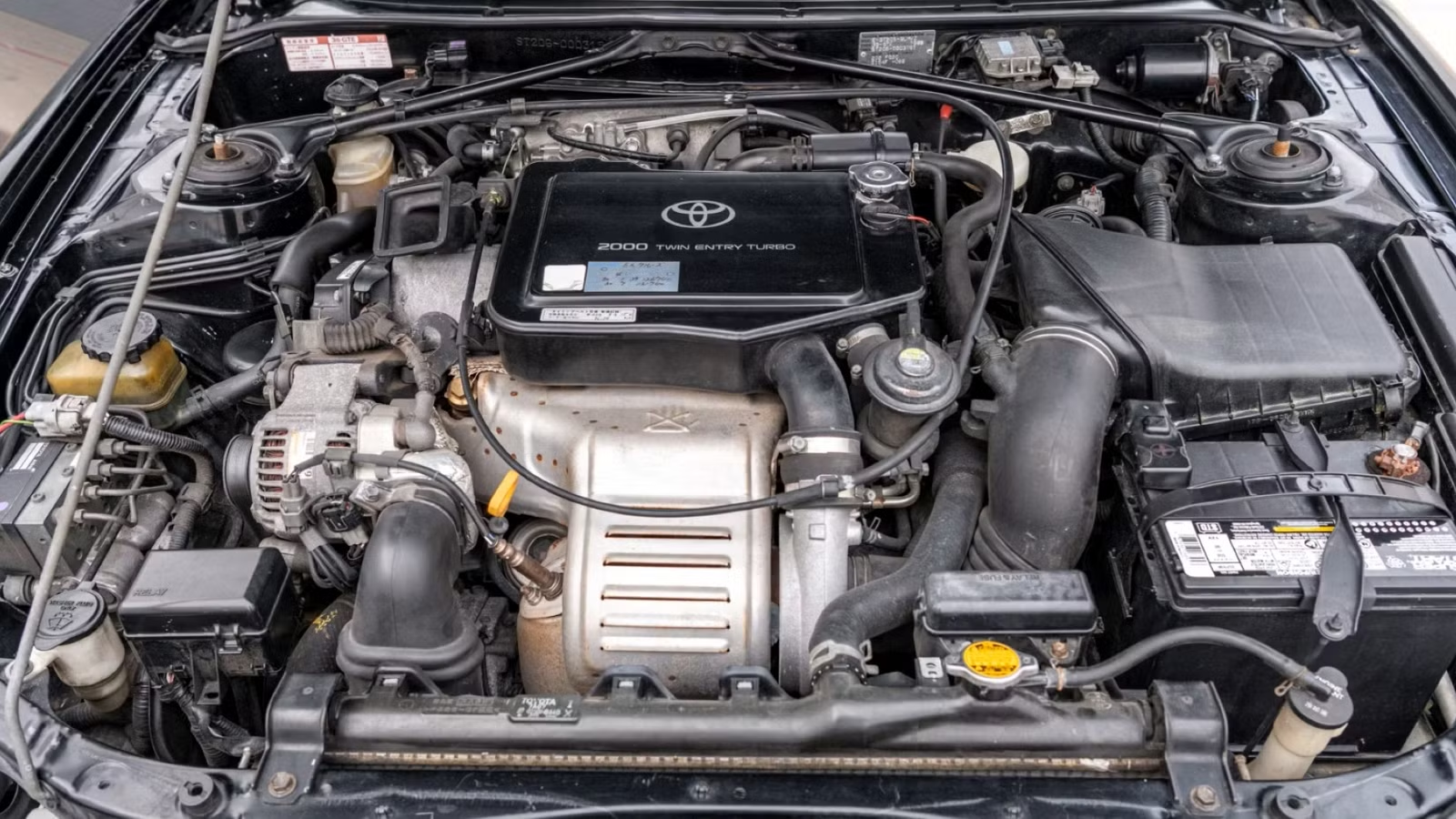
As every JDM fan knows, the Japanese automakers have built some of the best engines the world has ever seen. Everything from tiny 3-cylinder engines for Kei Cars to big V8s and even V12s have come out of Japan’s factories, and many of them have been absolutely brilliant. That includes this engine we’re going to cover here. It may be a small unit, compared to a lot of other Japanese engines from the ’80s and ’90s. But, it more than proved itself on the streets, on the track and on rally stages all over the globe.
By The 1980s, Japan’s Sports Cars Were Getting Powerful Enough To Compete With America’s Best

For a while, Japanese Sports Cars didn’t have the kind of power to compete against the best that America had to offer. But, by the time the 1980s rolled around, everything had changed. The malaise era and its ever-increasing efficiency demands led to big, old-school V8 engines being strangled or scrapped entirely so that American emissions regulations could be met. This actually gave the Japanese contenders, with their smaller and more efficient engines, a fighting chance against American muscle. Couple that with how much more reliable they tended to be than the American offerings they were up against, and for many customers it seemed almost like a no-brainer to buy a Japanese sports car instead.
Toyota Became Known For Building Amazing High-Performance Engines

All the major Japanese manufacturers were in on the sports car game by the 1980s, and they were very much in competition with each other. That wasn’t just in terms of building cars, either. It was also in terms of building engines. When it came to the engine front, Toyota quickly built itself a reputation for being one of the best. You only have to look at how many cars the naturally-aspirated and turbocharged versions of the 2JZ inline-6 have ended up in, whether that was through them being factory-fitted or swapped in later as part of a crazy performance build.

The engine we’re going to talk about here, though, is much more overlooked than Toyota’s inline-6 beasts. It only has four cylinders. But, those four cylinders pack a lot of turbocharged punch even from the factory. It also proved that it could produce much more power than what it originally offered, and ended up becoming the centerpiece of one of motorsport’s greatest scandals.
The Toyota 3S-GTE Is A Turbo Four That Could Compete With America’s Best V8s
When you first take a look at the 3S-GTE, it just looks like a fairly normal 2-liter turbocharged Japanese engine. In many ways, that’s what it is. It’s a variant of the 3S family of engines, which have been used in many common or garden Toyotas over the years. But, thanks to that turbo, the 3S-GTE is a bit more special than the regular 3S engines.
The first generation of the 3S-GTE produces anywhere from 185-190 horsepower and 177-190 lb-ft of torque. Those were fantastic numbers for a turbo four from the mid-’80s (this engine was first introduced in 1986). That made it almost as powerful as the 5-liter V8 that was in the Fox Body Ford Mustang GT (200 horsepower and 285 lb-ft of torque). The second-generation 3S-GTE pushed the power up to 200-232 horsepower and 200-224 lb-ft of torque, while the third-generation 3S-GTE bumped things up even further to 245-255 horsepower and 224 lb-ft of torque. The final fourth-generation 3S-GTE kept this engine going well into the 2000s, and produces 256 horsepower and 239 lb-ft of torque.
It’s Solidly Constructed Enough To Be Able To Take Big Power
One of the key features of the 3S-GTE’s design that’s made it an underrated high-performance favorite is that it’s incredibly well-built from stock. It has a cast iron block, an aluminum cylinder head, a forged crankshaft, forged connecting rods and aluminum pistons. All those components come together to make a package that can take a lot more power than the factory tune. Many tuners reckon they can get as much as 450 horsepower without having to change any of the stock internals out for beefier components.
It’s Powered Some Fantastic High-Performance Toyotas… Including An Overlooked JDM Sleeper!

One of the biggest reasons why the 3S-GTE has any kind of notoriety is thanks to the sports cars it was dropped into. It’s a key component of why the Toyota Celica GT-Four is so great, combining that turbocharged 4-cylinder power with a rally-bred all-wheel drive system. It also got put into the JDM-only turbocharged versions of the Mark II Toyota MR2, another strong favorite among enthusiasts.

While the sports cars get all the attention, they weren’t the only high-performance Toyotas that got this fantasic engine. Toyota also put it in the JDM-only Toyota Caldina. Both generations of this minivan/crossover family car had the 3S-GTE as its most powerful engine option. In the first-generation Caldina, it powered the top-of-the-line GT-T model. When things moved over to the second generation, the top trim with the 3S-GTE engine became known as the GT-Four. Both generations were rated at the 3S-GTE’s highest output of 256 horsepower and 239 lb-ft of torque. That was seriously good power for a Japanese family sleeper back then, and it makes you wonder why this car’s been so overlooked.
It’s One Of Toyota’s Biggest Motorsports Successes

The 3S-GTE engine was a great choice for Toyota’s high-performance street cars. That’s only a small part of its story, though. This engine has been a part of what are arguably some of Toyota’s biggest successes in motorsports. Because this engine could be tuned to produce crazy amounts of power for such a small unit, it was almost inevitable that it would end up being a part of some racing efforts. That’s included a couple of periods of Toyota running at the top of the pack. One of those periods was caused by a clever trick that, once the scrutineers discovered, led to one of the most infamous cheating scandals in motorsports.
It Was Part Of One Of The Most Infamous Rally Campaigns Ever
If you know anything about Toyota’s exploits in rallying, you’ll know all about the Group A version of the Celica GT-Four. Group A rallying is actually the entire reason why the Celica GT-Four exists. That was made very obvious when Toyota poured huge amounts of money and resources into developing the rally version. As a part of that development, Toyota found a way to work around a rule regarding turbocharged cars that had been put in place to limit the danger and excesses of the Group B era.
The World Rally Championship required that all turbocharged cars have air restrictors on the engines to limit their power outputs. Using some clever engineering, Toyota worked out a cheat with the restrictor plates. Three washers were placed under the standard steel cuff that clamped the turbo hose down, and those washers reacted to how much air was going through that hose. When they moved, they activated a small mechanism that pushed a crescent-shaped subsection of the restrictor plates that Toyota’s engineers had cut back. This opened up the restrictor plate, allowing more air to flow through and for the full power of the engine to be unlocked. Because all the components that were used to make this trick work were already on the standard car, it technically didn’t break any rules. As a way of making sure that this system was absolutely legally watertight, Toyota even installed it on the homologation special street cars.
While Toyota were consistently among the front-runners in the 1995 World Rally Championship thanks to this engineering trick, it did end up getting found out. That was thanks to an observant FIA scrutineer who accidentally discovered it. Toyota were disqualified from the 1995 championship on the spot, but not before then-FIA President Max Mosley called it “the most sophisticated and ingenious device I have ever seen in 30 years of motorsport.”
A Closely-Related Race Engine Dominated American Sports Car Racing During The 1990s
The 3S-GTE’s motorsports dominance wasn’t just restricted to rallying. While it wasn’t exactly the same engine, one that was very similar to it became a real powerhouse in sports car racing in both Toyota’s native Japan and North America. This engine is known as the 503E, and it was a joint development project between Toyota Racing Development (TRD) and Yamaha. It’s an absolute beast of an engine, producing anywhere from 650-680 horsepower in its regular configuration and 800 horsepower or more for sprint races. It’s even been estimated that these engines could reach 1,000 horsepower or more if you turned the boost all the way up! Oddly, the 503E actually came before the 3S-GTE did. It was a totally clean sheet design, and had a heavy-duty cast iron block as part of it. That’s something that absolutely passed down into the 3S-GTE later.
The 503E was the power plant of several different race cars. To people who live in North America, the most well-known car it’s been in has to be the Eagle Mark III GTP prototype. This car absolutely dominated the IMSA Sports Car Championship during the 1990s. In the 27 races it entered, it got 21 wins, 18 pole positions and 16 fastest laps. That level of dominance was so huge, that it actually ended up killing the old-school GTP class entirely! Toyota withdrew from top-level IMSA competition as a result, and hasn’t returned to that level since. It was also supposed to power the Toyota MR2 222D Group S rally car, and in that guise it could have had as much as 750 horsepower. But, Group S was cancelled before it even raced, and the Group A regulations we’ve talked about earlier were adopted instead.
Sources: Ford, Motor Reviewer, Toyota

Related posts





Latest Post


No Comments