
The 1977 Pontiac Can Am: The Rarest Trans Am You Never Got
Pontiac was a brand in a state of perpetual flux back in the late 1970s. In the time we’ll loosely call the era post-GTO, the brand needed other ways of fielding a mid-size muscle car with much of the same flair and style, but tailored to an age when the muscle car era itself was already more or less over. Given the emissions and fuel economy restrictions imposed by the government at the time, this was bound to be easier said than done. All the credit to GM, it managed to do so for all of a single measly model year. The reason why is complicated, and in hindsight, not all that sensical. Yet, in the context of the era it was made, sometimes things weren’t meant to make sense.
The End of the GTO, the Start of a New Era

To spare you another long dissertation about the downfall of Pontiac in the ‘70s, it’s likely better to view it from the focal point of its all-time greatest hit, the GTO. The 1970s weren’t kind to Pontiac’s flagship muscle car. Gone were the flagship Pontiac engines, so large and over-built that they became the stuff of legend long after they were gone. The Pontiac V8 line would carry on for a few years longer, but utterly neutered, and reduced to mere shells of what they once were.
As far as the GTO was concerned to sensibilities of the time, the lack of a de-restricted “big block” displacement motor meant there really wasn’t much sizzle to sell the steak. Worse still, 1973 GTOs were visibly blobbier and less, well, muscly, than generations prior. It was a point duly noted when, likely citing poor sales and bad user feedback, Pontiac transitioned to an all new body style the very next year in 1974. 1974 wasn’t much kinder to the GTO, in fact, it was downright worse. After transferring away from the beloved GM A body platform that underlined the Chevy Malibu SS and Oldsmobile 442 as well, the GTO’s new platform for 1974 was the markedly less exciting X body.

Smaller, lighter, but lacking anywhere near the same level of gravitas as the old A bodies, the GTO was a shell of its former self by this stage in its life. In fact, the GTO of 1974 was more of an optional mild visual and performance upgrade package. Far from the glory days of 455-cubic-inch plants being readily available, the biggest engine you could buy in a GTO in 1974 was a “measly” 350-cubic inches. Yup, there was a time when 5.7 liters was actually pretty small. From there, the GTO nameplate would disappear for the better part of 30 years, and that left Pontiac in a very unenviable position.
Replacing an Icon: An Impossible Task Given the Circumstances

As conventional wisdom often tells us, the first great muscle car renaissance met its true end some time between 1971 and 1973, at the hands of fuel economy standards and newly-minted EPA emissions restrictions that turned the great V8s of the day into glorified paperweights across the industry. By and large, that line of thinking holds water. And yet, the market segment of the mid-size sporty muscle coupe didn’t exactly go away once the catalytic converters and government bureaucrats got involved. Knowing this, Pontiac was still dead set on fielding a spiritual successor of sorts.
Rather than a direct sequential followup, Pontiac took its sweet time, as much as three years, developing an American V8 sports car with similar vibes, but built for an America that simply couldn’t support the muscle car class the way it once had. For starters, Pontiac opted to return to the A body platform that once underpinned the GTO in its best years. Of course, by this stage of GM’s existence, the A body was far removed from what it once was even a decade prior. Smaller, lighter, and re-engineered to better conform to the post-OPEC hellscape that was the American auto industry of the time, the A body retained just enough of its previous credentials to even attempt making a sports car with its underpinnings.

With this in mind, Pontiac had to get clever to make things work, starting by taking the basic LeMans Sport Coupe and fit it with as many Trans Am-coded body parts and internals as federal regulations could possibly let it get away with. For starters the whole operation was outsourced to a Detroit-based OEM+ subcontractor specializing in performance upgrades called Motortown Corporation. Run by two world-class automotive marketers in Dave Landrith and Jim Wangers, delegating the task of making the LeMans gentleman’s runabout into something sporty off-premises allowed Pontiac to bypass the more annoying federal regulations holding the company down. No longer a car for geriatrics, what resulted was something altogether more aggressive.
The 1977 Can Am: Here for a Year, Gone in a Flash

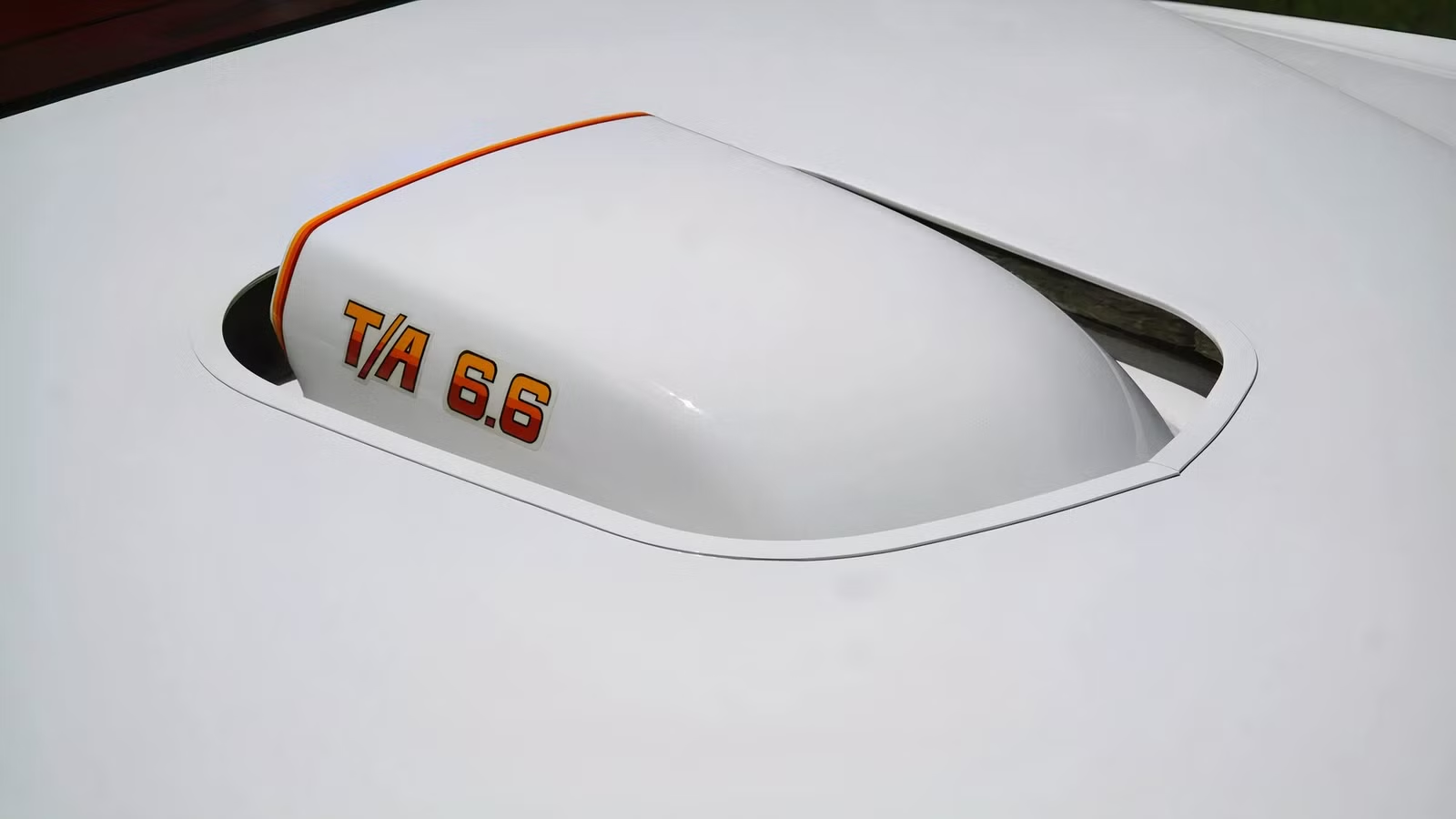
The result was something that looked like a typical LeMans coupe was hit by a Trans Am-ifying beam and given a liberal dose of racing stripes and chrome trim. The normal humdrum hindquarters was fitted with louvered rear-quarter windows, multi-colored tape stripes, and a rearward-facing hood scoop which, while not exactly hiding a 455 V8 underneath like Pontiacs of old, was genuinely functional in a way that other gimmicks of the period simply weren’t. Under said hood was, in effect, the best and biggest Pontiac motor the brand could come up with at the time, given all the restrictions. In fact, it was the very same W72 T/A motor that 1977’s Trans Am used.
At 400 cubic inches, it certainly wasn’t small, and there was enough low-end torque latent within it to make a truck feel jealous about itself, 325 lb-ft to be exact. Still, with just 200 net horsepower, measured under the hood with accessories attached, that power was well behind you by the time you worked your way up the rev range. In California-spec variants, subject to even harsher emissions laws, you were stuck with an even whimpier 403-cubic-inch Oldsmobile V8 churning out a measly 185 horsepower. Paired with the only transmission choice of a three-speed automatic, 400 V8-powered Can Ams managed to sprint to 60 mph in roughly 8.5 seconds and on to a quarter-mile time in the low 16-second range.

Granted, that was pig slow compared to older muscle cars, yet, for the Can Am to go that fast without the EPA nanny state turning all of Pontiac to ash with fines was actually quite the feat. Not that anyone was around for long enough to see it happen. Why? Well, Pontiac only managed to sell 1,377 units before General Motors pulled the plug on the project entirely. The reason behind it could just as easily be pinned to all the hoops that needed to be jumped through for the Can Am to be built at all as its lackluster performance.
The Reason it Never Stood a Chance

Not only did the Can Am need to be built well away from an official GM factory to exist in the first place, but Pontiac was utterly unprepared for the sheer level of consumer demand for the old GTO’s spiritual successor. Pontiac only anticipated that 2,500 units would ever be made, and set production quotas accordingly. Yet, as many as 5,000 to 10,000 production orders poured in from dealers the country over, just in a few short months of 1977. All the while, the custom tooling needed to produce that trademark fiberglass rear decklid spoiler at Motortown Corporation broke right at the peak of demand.
Rather than spend tons of money rebuilding the machinery, Pontiac controversially opted to can the Can Am project altogether. In a move that’s typically justified as little more than internal politics, the Can Am became little more than a footnote in the history of a Pontiac brand that continued to decline until it went out of business entirely in 2010. Meanwhile, seeing a Can Am roll onto the auction block is a rare occasion in 2026, one where it easily sells for as much as $60,000-plus in clean, numbers-matching conditions. For a late ‘70s Pontiac that isn’t a GTO, one can only assume its sheer curiosity provides oodles of value nowadays.
Source: Bring a Trailer, Classic.com (sales data)

Related posts




Latest Post




No Comments