
The European Two-Stroke That Forced American Motocross To Rewrite Its Rulebook
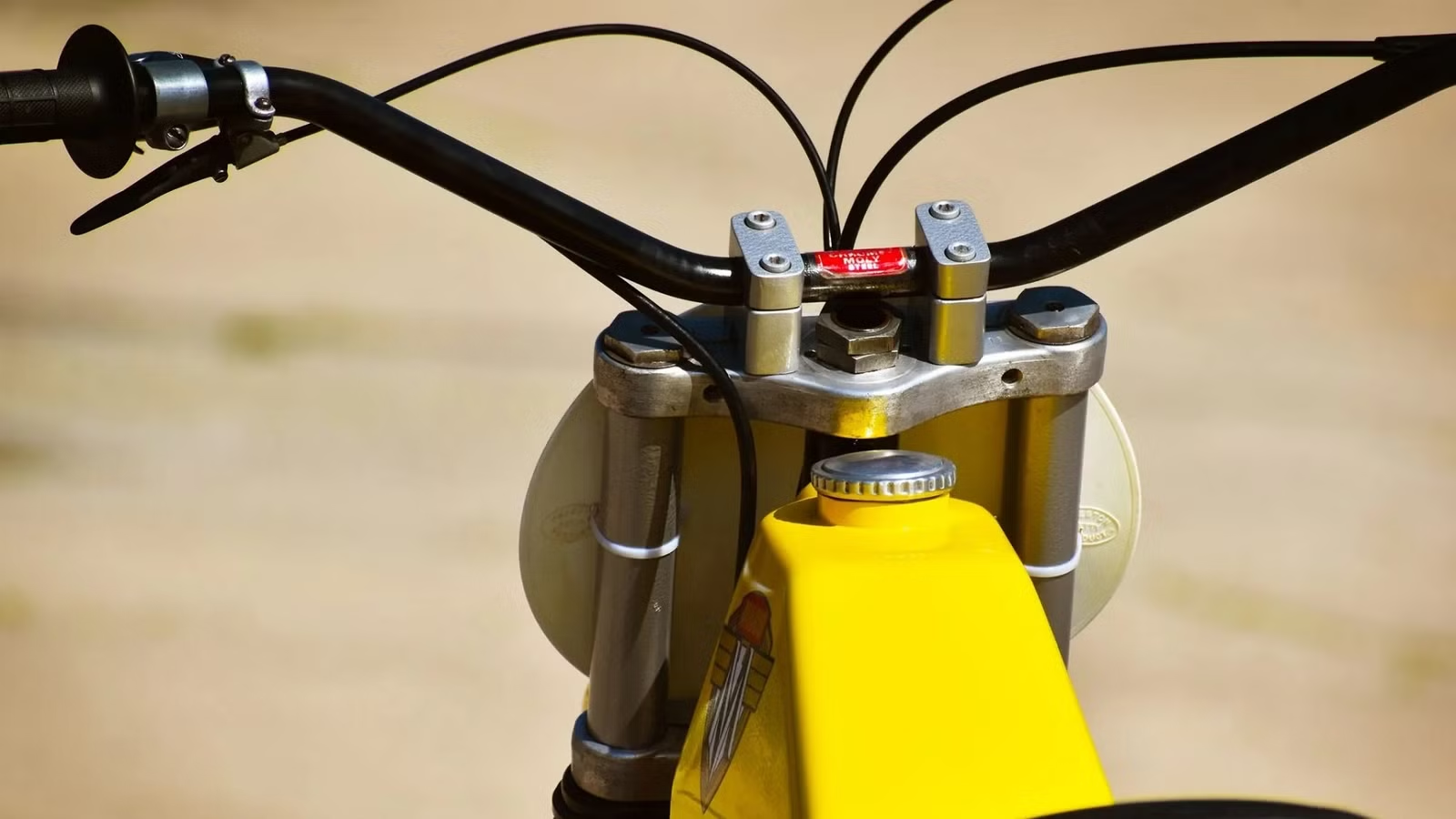
Picture an American race official studying a motorcycle at technical inspection in 1967. The entry form says 354cc, so the ruling seems easy: put it in the 500 class. Yet the machine in front of him looks closer to a lean 250 than the large British singles and twins long associated with open racing. That mismatch was real—a new kind of European two-stroke had arrived, one that used less engine, less mass, and smarter design to challenge America’s idea of a big motocross bike.
America’s Biggest Motocross Bikes Had Become Their Own Handicap

Let’s admit it—American motocross did not begin with purpose-built stadium machines, corporate race teams, or mechanics carrying laptops. It grew from scrambles, desert events and rough natural-terrain races. Many competitors used motorcycles that traced their roots to street machines. Large British singles and 650cc twins carried strong reputations because they had torque, speed, and proven strength. In that world, greater displacement suggested a more serious motorcycle and, by extension, a more serious rider.
That traditional formula came with a bill. A large four-stroke single or twin needed a strong frame, a sturdy gearbox, and enough metal to keep the engine together. Weight climbed quickly as a result. The late Matchless G85CS, one of the old school’s sharper efforts, still weighed about 300 pounds despite its competition focus, and older twins could weigh even more.
These motorcycles offered impressive drive in a straight line, but motocross rarely stayed straight for long. Every turn asked the rider to slow the mass, change its direction and accelerate it again. Rougher tracks made the problem obvious. Maximum power mattered, but so did the time needed to reach it, control it, and recover after using too much of it. A lighter machine could brake later, cut inside a heavier rival and regain speed sooner after a bad landing. It also punished the rider less. By early 1967, the days of the full-size competition 500 were running out because of weight.

The Most Dangerous Number In The Paddock Was 354

The engine that exposed this shift used a 77mm bore and a 76mm stroke. Those nearly equal dimensions produced 354cc. On paper, that number looked awkward rather than revolutionary – it sat far above the 250cc limit, so no organizer could place it among the middleweights. At the same time, it fell well short of the 500cc figure printed above the premier class. It lacked the displacement people expected from a true open-class machine, and it did not bring the physical bulk that usually came with one. The number 354 therefore created a small administrative problem and a much larger engineering one: what exactly defined a 500-class motorcycle?
The answer began outside the cylinder. The engine cases remained similar in external size to those of the manufacturer’s respected 250. The larger motor did not need a huge new bottom end, an oversized chassis, or the visual drama of an engine that appeared capable of powering a cement mixer. It followed the idea of a scaled-up 250. That gave the motorcycle the useful qualities of the smaller class—compact proportions, easier movement, and less unnecessary mass—while adding the torque needed to challenge open-class machinery.
Still, the design involved much more than drilling a larger hole in a 250 cylinder and hoping the crankshaft held up. Engineers increased the size and capacity of the crank assembly and its bearings. They fitted wider transmission gears to cope with the extra load. The connecting rod used a roller-bearing big end, while a substantial wrist pin handled the piston’s greater forces. Even the thick steel cylinder liner served a purpose: its expansion characteristics allowed tighter piston clearances, which helped reduce cold piston slap and compression loss without making seizures a regular part of the ownership experience.
The Maico 360 Oval Barrel Was The Bike That Fit Nowhere

The mystery motorcycle was the 1967 Maico 360, now commonly called the Oval Barrel or round-barrel Maico by collectors. Its curved cylinder finning separates it visually from the square-finned X4 that followed in 1968. The nickname makes the early bike sound gentle, perhaps like something that ought to hold flowers. The riding experience had other plans—the Maico did not need a 500cc engine to become a 500-class motorcycle. Its 354cc two-stroke combined open-class torque with proportions and handling responses closer to a 250. That mix changed what American riders could demand from a large-class machine.
Its 77 x 76mm engine dimensions sat close to square, which helped the motor deliver useful power without relying on a narrow, frantic peak. Power was rated at 29 horsepower at 6,000 rpm for the 1967 motocross and enduro versions. That figure sounds modest beside later open-class claims, but peak horsepower tells only part of the story. The 360 carried strong torque and little more weight than Maico’s 250-based package. It could drive out of loose turns without asking the rider to spin the engine like a dentist’s drill.

Maico also fitted the X3 with a twin-plug cylinder head. Both plugs remained installed, but only one carried the lead wire. When the working plug fouled, the rider could move the cap to the spare and continue. Not glamorous technology, but the kind that could save a race. The later X4 retained that system and added another Maico trademark: a compression release mounted high in the cylinder barrel. The release reduced the effort needed to start the large single.
The big class paradox appeared plainly in the March 1967 road test. Cycle World described the Maico as a motorcycle created to race in the 500cc class even though the engine displaced only 354cc. The bike did not cheat or slide through a secret loophole, though—open-class rules generally treated 500cc as a ceiling or category name, not a command that every cylinder must measure exactly half a liter. The Maico delivered the qualities racers wanted from a 500-class machine without approaching 500cc.
Frank Cooper Made The Import Pipeline Run Both Ways

Frank Cooper played a larger role than that of a businessman opening crates of German motorcycles in California. He served as Maico’s influential West Coast distributor, but he also acted as a racer, promoter, engineer and professional troublemaker when the sport needed one. He had organized early scrambles, promoted desert competition and helped establish major California events. He understood that an imported race bike could not succeed only because it worked in Europe. Cooper collected complaints, test results and mechanical observations, then carried them back to the people who could change the motorcycle.
That system reversed the normal direction of an import business. A conventional distributor received a completed product, advertised it and delivered it to customers. Cooper sent something valuable back across the Atlantic: information. Some changes began with components engineered and tested under American conditions before Maico refined them with its larger factory resources. Cooper even brought a factory engineer to California to witness the dust, speed, poor servicing, and general mechanical cruelty for himself. The resulting motorcycles remained European-built, but American competition helped shape their development.
The speed of that feedback appeared in the 1968 X4. Maico kept the basic 354cc displacement and the same 77 x 76mm bore and stroke, but little else remained unchanged. The factory replaced the rounded cylinder fins with massive square finning and added more cooling surface area. Engineers redesigned the head, enlarged and repositioned the ports, reshaped the combustion chamber, and fitted a revised expansion chamber. Maico claimed 40 hp for the X4.
The X4 also kept the numbers attractive to private racers. It weighed 235 pounds with half a tank of fuel, placing it between the lightest and heaviest contemporary 360s rather than among the old 300-pound giants. Qualified competition riders could buy it for $998.
The Maico 360 Proved Displacement No Longer Defined The Class

American motocross eventually placed clearer labels around the new order. The AMA’s national motocross championship began in 1972 with separate 250MX and 500MX title classes. Official championship records list Gary Jones as the first 250 champion and Brad Lackey as the first 500 champion. A national 125 class joined the structure in 1974. Decades later, the American Historic Racing Motorcycle Association preserved the same basic ladder for vintage competition.
While no located source proves that the AMA created those national categories because of the Maico 360, it was a big part of a new movement. The bike was also joined by 360cc machines from Husqvarna, CZ, and other European makers. The classes emerged during an era that motorcycles like the Maico had already transformed. Its compact 354cc engine showed that “500 class” increasingly meant open performance rather than a starting grid filled only with literal 500cc motorcycles.
Back at that imagined 1967 inspection line, the official could send the Maico into the 500 class without hesitation. The ruling solved the paperwork but failed to explain the motorcycle. It was smaller than the category suggested, stronger than its compact cases implied, and lighter than open-class tradition said it should be.
Source: Maico, Cycle World, AMA

Related posts



Latest Post


No Comments