
The Pontiac That Rewrote The Rules Of The Malaise Era
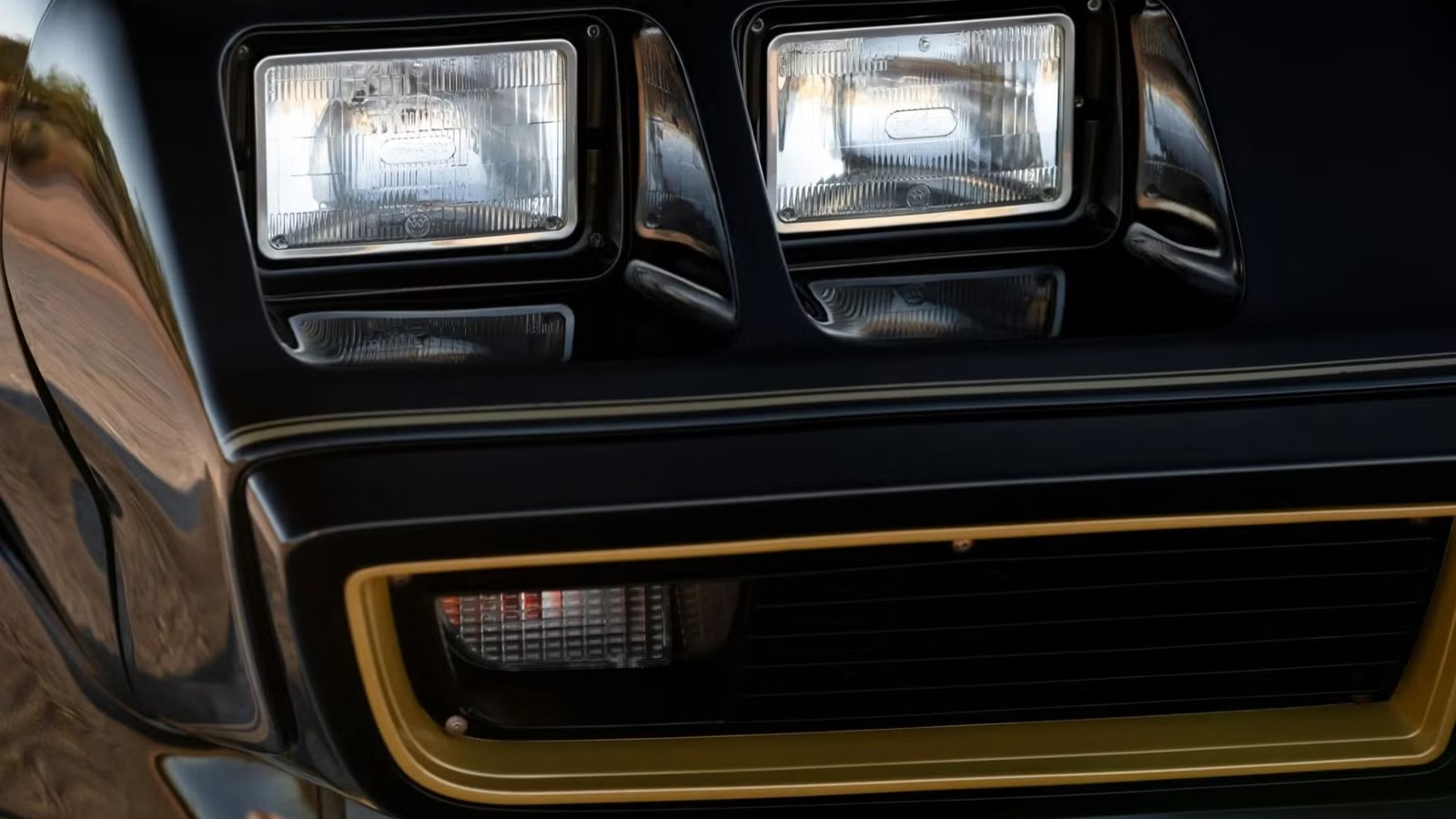
In golfing terms, it is called a Mulligan. The chance to forget and move on from a bad moment and have another shot later down the line. This was the Malaise Era in muscle car history, a time when illustrious nameplates were matched to wheezy engines that would have been better suited to lawnmowers. Better to forget it ever happened, and focus on the second great golden age of the muscle car that arrived just after the turn of the century. But before we try to erase the Malaise, was it really as bad as we thought? One car has the answer: maybe not.
The Malaise Era Spelled The End For The Muscle Car Party

The muscle car is a perfect analogy for pretty much everything that was happening in America in the ’60s. Just like society as a whole, the muscle car was having fun for the first few years after its arrival in 1964, with an irreverent view on life, and brimming with confidence. But this optimism wouldn’t last, and while US society moved into a more sobering decade called the ’70s, the muscle car too was suddenly writing cheques it couldn’t cash. Emissions regulations, gas prices, less disposable income in people’s pockets, insurance premiums rocketing: all these things were conspiring against the freewheeling days of outrageously powerful muscle cars. Suddenly, it seemed, making a car go faster just by using another gallon of fuel a second seemed a little two-dimensional.
Muscle Cars Were Muscular By Name Only
What happened next was just plain weird. Not to pick on any model in particular, but the 1976 Mustang Cobra II summed up what was going on. The car sounded the part (in name) and looked the part too (kind of), but the reality was that it could be specced with a 2.3-liter four-cylinder that pumped out 92 horsepower. 92 horsepower. Cars from this era were slow, often not well-made, and didn’t look that great — these days they are generally worth nothing. The Japanese, however, were having a great time, filling the void with models like the Toyota Celica, which looked a bit like a Mustang, didn’t have much power, but was well-made and contemporary. In the end, the Malaise Era from the mid ’70s to the mid ’80s is probably worth forgetting all about and moving on. Or is it?
The Pontiac Trans Am Turbo Didn’t Play By The Rules Of The Malaise Era


If muscle cars were supposed to now be compact runabouts with go faster stripes and leaf blower engines, no one at Pontiac got the memo. Pontiac wasn’t going to go out like this, so rather than just pack it in altogether, it decided to go down an unconventional route to muscle car power. True, turbocharging had predated even the muscle car, arriving in the Oldsmobile Jetfire in 1962, but it had been forgotten about in America. In Europe, with the likes of Porsche and Saab, turbocharging was the newest tech on the block. Pontiac took its aging 4.9-liter (301 ci) V8 engine and bolted on a single Garrett AiResearch TBO-305 turbocharger. The result was a smaller, more economical engine that hoped to bring back at least some of the performance of a 400.
The Turbo Trans Am Was A Ray Of Hope For Muscle

The execution was a little crude by today’s standards, and the results were not exactly mind-blowing, but the Firebird Turbo of 1980 (available as an option in Trans Am and Formula Firebirds) was a worthy effort. Pontiac added a new oil pump to the unit, reinforced the block and dropped compression to 7.6:1, while adding cool features such as a “Turbo Boost” indicator with LED lights (Normal, Medium, and High) on the hood.
The hood itself was raised to fit the turbo in the bay and the car featured a special rear spoiler identification. The 301 Turbo engine was linked to a Turbo-350 automatic transmission, and a 3.08:1 ratio rear axle. Pontiac also offered a WS6 package, giving the car far sharper handling thanks to upgraded suspension. It would be easy to scoff at the 210 horsepower on tap, and the fairly simple turbocharger set-up, but these were early days of forced induction, and that figure wasn’t bad at all. Far more impressive, however, was the 345 lb-ft available at just 2000 rpm, meaning the Turbo Firebird could waft around with ease just above tickover.
Fast Cars Of The Era Feared The Turbo Trans Am

The Turbo Trans Am was reaching 60 mph between eight and nine seconds when tested. That might not sound like much these days, but that was pretty quick for 1980. Bear in mind that the 1982 Audi Quattro, a car that was the epitome of futuristic sports car tech, featuring a turbocharger and four-wheel-drive, needed 7.8 seconds to reach 60 mph. The Golf GTI, one of the most influential performance cars of all time, needed nine seconds to reach the same speed. A 1980 Chevrolet Corvette had a 190 hp and 280 lb-ft 5.7-liter V8. That would get to 60 mph in 7.6 seconds. In this arena, the Turbo Trans Am was up there with the best.
The Turbo Trans Am Disappeared — But It Lived On In Some GM Greats

The Turbo Firebird had a fighting chance but didn’t really capture the public’s imagination. Despite being used as the pace car for the 1980 Indianapolis 500 and featuring in Smokey and the Bandit II, it only lasted two years before making way for the wedgy third-gen Firebird. Hemmings says that around 6,000 to 7,000 turbocharged Firebirds were made for 1980, and a similar number in 1981 — a far cry from the hundreds of thousands of Firebirds being sold in the late ’60s. There were questions over reliability, and some people felt that the performance figures just weren’t enough compared to the heyday of the ’60s. It was a tough ask.
But in many ways the Turbo Firebird saved the muscle car. GM went on to thoroughly develop the turbocharged 3.8-liter V6 that would appear in the Buick Grand National. That car would then evolve into the highly sought-after GNX. The iconic 1989 20th Anniversary Turbo Trans Am used a Buick V6 and was one of the fastest cars in the world at the time. All these models can at least give a small nod to the 1980 turbocharged V8 Firebird.
The Turbo Trans Am Is An Affordable Icon

Not long ago, the outlandish late second-gen Firebirds would have been an acquired taste, it could be argued, compared to the more toned-down earlier cars. But these days there is plenty of interest in these disco-era cars, and the Screaming Chicken on the hood couldn’t be more eye-catching if it were wearing a white three-piece polyester suit. The late ’70s cars are eye-catching, outlandish, and iconic. That said, the turbo versions won’t break the bank.
Hagerty puts the price of a turbocharged 1980 and 1981 Pontiac Firebird Trans Am in good condition at $25,900. Not cheap, but not exactly expensive compared to the more desirable ’60s muscle cars that were made in small numbers. Over at Bring a Trailer, it is even more encouraging. A project car with part of the engine in the trunk went for $2,400, whereas a really decent looking turbo Trans Am with the WS6 pack sold for just $8,500 in 2024. That is not a lot of money for a very cool-looking car.
Sources: Hagerty, Bring a Trailer, Pontiac, Volkswagen

Related posts


Latest Post


No Comments