
The 1967 Datsun That Outran Britain’s Roadsters Before The 240Z Existed
For most of the 1960s, an American who wanted a proper sports car bought British. MG, Triumph, and Austin-Healey filled the showrooms, the club races, and the magazine covers, and nobody expected that to change soon. Japan was known for cheap sedans and motorcycles, not open two-seaters with real performance. Then Datsun brought out a roadster that looked a lot like the British cars but went considerably faster. It beat them on the road, in the magazines, and on the racetrack, and it did all of this before the Z car was born.
When British Roadsters Ruled American Roads

British automakers built their American sales on light two-seaters with torquey fours and sixes, folding tops, and prices far below the European exotics. The MG MGB arrived in October 1962 and became the default choice, while the Triumph TR4A and the Austin-Healey 3000 offered more muscle for buyers who could stretch their budgets.
These cars earned real loyalty, but they weren’t advanced. The MGB used a 1.8-liter pushrod four making 95 horsepower, and its four-speed gearbox didn’t get synchromesh on first gear until 1968. The Triumph and the Healey used similar iron-block, pushrod engines, so for most of the decade, buying a British roadster meant accepting technology that dated back to the 1950s.
The same cars filled SCCA production class grids across the country, where MGs and Triumphs set the pace in the smaller-displacement classes. Any newcomer hoping to sell sports cars in America would have to beat them there first.

Nissan’s Early Bid To Build A Sports Car

Nissan started building sports cars well before Americans noticed. Its first effort, a 1952 roadster built on truck parts, sold only a handful of copies, and the fiberglass S211 of 1959 managed just 20 or so. The company kept at it, and by 1961 its steel-bodied Fairlady was drawing crowds at the Tokyo Motor Show.
America got its first serious look in early 1962, when Datsun showed its 1500 roadster at the New York International Auto Show, months before the MGB debuted in London. The resemblance to the British cars was obvious, though the Datsun wasn’t a straight copy. With 85 hp and drum brakes all round, it couldn’t yet run with the best British cars, and few of them found American buyers.
Things improved in 1965, when the 1600 brought 96 hp, front disc brakes, and a fully synchronized gearbox. It sold for roughly 20% less than an MGB and held its own on track, giving Bob Sharp the company’s first SCCA national title in F Production in 1967. It was still a car that matched the British rather than beating them, and Yutaka Katayama, who ran Nissan’s US operation, wanted something faster.
The 1967 Datsun 2000 Roadster Explained

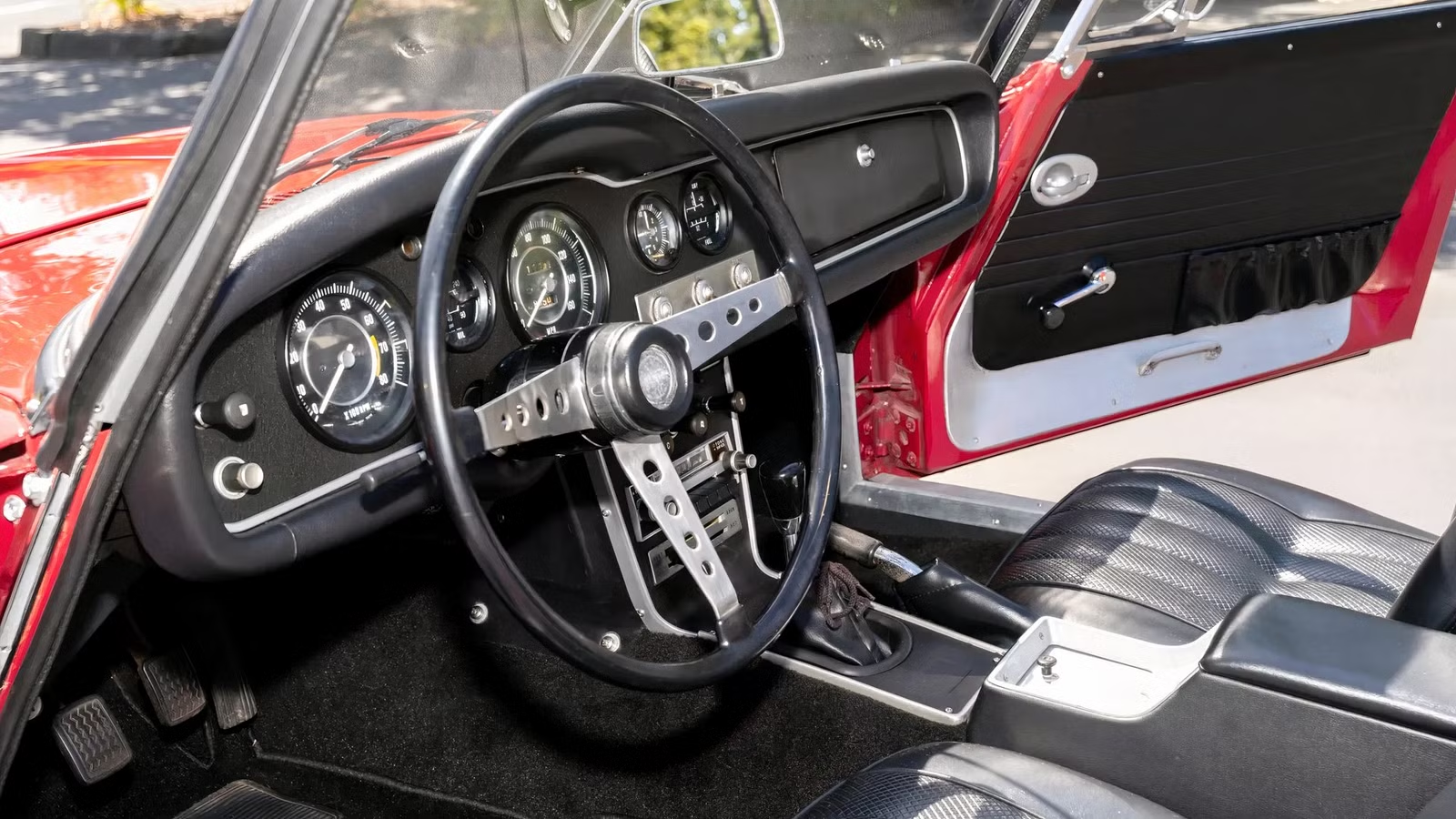
Nissan delivered it in 1967 with the Datsun 2000. Underneath, it shared the 1600’s body and chassis, but the engine was all new. The U20 was a 1,982 cc four with a single overhead cam and an aluminum head, rated at 135 hp at 6,000 rpm and 132 lb-ft of torque in US trim. Every car came with a five-speed manual using Porsche-type synchromesh, and a dealer-installed competition kit with Solex carburetors and a hotter cam raised output to about 150 hp.
With roughly 2,000 pounds to move, the 2000 carried less than 15 lbs per hp. Nissan claims a top speed of 205 km/h, or 127 mph, which made the 2000 the first Japanese production car to break 200 km/h. American testing produced lower numbers, closer to 114 mph. The car was listed at $2,950 when new.
How The Datsun 2000 Outran Britain’s Best

Period tests put numbers on the gap. The MGB ran the quarter mile in 18.7 seconds and topped out at about 104 mph, while contemporary tests had the 2000 covering the quarter in 17.3 seconds and running about 10 mph faster. The Datsun did it with 135 hp against the MG’s 95 hp, plus a fifth gear the British car couldn’t match.
Period testers recorded the best published 0 to 60 time for the roadster in September 1968, when a Solex-equipped car hit 60 mph in 8.8 seconds. The engine explains most of that advantage. The British rivals still used iron pushrod engines, while the Datsun brought an overhead cam, an aluminum head, and a five-speed to the same price bracket.
The Datsun Roadster On American Racetracks

Katayama understood that race wins sold cars, and Nissan’s US arm backed privateers in a way no Japanese automaker had before. For 1968, Peter Brock’s Brock Racing Enterprises received two Datsun 2000s and funding from Nissan. Frank Monise won the SCCA D Production Pacific Coast championship in one of them that year, proving the car could beat the British roadsters that dominated the class. Those BRE cars also gave the 2000 its signature striped livery, a look that still shows up on restored roadsters and reproduction decal kits today.
BRE arrived at the 1969 Runoffs at Daytona as the team to beat. John Morton put a Brock-prepared 2000 on pole, but both team cars lost their engines while leading. Even so, Datsun drivers took seven of the top eight places in the class that year.
The SCCA Champions Who Proved The Datsun’s Speed

BRE’s bad luck didn’t stop the Datsun from winning. Privateer Jack Scoville took the 1969 D Production national title at Daytona in his 2000, beating both the BRE and Bob Sharp teams. That started a run of four straight D Production titles, with Jim Fitzgerald winning in 1970 and Bob McQueen taking the next two in an ex-BRE car.
McQueen’s 1972 win at Road Atlanta came against factory Triumph GT6 entries, the same British maker whose cars had owned these grids a few years earlier. The 240Z that followed went on to win C Production titles with John Morton in 1970 and 1971.
Sources: Sports Car Market, Remember Road, Datsun Roadster Association, SCCA, Classic.com, Hagerty, Mecum, Bring a Trailer.

Related posts
Latest Post


No Comments