
Ford’s Biggest Gasoline V8 Was A Heavy-Duty Monster That Wasn’t Built For Muscle Cars
When automotive enthusiasts talk about Ford’s legendary V8 performance engines, the conversation usually leads to the high-revving Boss 302, the massive 429 Cobra Jet, the legendary 427 FE, or perhaps the modern, high-tech 7.3-liter “Godzilla” engine. All are powerplants designed to conquer drag strips, NASCAR ovals, and street races. Yet, none of these legendary engines comes anywhere close to holding the title of the largest gasoline V8 Ford ever engineered. To find Ford’s true displacement king, you have to travel back to the early 1940s, to a time when Detroit turned its massive industrial machine away from civilian automobiles and toward the fight for global survival.
The Government Needed Ford’s Help

Following the attack on Pearl Harbor in December 1941, the United States plunged headfirst into World War II. Overnight, the nation’s vast manufacturing network shifted into what President Franklin D. Roosevelt called the “Arsenal of Democracy.” Commercial automobile production was completely halted, and America’s auto titans were called upon to manufacture airplanes, artillery, ammunition, and armored vehicles.
Among the highest priorities for the U.S. Army was the production of medium tanks. Thousands of armored vehicles were needed to fight across the deserts of Africa, the muddy fields of Europe, and the jungles of the Pacific. Building the steel hulls and tracks was one challenge, but finding a suitable, reliable engine to move a heavy medium tank was an even bigger hurdle.
Tanks Needed More Reliable Power

In the urgent rush to ramp up war production, the tank manufacturers were forced to rely on whatever big displacement engines were readily available. Initially, some tanks were powered by the Continental Wright R-975, a nine-cylinder, air-cooled aviation radial engine. While it got the job done, radial aircraft engines were far from ideal for ground combat. They ran hot, idling choked them with unburned fuel, spark plugs frequently fouled, and their tall, circular design forced engineers to build tall tank hulls that made them easy targets for enemy gunners. Furthermore, the Air Corps needed every radial engine it could get for its aircraft.

Other automotive manufacturers came up with creative solutions. General Motors mated two inline-six diesel engines together to form the Twin 6046. Chrysler engineered the bizarre A57 Multibank—a complex monstrosity made by joining five 250-cubic-inch Chrysler Royal inline-six-cylinder engines around one crankcase. This engine had 30 cylinders, 60 valves, and five carburetors. It was a nightmare for field mechanics to keep tuned and synchronized under combat conditions. The U.S. Army desperately needed a single, purpose-built, highly reliable engine designed specifically to meet the demands of heavy, ground-based armored warfare.
Ford’s Giant Engine Borrowed Aircraft Technology Instead Of Muscle-Car Ideas

Before the outbreak of war, Henry Ford had looked into manufacturing the legendary British Rolls-Royce Merlin V12 aircraft engine under license in Detroit. However, political friction and Henry Ford’s personal aversion to building equipment for foreign governments killed the deal. Ford decided to build an all-American aircraft engine that would outperform the Merlin. Ford’s talented engineers went to work designing a 1,650-cubic-inch (27-liter) V12. It was an absolute engineering masterpiece, featuring state-of-the-art features like all-aluminum construction, double overhead camshafts (DOHC), four valves per cylinder, and a flat-plane crankshaft.
Despite its brilliance, the U.S. Army Air Corps ultimately declined to adopt Ford’s V12, having already committed heavily to the Allison V-1710 and the Packard-built Merlin. Millions of dollars in engineering, tooling, and development were about to go down the drain when the tank power crisis emerged. When the Army asked Ford for help with engines, they didn’t start from scratch. Instead, they pulled the blueprint for their advanced V12 and chopped four cylinders off the design. By retaining the overall architecture, cylinder dimensions, overhead-cam design, and manufacturing tools for the proposed V12, Ford transformed its aviation project into a brand-new, ultra-advanced V8 tank engine in record time.
The GAA Is Ford’s Largest Gasoline V8 Ever Built
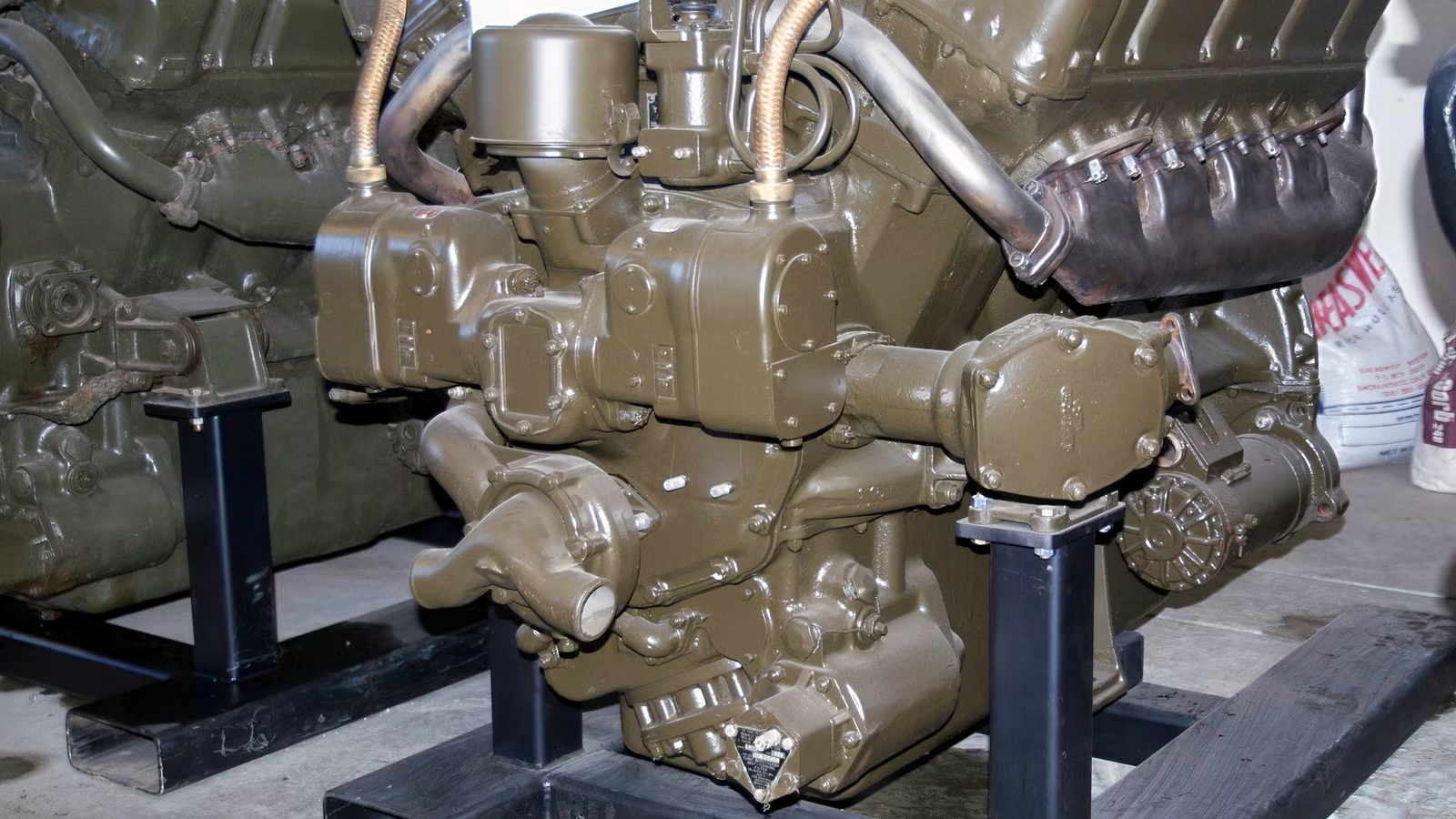
The final creation was designated the Ford GAA V8. By automotive standards, this engine was huge. It was five feet long, four feet tall, three feet wide, and weighed 1,470 pounds dry. Its physical dimensions were matched only by its incredible displacement. It had a displacement of 1,100 cubic inches and was making 500 hp at 2,600 RPM and 1,050 lb-ft of torque at 2,200 RPM.
For context, the biggest modern heavy-duty Ford truck engine is 7.3 liters. The Ford GAA was 18 liters. All of its torque was made near idle, giving heavily armored vehicles weighing over 66,000 lbs the massive low-end grunt required to drag tens of thousands of pounds through mud, sand, and steep inclines.
Built Specifically For The M4A3 Sherman

When the GAA V8 was dropped into the engine bay of the Sherman tank, it created the M4A3 variant. The M4A3 quickly became the absolute favorite variant among American tank crews and commanders in Europe due to its superior power delivery and ease of field maintenance.
Ford produced the M4A3 Sherman at its Highland Park plant, but the demand for the GAA engine was so great that the GAA was used across multiple tank designs and variations. GAA V8 variants (including the modified GAF and GAN versions) powered tanks like the M4A3E2 “Jumbo” Sherman assault tank, M10A1 Wolverine tank destroyer, M7B1 Priest self-propelled artillery, and M26 Pershing heavy tank (powered by the GAF variant). By the time war production ceased in 1945, Ford had manufactured over 28,000 GAA-series V8 engines, making it one of the most widely produced high-displacement military engines in history.
What Made The Ford GAA Such A Good Engine

Engineers and war historians still admire the Ford GAA V8 today because it brought genuine aircraft-grade technology to combat grounds. In an era when most American cars were using basic cast-iron blocks with basic flathead or pushrod valve designs, the GAA was decades ahead of its time. It had dual overhead camshafts with four valves per cylinder (32 valves), an all-aluminum cylinder block and head for weight savings, a gear-driven system for the water pump, fuel pump, and oil pumps to ensure reliable operation, and two independent magnetos and twin spark plugs per cylinder for maximum operational redundancy. When compared to the German tank engines of the era, the all-aluminum Ford GAA was significantly more advanced, far lighter relative to its power output, and infinitely more durable.
It Was Built To Be Reliable and Durable

High-tech aircraft engines are usually fragile, but Ford managed to combine top-tier technology with bulletproof durability. The engine was originally designed to produce about 1,800 to 2,000 hp as a supercharged aviation engine; detuning it to 500 hp for tank usage meant it was barely stressed. Internal components like the forged steel connecting rods, forged aluminum pistons, and massive main bearing caps were virtually indestructible under normal operating conditions.
In combat, the Ford GAA proved it could take unbelievable abuse. It ran reliably through sub-zero European winters, blistering desert heat, fine dust, thick mud, and severe lack of routine maintenance. While other tank engines choked or required constant overhauls, the Ford GAA gained a legendary reputation for starting up every single time crews turned the key.
Why Ford’s Largest V8 Still Deserves To Be Remembered

When car enthusiasts think of massive Ford engines, the usual performance big-blocks come to mind, like the Boss 429 (7.0 liters) and 7.3 Godzilla (7.3 liters), but the GAA dwarfs them. To put the sheer scale of the 1,100-cubic-inch (18.0 liters) GAA into perspective, it is bigger than two 7.3-liter Godzilla V8s combined (14.6 liters) and is nearly three times the size of the legendary Boss 429 (7.0 liters) muscle car engine.
After the war, surplus GAA engines even found a second life in civilian motorsport. Hot rodders, tractor-pull competitors, and drag racers realized the immense potential of the over-engineered block. With modern forced induction (turbos or superchargers) and modern fuel systems, these 1940s wartime GAA blocks have the potential to make well over 2,500 hp.
It Proved Ford Could Build A World-Class Engine

Today, no one bats an eye when Ford designs a complex, high-performance engine like the dual-overhead-cam 5.2-liter “Predator” V8 or a twin-turbocharged EcoBoost V6. We take Ford’s high-tech engineering capabilities for granted. However, back in 1940, Ford was still primarily known for mass-producing simple, low-cost, side-valve flathead engines for the working class.
The GAA V8 was the project that proved to the military and the automotive world that Ford could step onto the global stage and build a world-class aluminum powerhouse capable of out-engineering the best military minds in Europe. It didn’t win car shows or set quarter-mile records on 1960s drag strips, but it did something far more important: it helped win World War II. And that is why the mighty 1,100-cubic-inch Ford GAA deserves to be remembered among the greatest V8s the Blue Oval ever built.
Sources: Ford, Fordgaaengine.com, Theshermantank.com, War.gov, National Air and Space Museum.

Related posts

Latest Post


No Comments