
The KTM Motorcycle Balances Razor-Sharp Backroad Agility With Upright Daily Street Comfort
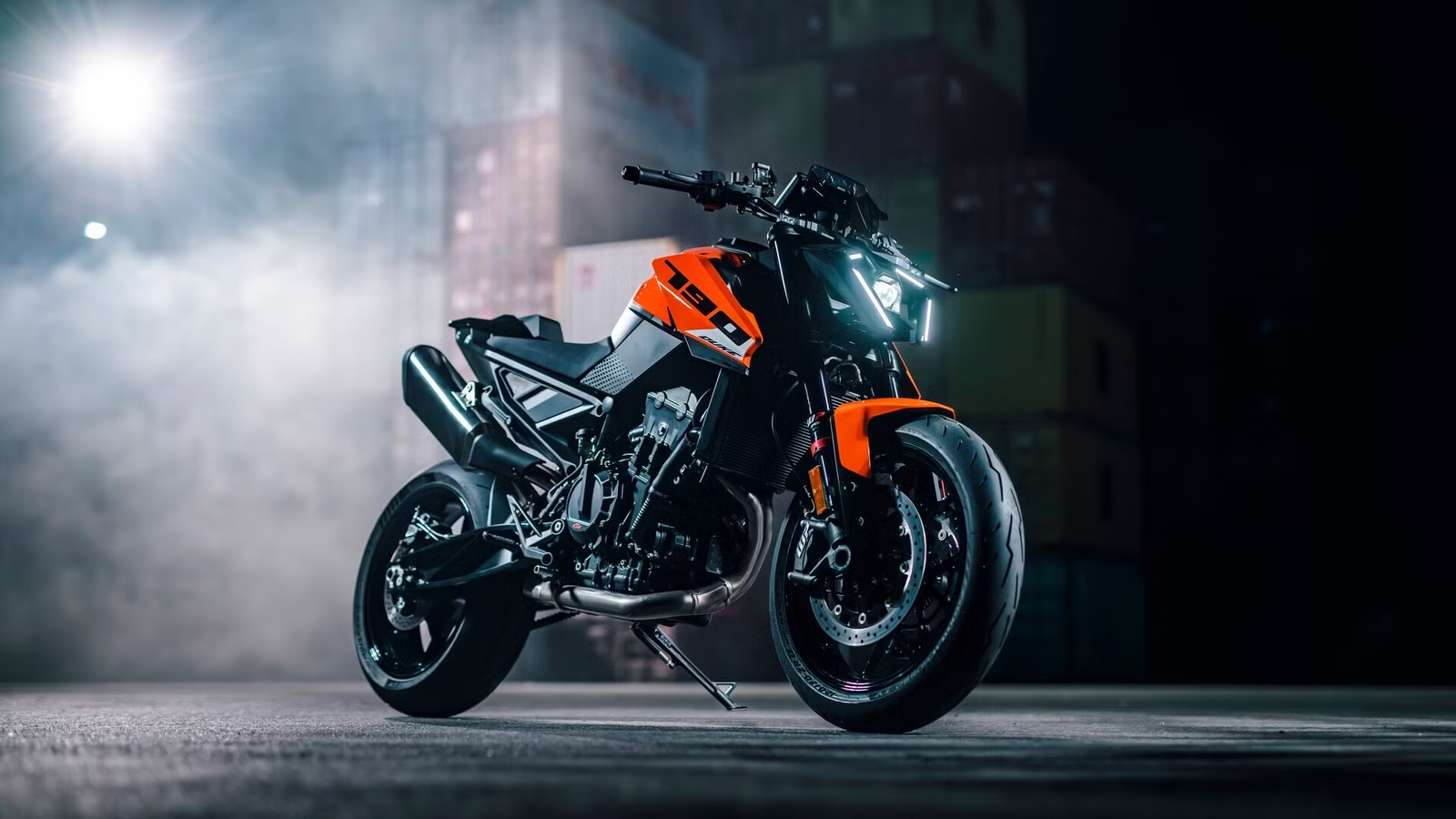
KTM built its global reputation on hardcore off-road racing. Soon after, it translated that aggressive mindset directly into performance-focused street bikes. Today, there is an army of performance-centric machines in its arsenal that focus on aggression first, usability second. Look closely, though, and there is a machine that takes a slightly different path. It trades extreme race-focused performance for everyday usability, getting you a practical daily machine without sacrificing the sharp chassis dynamics and engine response that define the Austrian manufacturer.
The Middleweight Naked Class Brings A Trade-Off Between Performance And Practicality

The middleweight naked category presents a constant trade-off. Budget-oriented parallel twins keep purchase prices low, but manufacturers cut costs by using basic suspension hardware and budget brakes, resulting in soft handling and uninspiring power delivery. Conversely, premium middleweights offer sophisticated electronics and powerful engines, but they run hot in traffic, demand aggressive riding postures, and cost more.
It’s the same story with KTM’s lineup. The focus usually leans toward sharp, uncompromising performance that can prove tiring in daily commuting. Finding a middleweight that balances dynamic capability with daily comfort remains difficult for riders who want a versatile motorcycle.

What’s the solution? KTM handled this by relying on a mature, thoroughly tested parallel-twin platform, cutting production expenses and solving early manufacturing problems while keeping premium hardware intact. The motorcycle retains a six-axis IMU, one of the highest power outputs in the segment, and a rigid, lightweight frame. This approach delivers lower ownership costs and proven reliability without watering down performance.

The KTM 790 Duke Offers Balance, Not Compromise

The KTM 790 Duke serves as the well-rounded motorcycle in the brand’s Duke lineup. Known as “The Scalpel,” the 790 Duke balances performance with everyday usability by packaging an established, reliable platform at a relatively competitive price point. It has doubled down on that competitiveness with a major update for 2027.
It features an upright riding triangle that works well in heavy urban traffic, matched with strong low-to-midrange power and a sophisticated electronics package that rivals premium examples in the segment. It filters easily through city streets while remaining fast and composed on twisty backroads, proving KTM can build an affordable, practical motorcycle that still delivers sharp performance.
A $9,799 Price Leaves Room For Software Upgrades

KTM has always been a premium brand, and even though the 790 Duke is supposed to be a value product from the KTM stable — what with its manufacturing being in China — it still lands in the premium tier of midsize naked bikes. This holds especially true when you throw in what you feel should have been standard on a premium middleweight, like a two-way quickshifter and cruise control. This is what you need to keep in mind when you look at the $9,799 base price, but it remains the best KTM motorcycle for new riders who want performance on a budget.
The 799cc LC8c Parallel Twin Delivers Snappy Low-RPM Punch

This is essentially a 10-year-old engine, but it is good enough to even power a new middleweight sport bike from the Austrian brand. It generates 103.6 horsepower (at 9,000 RPM) from 799 cc, and uses a parallel-twin configuration with a 285-degree firing order to mimic its 75-degree V-twin siblings. 64 pound-feet at 8,000 RPM is also present. This is put through a six-speed manual transmission with an assist-and-slipper clutch. A two-way quickshifter is an optional extra.

The engine’s horsepower combined with the Duke’s low weight offers pupil-dilating performance, with the shove at the low end of the rev range especially deserving of praise. It will get to 60 miles an hour from a standstill in just 3.1 seconds and on to a top speed of 146 MPH—figures that would make some liter nakeds proud.
Adjustable Suspension Fixes One Of The Old Weak Links Of The 790 Duke

The 790 Duke has a tubular chromium-molybdenum steel trellis frame that uses the engine as a stressed element like any other KTM. It has WP Apex suspension: 43 mm open cartridge inverted front forks paired with a monoshock at the rear. KTM has given it a minor refresh in 2025, and for MY27, the brand has now added adjustment for compression and rebound damping at the front, and preload and rebound damping at the rear. Previously, the only suspension adjustment available was rear preload.

The brakes have been upgraded as well, with WP replacing the J.Juan setup. The specs remain the same, with twin 300 mm discs at the front with four-piston radial fixed calipers and a 240 mm disc at the back with a single-piston caliper. KTM claims the new WP brakes offer better feel, feedback, and power. They are mounted on 17-inch alloy wheels fitted with tubeless radial tires. The result is a machine that might not seem like it will have premium handling, but the well-tuned chassis and powerful brakes ensure that it stays up to the standards of KTM performance.
A Sub-370-Pound Dry Mass And 58-Inch Wheelbase Maximize Fun
This is a very compact motorcycle – it is 81.2 inches long, but the wheelbase is an incredibly short and fun 58 inches. The seat’s standard height is 32.5 inches, but there is also a PowerParts accessory seat that can drop it to 31.7 inches, making it more manageable to a wider audience. The weight has also dropped to 368 pounds from 372.6 pounds without fuel. The combination of low seat, light weight, and narrow waist makes it one of the best motorcycles to have in the city, whether you’re a beginner or a veteran rider whose back is having a bad day.
Losing The Demo Mode Has Made The Feature Set Clearer

The first look of the 2027 790 Duke shows that it has an updated electronics suite to help you keep the rubber side down, beginning with the redesigned five-inch TFT display and navigation buttons on the handlebar. It has all-LED lighting, and the design has been updated to reflect current Dukes. There were some gremlins with quality during its manufacture in Austria, but in its second innings it is now manufactured by CFMoto in China. That has put to rest the questions about quality.

As standard, there are three ride modes, and ABS can be turned off at the rear. The dreaded ‘Demo Mode’ has gone and is replaced by optional packages, beginning with the Track Pack. This adds launch control, a fourth ride mode (Track Mode), wheelie control, MTC slip adjustment, and a display that shows telemetry and a lap timer. You can add the Tech Pack on top of the Track Pack, and it adds motor slip regulation, cruise control, and the quickshifter. KTM has also included Bluetooth and navigation as standard features with the ’27 MY refresh; they were options earlier.
Platform Siblings And Japanese Triples Pressure The 790 Duke On Value

This is a surprisingly crowded segment, so we’re going to have to limit ourselves to motorcycles that are priced roughly the same as the 790 Duke, which eliminates stalwarts like the Yamaha MT-07 and Aprilia Tuono 660 Factory. We start with its twin, the Husqvarna Svartpilen 801 SE that was launched in America in 2024. Under the skin, it is exactly the same motorcycle, but it costs a little more at $10,799, because Bluetooth, navigation, and the quickshifter are unlocked for that base price. You still have to pay more for Track mode that gives you cruise control and granular control over parameters like slip angle and back-torque.

If you like the KTM 790 Duke and are on a budget, the CFMoto 800NK delivers the thrills without the debt at $8,199 and is mechanically the exact same motorcycle as the 790 Duke. However, this is the base model available in the US market so that it doesn’t tread on the toes of the KTM. It still has a two-way quickshifter, cruise control, and a steering damper.

The Triumph Street Triple R is the base model of the Street Triple range, which is why it is priced at $10,595. This is a sleeper that everyone overlooks; it gives you access to Triumph’s free-revving inline three-cylinder engine, a two-way quickshifter, switchable cornering traction control, wheelie control, and the signature twin-headlamp Triumph look. The part-LCD, part-TFT instrument cluster design is polarizing, though.

The Japanese competitor to the KTM is the Yamaha MT-09, which can do it all. It is technically in a class above, but it costs $10,899, which is incredible value, and the reason it is here. The CP3 crossplane inline engine is a legend in its own right; it generates more power than the KTM at 117 horsepower, and it is fantastically reliable since it is a mature design. You also get all the bells and whistles, including cruise control, a third-generation quickshifter that allows you to upshift or downshift irrespective of whether the throttle is open or shut, adjustable wheelie control, and even Yamaha’s Slide Control System.
Source: KTM USA

Related posts

Latest Post


No Comments