
You Could Retire Right Now If You Bought This Used Dodge Muscle Car Back In 1985
By 1985, the muscle car era felt like ancient history. Fuel crises, insurance surcharges, and emissions rules had killed off the big-block brawlers, and most of the survivors were just tired old cars with thirsty engines and rusty quarter panels. Dodge had built some of the wildest of them all, and by the mid-’80s, plenty of those cars sat in classified ads for less than a new economy hatchback. One of them, though, was something very different. Anyone who bought it back then and simply kept it could now be sitting on a retirement fund with a wing on the back.
When Muscle Cars Were Just Old Cars

It’s hard to overstate how little old muscle was worth in the mid-’80s. Enthusiasts who saved period newspaper classifieds have shared what they found, and the numbers are painful to read now. A 1985 Pittsburgh Press ad listed a 383-powered Dodge coupe for $4,500, while another reader recalled a one-owner big-block R/T for $600 in 1984. Rougher examples went for even less.
Even the rarest Mopars weren’t safe from the slump. A December 1983 ad for a Hemi ‘Cuda showing just 383 miles asked only $12,000, a car that would later sell for well into seven figures. The collector market existed, but it was small, and most buyers saw these cars as cheap fun rather than investments.
The Dodge Built Only To Go Racing


Some Dodges from that era were never really meant for the street. They existed because NASCAR’s homologation rules required a manufacturer to sell a minimum number of road cars before it could race a design, and Dodge needed a shape that could cheat the wind on superspeedways. The result looked nothing like anything else in a late ’60s showroom.
Buyers didn’t know what to make of it. Some dealers struggled to sell their allocation, and a few owners even had the race-inspired bodywork removed so their cars looked normal again. That reputation as an oddball is exactly what kept prices low for years, and it’s why a handful of patient owners eventually did very well.
The 1969 Dodge Charger Daytona Hemi Explained

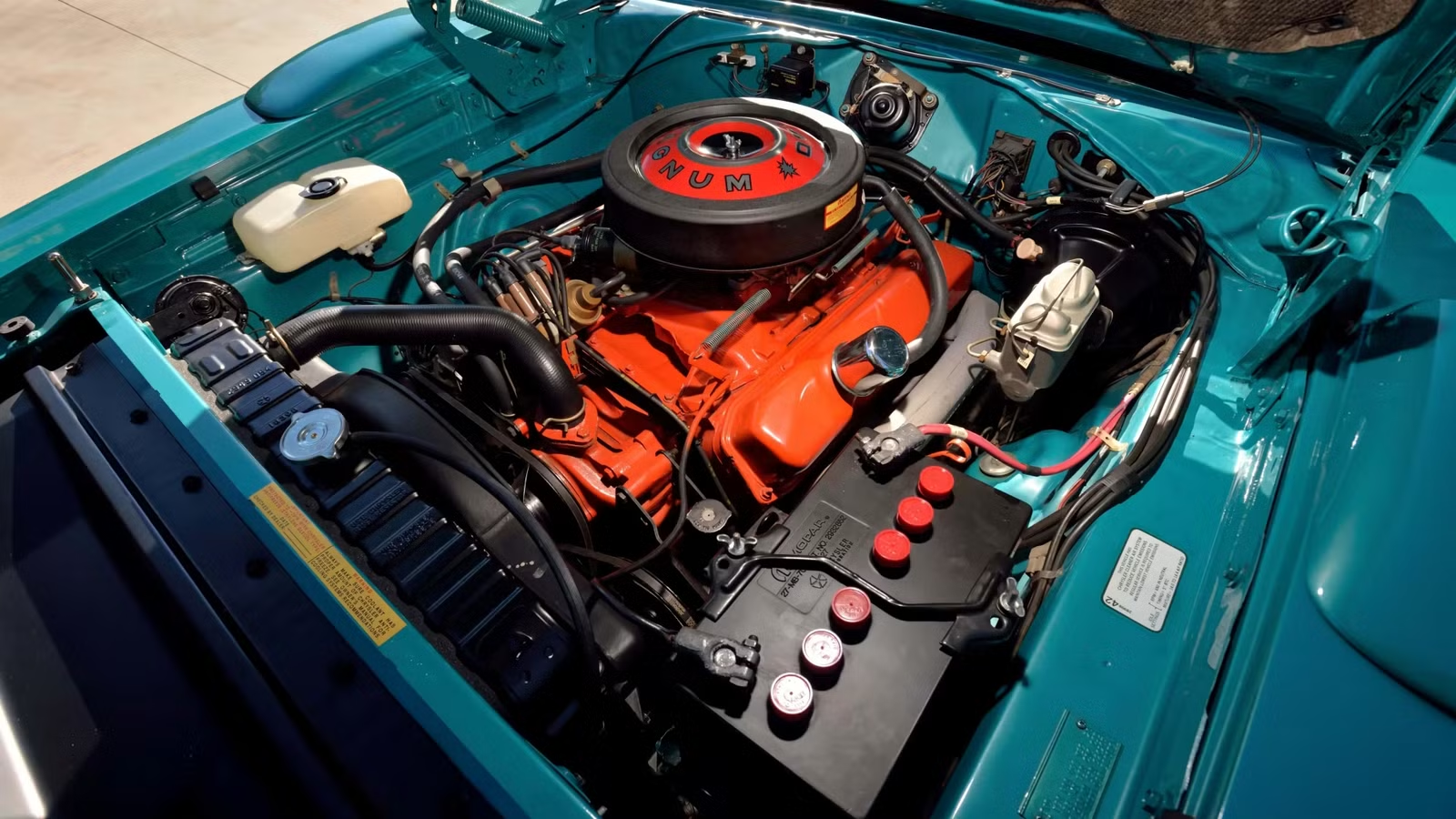
The car was the 1969 Dodge Charger Daytona, and its pointed nose cone and towering rear wing were pure aerodynamic engineering. In NASCAR trim, the Daytona became the first car to officially top 200 mph on a closed course, when Buddy Baker hit 200.447 mph at Talladega in March 1970. Most road cars used the 440 Magnum V8, but the one to own carries the 426 Hemi, rated at 425 horsepower and 490 lb-ft of torque.
Production figures are where things get murky. The most widely cited total is 503 Daytonas, of which roughly 70 carried the Hemi and only around 22 of those had a four-speed manual. Some historians argue the true count differs slightly, since a few cars may have been built on other Charger VINs, so the Hemi number is best treated as approximate rather than exact.
What A Hemi Daytona Cost In The 1980s

Nobody kept a ledger of Hemi Daytona sales in 1985, but the market around it leaves little doubt about where prices sat. The 383-mile Hemi ‘Cuda asking $12,000 in 1983 was about as desirable as a Mopar got, while big-block Dodge coupes from the same era routinely changed hands for under $5,000. Drop a Hemi Daytona into that market, and it lands between $10,000 and $20,000, with a tired example at the bottom and a clean, four-speed car at the top.
Those prices held because the Daytona was still a niche taste. Serious Mopar collectors knew exactly what a Hemi winged car was, but the wider market hadn’t caught on, so a buyer with $15,000 and some patience faced little competition for the best cars.
What A Hemi Daytona Is Worth Today

Those insiders were right. Hemi Daytonas now trade at a market average near $1.45 million, and the record stands at $3 million for a car sold on August 14, 2024. Run the numbers on that 1985 range, and the return is staggering. A $15,000 purchase turning into a $1.45 million car means close to a hundredfold gain, before you count the record sale.
Why Not Every Winged Mopar Is A Safe Bet

Winged Mopar values can swing hard, and the Plymouth Superbird proves it. A Hemi Superbird that sold for $1.65 million at Barrett-Jackson in 2022 later crossed the block for $418,000 at Mecum Indy in 2025, offered with no reserve. That drop came down to that car’s specifics rather than a market collapse, but it’s a useful warning. Documentation, originality, and drivetrain matter enormously, and a Hemi Daytona with the wrong paperwork won’t command a top-tier price.
Could You Still Retire On A Hemi Daytona

For anyone who bought a Hemi Daytona in 1985 and kept it original, the answer is a clear yes. Even at the market average, a seven-figure sale would fund a comfortable retirement for most Americans, and a car with the right options and history could do far better.
The lesson is less about predicting the next big collector car and more about patience. In 1985, the Daytona was an odd, unloved homologation special with a strange nose and a silly wing. Four decades later, that same oddity is exactly what makes it one of the most valuable American muscle cars ever built.
Sources: For B Bodies Only, Fox News, Classic.com, Hagerty, Mecum.

Related posts


Latest Post


No Comments