
How A Sunroof Company Built The Greatest Performance Cars In American History
Great cars often come from humble beginnings. Henry Ford used to work as a steam engine repairer; Carroll Shelby was once a chicken farmer; and Ferruccio Lamborghini famously made tractors. All these people went on to change the world of automobiles, dreaming big and creating revolutionary road cars.

But there was one company that changed the US (and European) performance car market that most people don’t know about. To put it another way, Kendrick Lamar’s Super Bowl LIX halftime show wouldn’t have been anywhere near as spectacular if a German cab driver hadn’t started cutting holes in the roofs of cars during the ’60s. This is the story of the most unlikely hero of the American Sports Cars scene.
Some Of America’s Greatest Cars Came From A German Exchange Student
Heinz Prechter was a foreign exchange student from West Germany, who came to San Francisco state to study. Not afraid of hard work, Prechter was a farm boy who worked in his uncle’s auto repair shop and had also worked as a cab driver in Germany, so he got himself a part-time job in a body shop to help finance his one-year placement in California. But at heart, Prechter was an entrepreneur. Noticing that aftermarket sunroofs weren’t as big in America as they were in Germany, he secured a deal with Golde, a leading sunroof company in Europe, to start installing them aftermarket.

Before long, his firm, American Sunroof Company, was fitting sunroofs into the cars of high-end customers out of its shop in Los Angeles. It could have easily ended there as a boutique sunroof company, but Prechter’s work was noticed by Ford. He first got a contract to do custom work for the Blue Oval, going on to fitting factory installations in cars like the Mercury Cougar toward the end of the ’60s. But Prechter was just getting started.
The American Sunroof Company Quickly Went From Humble To Greatness

By the mid-’70s, ASC was also doing high-end coachbuilding, specializing in extravagant custom creations, concept cars, and wagon conversions. ASC also saw a gap in the market, with the lull in demand for factory convertibles, creating the Buick Riviera drop-top in 1982. Essentially, ASC took the hassle and cost of making a convertible variant from manufacturers by developing it themselves. Other carmakers started lining up to work with ASC, with the company helping out with convertible versions of the Chevrolet Camaro, the forward-thinking Buick Reatta, and the Dodge Dakota pickup truck. But ASC was especially useful to those who knew a convertible was vital to the American market but didn’t have the resources to develop one in their country of origin.
The Company Didn’t Just Work In America

Now employing some 2,000 people, ASC was far more than just a sunroof specialist. Saab asked ASC to create the iconic 900 Convertible, and the company also took care of the Nissan 240SX and 300ZX cabrios. It later added the complex but wonderfully executed Mitsubishi 3000GT Spyder to its to-do list. The German arm of ASC, Prechter GmbH, also produced the attractive 944 S2 convertibles, while ASC also assisted with the BMW Z3 and Z4. ASC also completed the Toyota Celica Speedster concept for the Detroit Auto Show in 1991, which paved the way for a standard convertible version for production.
Few companies in the automotive world can claim to have worked across such an extensive range of models from different countries. But the moment when ASC truly expanded was when it acquired the US-based McLaren Engines operation located in Livonia, Michigan, during the 1980s. ASC was keen to add powertrains to its offerings and bought the company when McLaren’s racing division had moved largely to the UK. The initial ASC/McLaren Fox-body offerings weren’t dramatically more powerful, but ASC focused heavily on structural rigidity and interior refinement of the vehicle. When Buick approached the company to build a limited-edition range topper, it jumped at the chance.
The Buick GNX Was The Work Of A Sunroof Company

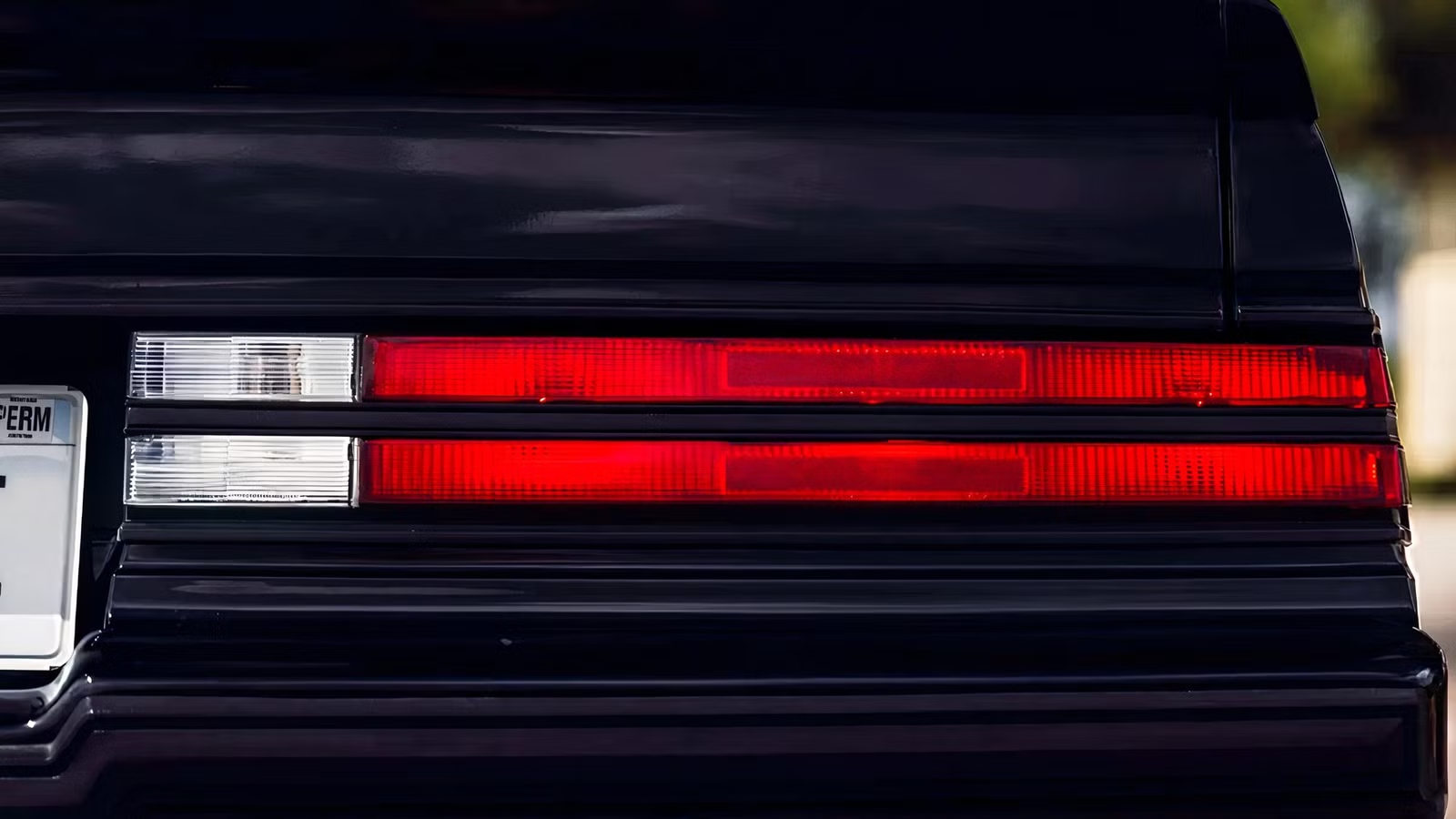
Buick turned to ASC Inc. and McLaren Engines to develop a final showstopper to celebrate the end of the Buick Grand National, itself the performance version of the mid-sized Regal. ASC/McLaren improved the GNX—the acronym standing for Grand National Experimental—by adding a Garrett AiResearch T-3 turbocharger, free-flow heads, dual mufflers, a turbo Hydromatic 200-4R transmission, and a host of other upgrades, boosting output to 276 hp and 360 lb-ft of torque. Larger 16-inch black mesh aluminum alloy wheels and an improved rear suspension meant that the GNX had a better chance of channeling that power down into the asphalt. The all-black exterior gave it the menacing presence of Darth Vader.
ASC/McLaren built 547 GNXs under contract for Buick, with the cars retailing for a whopping $29,900 in the US. The GNX had absurd performance and was the fastest car of its time in America, with a sprint to 60 mph that could barely be matched by Italian exotics. Who would have thought that it came about from a sunroof company that started in an LA garage?
Buying An ASC Product From Cheapest To Priciest

If you want to buy an ASC product, then there are plenty to choose from. In 2005, ASC completed its one-millionth convertible top system, which is quite some milestone. It wouldn’t be hard to find a high-mileage BMW Z3 in need of some attention that costs a few thousand dollars, but if you want to look at ASC-badged cars, your cheapest entry point would probably be a Pontiac Grand Prix Turbo. Powered by a turbocharged 3.1-liter V6, these feisty coupes tend to come in around the $15,000 mark for a good one, but you can expect to pay more like $10,000 for something in need of a bit more love.
The GNX Is One Of The Hottest Muscle Cars On The Market Right Now

Slightly higher up the scale of ASC products is a 1989 Porsche 944 S2, which Hagerty Valuation Tools gives a good-condition price of $27,000. Good Mercury Capri ASC McLarens can go for $25,000 in coupe form, but you can pick up well-used convertibles for just $6,000. This leads us to the crown jewel of ASC: the Buick GNX. These blacked-out ’80s muscle cars are highly sought after right now, helped by Lamar’s Super Bowl appearance standing on top of one (though not actually a real one).
You can expect to pay $130,000 for a good-condition example of one of these ultra-rare turbocharged coupes in 2026, says Hagerty. Sadly, having experienced mental health problems for a long time, Heinz Prechter died by suicide on July 6, 2001, at the age of just 59. Prechter, along with ASC, may not be as well known as some of the great pioneers in the US car industry, but his impact is hard to overstate.
Sources: Hagerty

Related posts




Latest Post


No Comments