
The 1,000-HP Mustang Ford Built For Soldiers Instead Of Showrooms
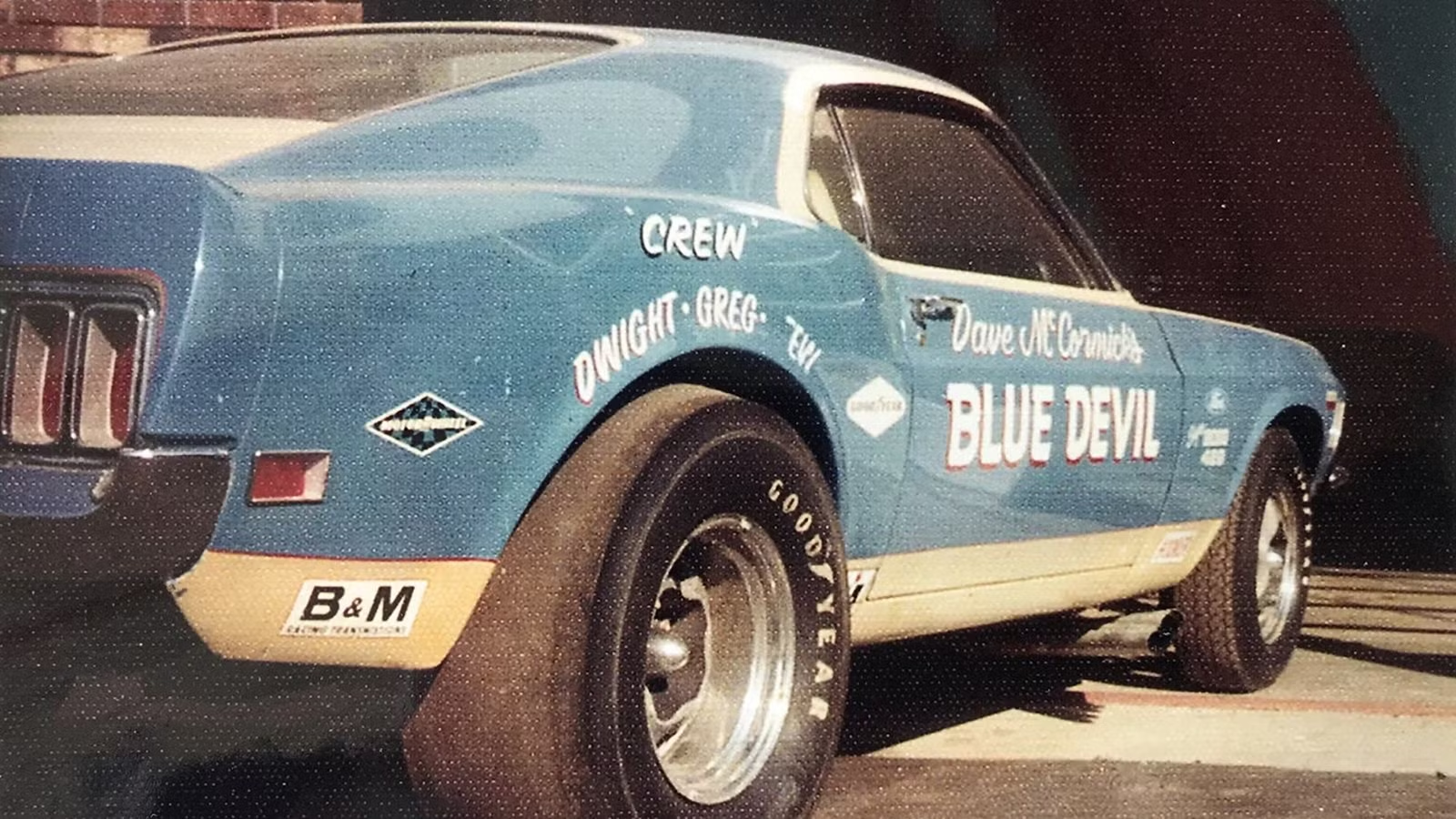
By the 1970s, Detroit’s muscle-car arms race had reached its absolute peak. Manufacturers were regularly using what were effectively race engines under the hoods of mid-sized coupes, creating an era defined by raw, unbridled mechanical performance. If you had a driver’s license and a decent line of credit, you could just walk into a showroom and pick up a car capable of running the drag strip in under 12 seconds.

Yet during this peak of automotive muscle. Ford sanctioned the creation of the wildest and most powerful Mustang yet. Under its hood, the Mustang had a NASCAR powerplant, with forced induction and an estimated output that broke the four-figure performance barrier. A feat completely unheard of for a factory-produced vehicle at that time.
But if you were a civilian and walked into the Ford dealership in 1970 with a briefcase full of 100-dollar bills, you would not be able to buy it, you see; Ford didn’t build this specific Mustang to chase sales figures or to dominate the oval, or to draw crowds to the dealership window. Instead, the Mustang was specially commissioned with a mission in coordination with the Pentagon. It wasn’t built for civilians. It was engineered specifically for soldiers deployed overseas, and the primary objective was not to win races but to keep American soldiers alive.
Why Surviving Vietnam Was Only Half The Battle

To understand why a major manufacturer built a 1,000-horsepower car with no intention of selling it, you have to look at the tragic trend unfolding on American highways at the time. Thousands of young soldiers came back after being deployed in Vietnam and being in high-stress combat zones for months or even years.
These young men arriving back on domestic soil had their pockets full of unspent combat hazard pay. They were eager to dive back into American culture, and in 1970, nothing screamed freedom and excitement like a brand-spanking-new muscle car. Dealerships outside major military bases were flooded with returning soldiers buying high-performance machinery right off the lot.
Unfortunately, this trend quickly turned catastrophic. Soldiers who had spent years operating slow, heavy military machinery or transport trucks in the dense jungles of Southeast Asia were suddenly dropped behind the wheel of lightweight, rear-wheel-drive coupes pushing almost 400 horsepower.
The results were immediate and devastating. Returning veterans were dying in high-performance car crashes at an increasingly alarming rate. The chase for adrenaline, a lack of familiarity with these powerful machines, and a complete absence of high-speed driving education combined to create a deadly crisis. The Pentagon realized it had a massive problem: soldiers who survived the horrors of overseas combat were losing their lives on the American interstate.
Horsepower Diplomacy: Ford’s Secret Weapon For Troop Morale

Punitive safety measures, like safety lectures and text-heavy military books, were not going to solve the problem in Ford’s eyes. Young soldiers sitting on bases in the Pacific theater didn’t want to listen to lectures about speed limits and defensive driving tactics. Ford wanted to speak to the soldiers in their own language, so they opted for “horsepower diplomacy.”
Ford stepped up to fund an unconventional solution: the 1970 Military Performance Tour. The concept was radically brilliant. Instead of waiting for soldiers to get home and buy cars blindly, Ford would take a fleet of the most extreme-performance vehicles directly to active-duty military bases overseas.
The goal was to use the spectacle by staging massive, tire-smoking exhibition shows right on the tarmacs of the Pacific bases, where they could capture the undivided attention of thousands of servicemen. Once their eyes were glued to the asphalt, the team could transition from tire-melting showmanship to a genuine, hard-hitting live demonstration of vehicle dynamics, breaking limits and demonstrating high-horsepower safety. It was a highway safety intervention dressed as a circus of speed.
Enter The “Lawman” Boss 429: A 1,200-HP Monster With A Pentagon Mission.

The crown jewel of this military tour was a heavily modified fastback simply known as the “Lawman” Super Boss 429. It was spearheaded by Al “Lawman” Eckstrand, a practicing attorney, a safe driving advocate, and a highly accomplished factory drag racer. The Lawman Mustang was a massive departure from the standard NASCAR-homologation Boss 429s available to the public at the time.
While a standard showroom Boss 429 was rated at 375 horsepower, Eckstrand’s Lawman featured a massive Roots-style supercharger bolted to the big block. Powered by specialized nitromethane, the engine screamed out with incredible figures of 1,000 to 1,200 horsepower, channeling roughly 900 pound-feet of torque to the rear tires. The build cost for this mechanical monster was an astronomical $23,000; that’s almost $200,000 in today’s money.
Because the car was designed to demonstrate control and stability during wild exhibition runs, the standard four-speed manual found in the regular Boss 429 models was instead fitted with a heavily modified, reverse-pattern Ford C-6 automatic transmission, making it unique from all the other Mustangs in existence.
Accompanied by a support fleet of five 428 Cobra Jet Mustangs, Eckstrand and his crew shipped out on a grueling tour route that would take them through active military hubs in Japan, South Korea, the Philippines, and Vietnam. Historical records debate the exact scope of the crowds Eckstrand’s crew drew. While some estimates suggest roughly 40,000 servicemen witnessed the tour, other accounts from the military and auction archives place the total number of soldiers at a staggering 240,000. Regardless of the exact number, the main goal was achieved, and the impact was profound: soldiers watched a 1,000-horsepower beast in all its glory and then listened intently as Eckstrand broke down exactly how to get hold of one.
|
Engine |
Power |
Torque |
Transmission |
0 to 60 |
Top Speed |
|---|---|---|---|---|---|
|
429 ci “Semi Hemi” V8 w/ Roots Supercharger |
1,000 to 1,200 HP (on Nitro) |
900 LB-FT |
Heavy Duty Ford C-6 (Reverse-Pattern Auto) |
3.5 Seconds Estimated |
180 MPH |
The Disaster At The Docks That Sparked A Muscle Car Legend

The tour was going well and was an overwhelming success, but operating such a program in the middle of an active war zone was unpredictable and dangerous. While transitioning through a port in Vietnam, disaster struck when a massive shipping container broke loose during heavy loading and crashed down directly onto the original Lawman Super Boss 429, completely crushing the one-of-one machine into metal scrap.
With thousands of soldiers waiting to catch a glimpse of the Lawman at the next scheduled performance, the morale and safety initiative was abruptly and heartbreakingly ended. The news of the tragic accident reached Detroit. Recognizing the vital importance of the tour’s mission, automotive legend Carroll Shelby stepped in and, without hesitation, offered his personal factory-spec Boss 429 prototype, VIN 0F02Z110429, as a donor car.
The car was immediately rushed to Kar Kraft, Ford’s legendary custom-build house. What happened next remains one of the most legendary feats in muscle car history. A heroic effort with a non-stop 48-hour work on the bench, the technicians at Kar Kraft completely stripped Shelby’s personal car down to bare metal and reinforced the chassis, installed the supercharged 1,000 horsepower engine, mated it to the unique C-6 automatic, and finished it by painting it in the iconic “Lawman” livery. Just two days after receiving a bone-stock Mustang, they turned it into a fire-breathing car ready for the exhibition. The car was then loaded onto a transport plane and flown directly to the Pacific theater, and the tour didn’t miss a beat.
The Legacy of a Lifesaving Muscle Car

The Lawman Mustang stands as a monument to a moment in time when horsepower was used as a tool for public safety and the welfare of the troops. After the war ended and the tour concluded, the surviving Kar Kraft-built Mustang changed hands and was eventually acquired by legendary professional wrestler and automotive enthusiast Bill Goldberg. Under his ownership, the Mustang underwent a meticulous, historically accurate restoration to preserve its exact 1970 tour specifications.
Ultimately, the Lawman represents something far deeper than a rare vintage muscle car. It reminds us of a time when an automotive giant and the military looked at a rising national tragedy and chose to solve it uniquely and imaginatively. It remains, without question, the most powerful and meaningful Mustang Ford has ever produced. And not to sit under the bright lights of the showroom but to stand tall on the tarmac of foreign bases, keeping the American soldiers safe and alive, who saw it during the historic tour.
Sources: Hagerty, Hemmings, Barret Jackson, Pilgrim V8

Related posts
Latest Post


No Comments