
Suzuki Quietly Built One of the Smartest Motorcycles On The Market
Middleweight motorcycles seem to have developed a mild case of feature inflation. In order to give the buyer the best value for money, they’re employing bigger engines, increasingly sophisticated electronics, adjustable suspension, and premium hardware. All of it sounds great and is useful, but they have also pushed supposedly accessible all-rounders past $10,000 surprisingly quickly.

The smarter approach for many riders is a motorcycle that spends its engineering budget on the things they will use every day. Suzuki has decades of experience building motorcycles this way. Its latest crossover applies that thinking unusually well, combining a familiar mechanical foundation with enough genuinely useful modernization to feel current. The result makes considerable sense for Suzuki, but perhaps even more for the person paying for it.
Middleweight Crossovers Don’t Need To Become Miniature Flagships
Crossover motorcycles occupy an increasingly useful space between naked bikes and full-sized adventure tourers. They provide an upright riding position, wind protection, and enough carrying ability for a trip without committing to a 19- or 21-inch front wheel, overly tall suspension, or the added bulk that comes with genuine off-road ambitions. Yet the category has steadily moved upward, borrowing tech from larger sport-tourers that are filtering down from premium motorcycles. Nice-to-have things, certainly, but they also make a simple road-going middleweight considerably less simple to buy.
Suzuki Takes A Smart Approach


For its newest crossover, Suzuki already had most of the necessary ingredients without developing another motorcycle from scratch. The SV650 established its compact road-bike platform, while the V-Strom 650 proved that the same engine architecture could work perfectly well carrying luggage and covering serious mileage. Its larger GSX-S1000GX+ then showed exactly how Suzuki wanted a premium road-focused crossover to look and function.

Connecting those existing ideas was arguably more useful than going after another specifications war with its counterparts. A middleweight crossover primarily needs to commute comfortably, handle a good back road, swallow highway miles, and remain easy enough to live with that owners actually use it for all three. And rather than the clichéd thinking out of the box, Suzuki simply looked deeper into the box that had all the ingredients to make a smart production decision and an even smarter offering for the buyer.
The Suzuki SV-7GX Turns An Existing Formula Into Something New

The 2027 Suzuki SV-7GX is essentially the missing road-focused link between the SV650 and the old V-Strom 650, packaged beneath styling and a crossover philosophy borrowed from the GSX-S1000GX+. Rather than replacing the SV formula with Suzuki’s newer 776cc parallel-twin platform, it develops the familiar 645cc V-twin architecture into a more versatile motorcycle. The closely related SV-7GXV is mechanically identical, trading the GX’s more elaborate colors and graphics for Pearl Brilliant White bodywork and black wheels.
The Old V-Twin Is A Lower-Risk Starting Point

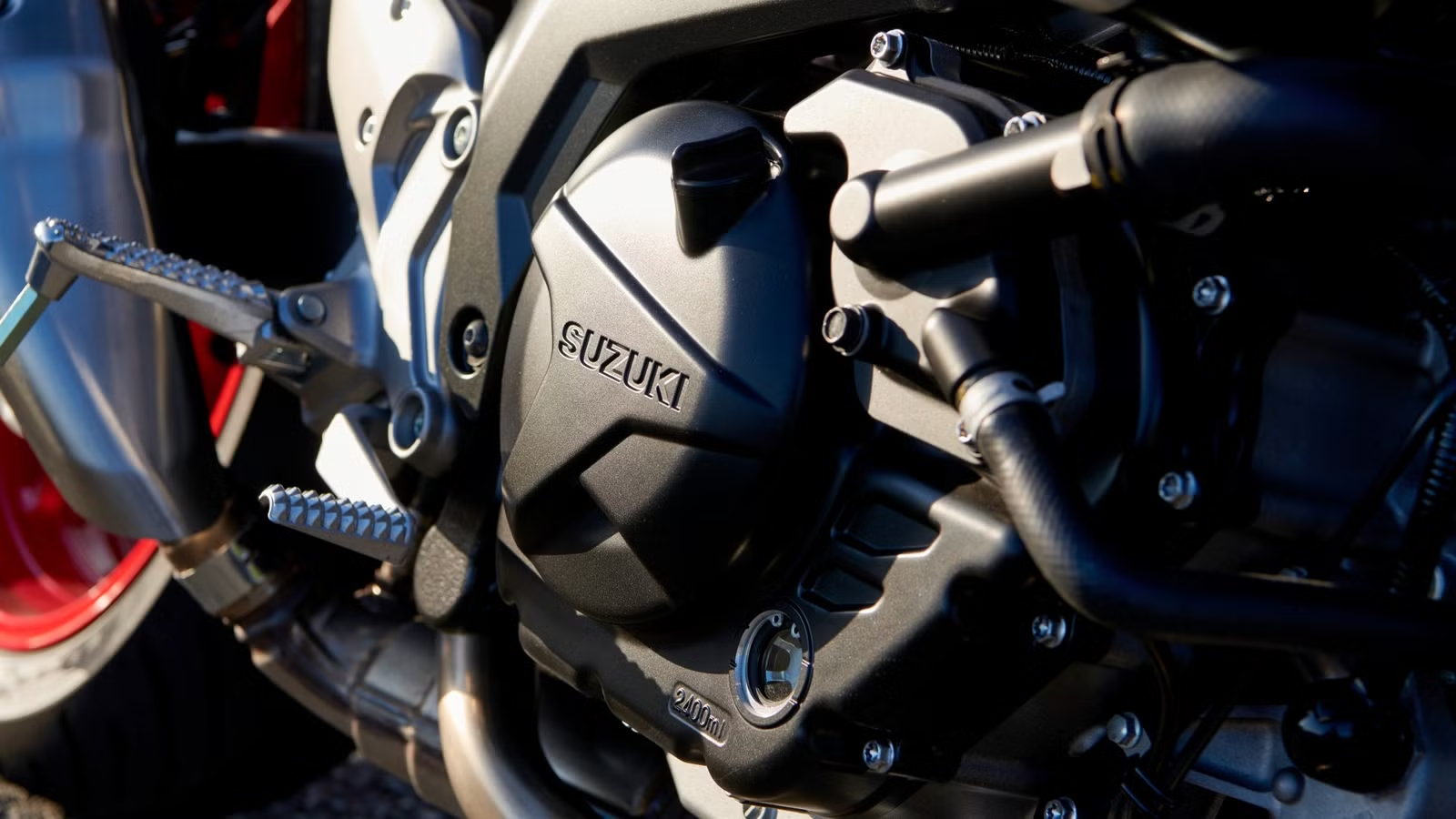
Suzuki’s 645cc, 90-degree V-twin has been around in one form or another since the original SV650 arrived in 1999. For the SV-7GX, it produces 72.4 horsepower at 8,500 rpm and 47.2 pound-feet at 6,800 rpm. Those figures won’t terrorize larger middleweights, but outright output is almost secondary to what Suzuki already knows about this engine. More than 25 years of development have exposed the basic architecture to street bikes, touring use, and countless high-mileage owners.

The SV650 and V-Strom 650 have consequently built strong independent reliability records, while Suzuki continues using friction-reducing features including its Suzuki Composite Electrochemical Material cylinder coating, coated pistons, and L-shaped piston rings. For a buyer, that’s preferable to treating the entire powertrain as a first-generation experiment simply because the bodywork is new.
Suzuki still made the changes necessary to keep it relevant. Electronic throttle bodies bring ride-by-wire control, while the intake, exhaust, and engine management were revised to meet current emissions requirements. The character remains recognizably SV, but the surrounding controls finally belong to a modern motorcycle.
The Simple Running Gear Isn’t An Oversight

The tubular steel trellis frame is paired with a conventional 41mm fork offering 4.9 inches of travel, and a linkage-type rear shock with 5.1 inches of travel, along with seven-step spring-preload adjustment. There is no semi-active suspension, electronically controlled damping, or even a clicker with mechanical fork adjustments. That sounds basic until you consider what the motorcycle is supposed to do.

A 31.3-inch seat height, 465-pound curb weight, 17-inch wheels, and Pirelli Angel GT II sport-touring tires keep the SV-7GX firmly road-focused and approachable. Its light steering and predictable cornering further add to a rider’s confidence, although the basic suspension can show its limits over rough pavement and harder braking. Suzuki saved money here without compromising the core mission, which is a much smarter compromise than fitting expensive suspension most owners will adjust once and forget.
Suzuki Put The New Technology Where Riders Will Actually Use It

The clever part is that “simple” doesn’t mean stripped. Ride-by-wire opens the door to Suzuki Drive Mode Selector (SDMS), adjustable Suzuki Traction Control System (STCS), and a standard bidirectional quick shifter. Instead of tying everything into increasingly complicated preset riding modes, Suzuki lets riders choose the throttle map and traction-control intervention separately.

Mode A provides the sharpest response, B softens delivery while retaining full output, and C reduces both response and maximum power. That gives the same motorcycle considerably more flexibility for a newer rider, wet conditions, commuting, or back-road riding without requiring an expensive inertial measurement unit and a dozen electronic submenus. Then Suzuki spent money on the less glamorous stuff owners interact with constantly. There is a 4.2-inch color TFT display with Suzuki Ride Connect+ smartphone integration and turn-by-turn navigation, full LED lighting, hand guards, a three-position windscreen, and an integrated rear carrier. The 4.6-gallon fuel tank also gives the SV-7GX enough capacity for genuine touring.
Suzuki Chose To Spend Less Yet Come Out On Top

The 2026 Kawasaki Versys 650 LT ABS costs $10,399, making it a stronger, ready-made touring package thanks to its standard 7.4-gallon hard saddlebags and more adjustable suspension. Honda’s 2026 NC750X DCT is yet another value proposition for everyday use. At $9,499, its automatic Dual-Clutch Transmission and integrated 6.1-gallon storage compartment make it an exceptionally practical commuter and tourer.

The Suzuki instead starts $1,800 lower, feels more compact, and gives riders electronic throttle control and a standard quick shifter without the higher price bracket. And that’s precisely why the SV-7GX works. Suzuki identified what this motorcycle needed rather than everything engineers could possibly fit into it. Buyers still get modern controls, genuine touring capability, one of the company’s longest-serving engine families, and an $8,599 MSRP.
Pick the mechanically identical SV-7GXV and the bill drops another $200, if flashy wheels and Suzuki’s racing-inspired color treatment aren’t priorities. Sometimes the smartest motorcycle is the one whose manufacturer knows exactly where to stop, and they don’t have to cost a bomb for you to make the smarter buying decision.
Source: Suzuki

Related posts





Latest Post


No Comments