
The Sport Bike That Changed More Than You Realize
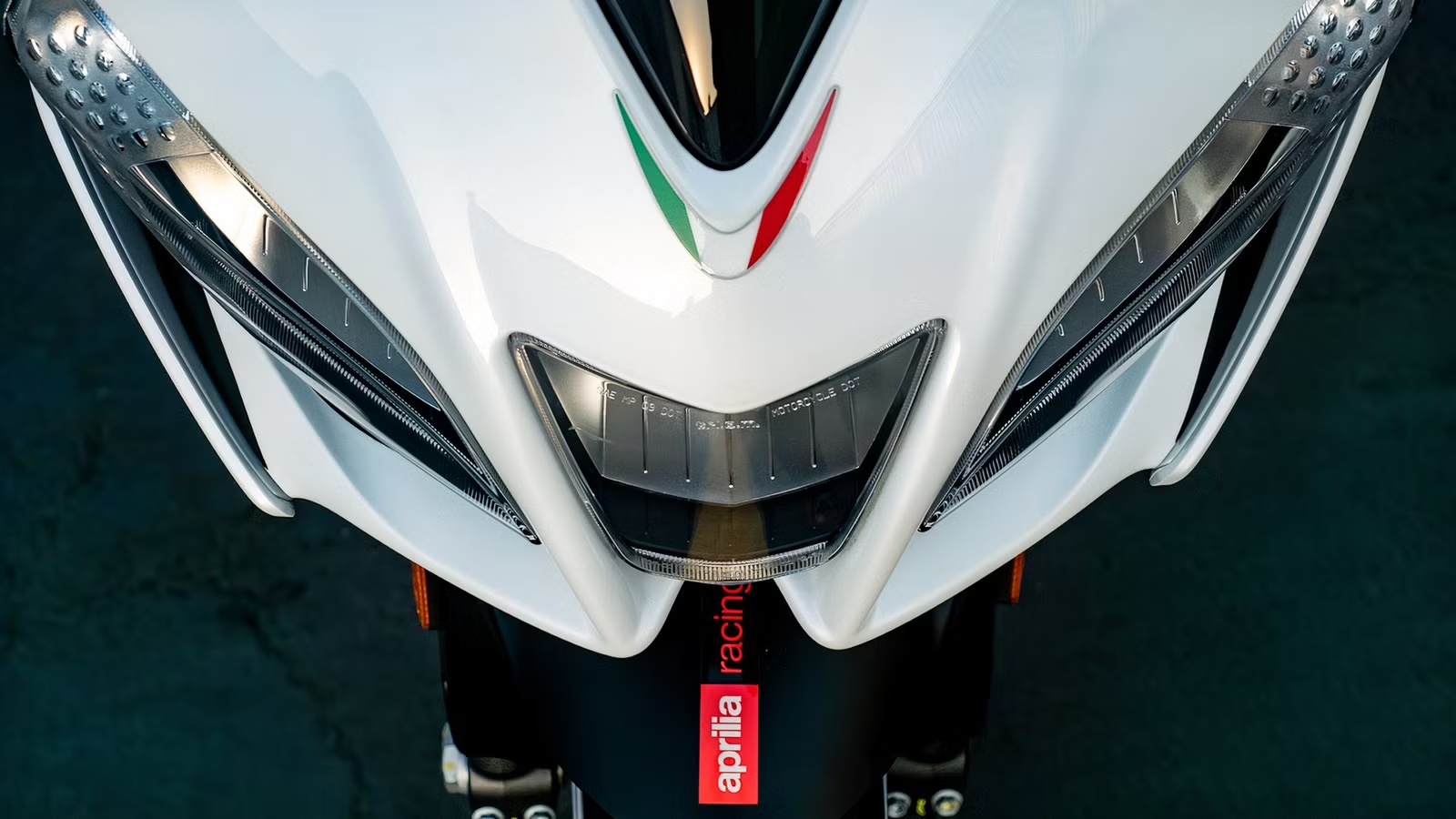
A liter-class sport bike from the early 2000s and one from today may share the same basic function, but almost everything governing how they accomplish it has changed. Mechanical grip is now managed alongside electronic software. Throttle inputs pass through algorithms in milliseconds before actuating the throttle valve. Wheelie control has become a performance tool rather than a killjoy, while aerodynamics increasingly influence braking stability and corner exits.

The interesting part is how gradually these changes became normal. There was no single year when the superbike suddenly became the machine we recognize today. One long-running Aprilia platform, however, formed the basis of this transformation, evolving from a compact analog-feeling V4 into a 220-horsepower motorcycle whose electronics can predict what the chassis is about to do.
Superbikes Were Running Out Of Simple Ways To Become Faster
By the end of the 2000s, the liter-bike formula had become brutally effective. Engines already produced enough power to overwhelm road tires, aluminum frames were highly developed, and mass centralization had become part of every manufacturer’s engineering vocabulary. Finding another few horsepower wasn’t especially difficult, and using it efficiently was becoming a harder problem.

Electronic throttles offered a way forward. Once the throttle grip stopped directly dictating throttle-valve position, engine management could consider gear, engine speed, wheel speeds, and other inputs before adhering to the rider’s request. Traction control could consequently become far more sophisticated than simply cutting ignition after excessive wheelspin appeared.

Chassis design was changing for similar reasons too. Racing teams needed control over geometry and weight distribution rather than merely firmer suspension, while manufacturers were looking for increasingly compact packaging as engines became stronger. The traditional superbike architecture wasn’t obsolete, but there was considerable performance left in combining the individual systems more intelligently.

Aerodynamics would eventually add another layer as things progressed further in search of more speed. Winglets barely registered on production motorcycles at the time, yet they would become another means of controlling acceleration and stability. The modern superbike was slowly becoming less of a collection of high-performance components and more of a coordinated system. Aprilia happened to build its flagship around exactly this idea.
The Aprilia RSV4 Broke Cover As A Clean-Sheet Racing Platform

Introduced in 2009, the Aprilia RSV4 abandoned the previous RSV Mille’s V-twin for a compact V4 and was developed around World Superbike competition from the outset. The approach worked quickly, and the efforts showed through Max Biaggi’s 2010 World Superbike Championship. The platform ultimately collected three riders’ and four manufacturers’ titles between 2010 and 2014. More significant for the road bike was that Aprilia had created a solid base that it could keep developing year-on-year.
The 65-Degree V4 Gave Aprilia Room To Experiment
The original 999cc engine produced a claimed 180 horsepower, but its 65-degree cylinder-bank angle was just as important a number. The narrow-angle V4 gave Aprilia a compact powerplant while retaining the rev capability of inline-four cylinders. That helped reduce frontal packaging requirements and left considerable freedom for chassis positioning. Aprilia then kept working on the same layout, and in 2016, new cylinder heads, crankshaft, connecting rods, camshafts, intake hardware, and titanium exhaust valves helped raise the claimed output to 201 horsepower without increasing the displacement.

Displacement eventually grew because there was useful performance left to extract from the engine. The 2019 RSV4 1100 Factory expanded to 1,078cc and claimed 217 horsepower, while the 2021 generation reached 1,099cc by increasing the stroke. The latter retained 217 horsepower while improving torque delivery and satisfying Euro 5 emission requirements. The modern engine still uses the same fundamental 65-degree V4 arrangement conceived for the original motorcycle.
Its Chassis Was Designed To Be Altered

The early Factory’s aluminum chassis showed how closely the production motorcycle followed racing priorities. Beyond normal suspension adjustment, teams could alter steering-head geometry, swingarm-pivot height, and engine position within the frame. Those provisions were far beyond what an ordinary street owner needed, but Aprilia thought otherwise.

The Italian marque wasn’t designing a road chassis and subsequently preparing it for competition, so adjustability had already been engineered into the platform. Thus, weight distribution and geometry could be changed around tires, circuits, and rider requirements. This level of mechanical flexibility gave the RSV4 a strong mechanical foundation. But the bigger shift came when Aprilia began allowing software to exert similar control over the motorcycle’s behavior.
APRC Previewed How Modern Superbikes Would Use Electronics

The 2011 RSV4 Factory APRC SE introduced Aprilia Performance Ride Control (APRC), combining eight-level traction control with wheelie control, launch control, and a quickshifter. Twin gyroscopes and accelerometers helped the system understand motorcycle movement; traction-control levels could be changed while riding, and wheelie control operated independently rather than being buried inside the selected traction-control setting.
This was more consequential than adding another rider aid. APRC treated electronics as a coordinated performance package. Traction control could permit controlled slip, wheelie control could manage acceleration without unnecessarily slamming the front tire back down, and the rider could alter intervention according to the given conditions. Electronics were becoming part of the setup rather than merely protection against mistakes.

The idea kept expanding as the model progressed. Later systems added cornering ABS, a bidirectional quickshifter, adjustable engine braking, riding modes, launch control, and a pit-lane limiter. Aprilia even offered smartphone-based telemetry and setup functions on earlier generations, including the ability to analyze electronic intervention around a circuit. By 2015, superbikes from multiple manufacturers were already converging on sophisticated electronics suites, but the RSV4 had been demonstrating the integrated approach for years.
Aerodynamics Became Part Of The RSV4’s Performance Package

Electronics could increasingly control wheelspin and wheelies, but software couldn’t create physical load on the front tire. Aerodynamics offered the solution. The 2019 RSV4 1100 Factory was equipped with MotoGP-inspired aerodynamic winglets alongside its larger engine, moving a concept developed in prototype racing onto a road-going flagship.

The 2021 redesign integrated aerodynamic surfaces into double-layer bodywork rather than simply hanging appendages from the fairing. Aprilia’s current design continues that approach, using wing surfaces beneath the windscreen and carefully managed airflow to increase vertical load and improve high-speed stability. It is a snapshot of how superbike development had changed as combustion, electronics, geometry, and airflow were being developed around the objective of extracting maximum performance.
The Current RSV4 Is Still Developing The Original Idea

The current RSV4’s 1,099cc V4 produces 220 horsepower at 13,000 rpm and 93.7 pound-feet at 10,800 rpm. Its latest APRC package uses a six-axis IMU and adds adaptive and predictive wheelie control, while Brembo Hypure calipers, a twin-spar aluminum frame, and the established aerodynamic package handle the mechanical side of the equation. The Factory version adds equipment such as forged wheels and Öhlins electronic suspension.
But the more interesting development is happening in the software. Predictive control reflects how far the original 2011 APRC idea has evolved. Instead of waiting for an unwanted condition and reacting to it, modern electronics increasingly calculate how the motorcycle is likely to behave and adjust intervention accordingly.

Seventeen years after the first production bike, the latest RSV4 therefore remains recognizable in its base architecture while functioning very differently from where it began. That is what makes its influence easy to underestimate. It did not single-handedly invent the V4 superbike, or the modern electronic system, or even the aero bodywork, but Aprilia repeatedly combined emerging technologies into one production platform early on. The RSV4 changed alongside the superbike itself, and on several important occasions, it got there before the rest of the class.
Source: Aprilia

Related posts



Latest Post


No Comments