
2027 Suzuki GSX-R1000RS Review: An Icon Refined
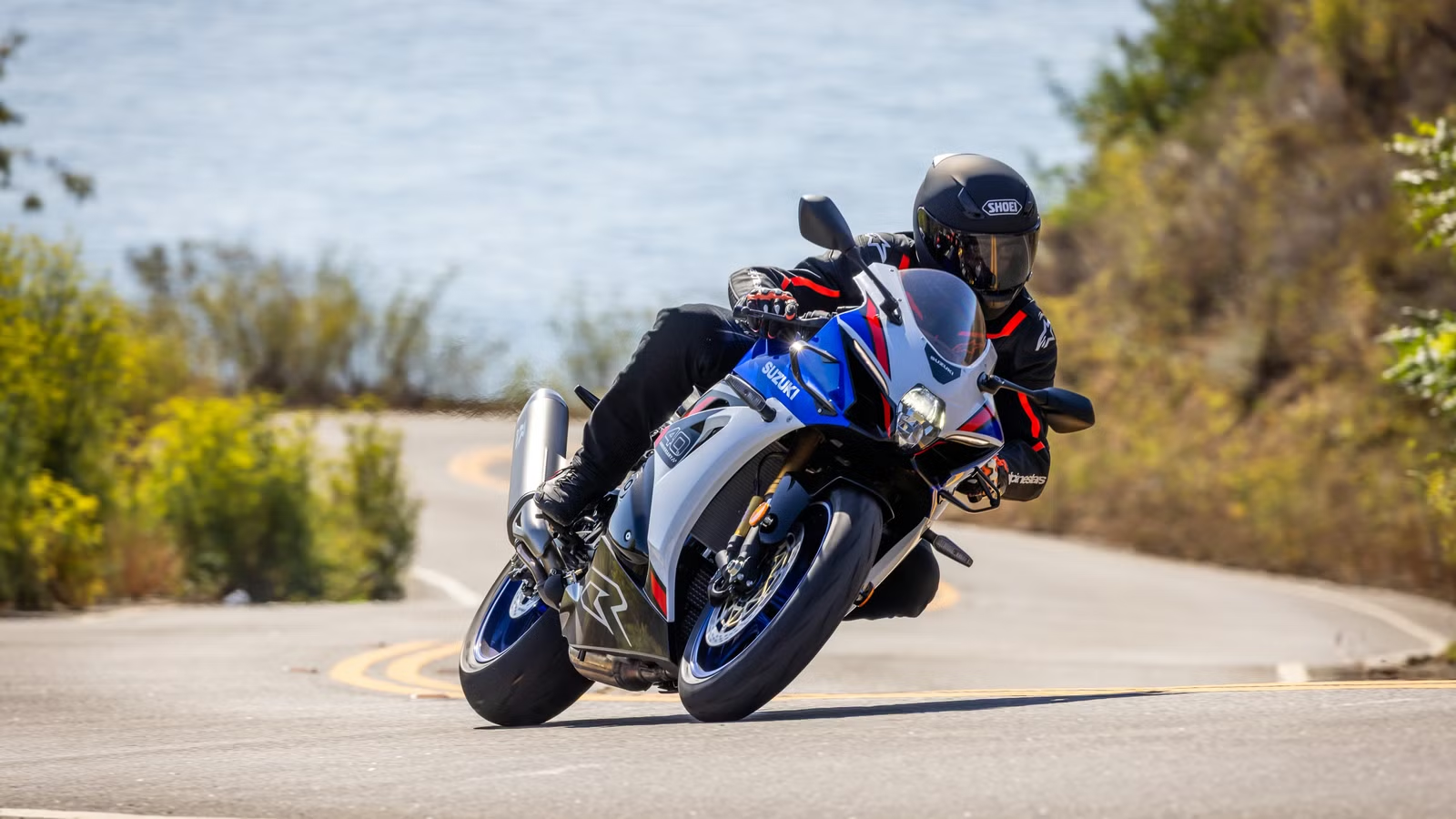
There’s a particular kind of friendship we’re lucky to experience once or twice in a lifetime: years apart don’t matter the moment hellos are exchanged, and small talk never enters the picture. You both pick up exactly where you left off, and that’s precisely the sensation waiting in the saddle of a 2027 Suzuki GSX-R1000RS. The liter-class GSX-R stormed the minds of budding riders worldwide 25 years ago, and much like the rest of us who were around back then, the GSX-R1000 platform has done a fair bit of growing up since.

Back then, both of us were considerably less refined. I was busy figuring out how to be a functioning adult, and the GSX-R had a lot of weight on its shoulders, living up to its family namesake. It met those expectations, quickly becoming the dominant superbike of the early 2000s, at least in North America. A quarter-century later, we’ve both changed. Many riders of my generation sport more gray in their manes than they’d like to admit, with families, mortgages, and responsibilities that shake out to wider opinions on sportbike ergonomics. The GSX-R, meanwhile, picked up variable valve timing, a six-axis IMU, a lithium-ion battery, and enough electronic rider aids to make its younger self blush. We’ve both matured. Neither of us peaked in our twenties, thankfully.
Here’s the thing: while the GSX-R1000 grew up, so did the rest of the superbike class. Aprilia, BMW, Ducati, and even Honda have all blown past the 200-horsepower barrier, turning the modern superbike into something that needs a small army of software engineers to keep the front wheel on speaking terms with the road. The rest of the Japanese brands aren’t far off, either, though there’s a distinct difference in approach from the Hamamatsu-based outfit. Suzuki staffers looked at that horsepower arms race, sucked air through their collective teeth, and politely said, “no, thank you.” That decision is likely why the GSX-R1000 has stuck to its roots, building a machine that works well both on and off the racetrack.
Those miffed by the RS badging in this review, allow me to explain. Suzuki splits the GSX-R1000 into three US trims, a distinctly North American habit; Europe and the UK just get one GSX-R1000R. The base GSX-R1000 starts at $16,399 with Showa’s Big Piston Fork and a remote-reservoir shock. The GSX-R1000R, at $17,939, adds an up-spec Balance Free Fork, a Balance Free Rear Cushion Lite shock, stainless brake lines, and adjustable swingarm pivot parts. The GSX-R1000RS, at $18,639, is mechanically identical to the R but arrives with carbon-fiber winglets and a solo seat cowl pre-installed rather than sold separately. It’s a little confusing turning one bike into three, but it isn’t worthy of pearl-clutching. Beyond that, the whole lineup is a bargain compared to anything hailing from Europe.

A Familiar Voice, Saying New Things: Engine

The GSX-R1000 platform is powered by an updated version of the 999.8cc inline-four-cylinder powerplant Suzuki introduced during the 2017 update, but calling it updated undersells how few engineering stones were left unturned. Up top, a larger throttle body pairs with reworked injectors and more fuel pump pressure, while the intake funnels feeding the outer cylinders switched from a dual-stage to a single-stage design to help top-end performance. Inside the cylinder head, camshaft profiles were revised to meet emissions standards by trimming valve overlap rather than reducing peak lift, so the zesty I4 isn’t kneecapped up top mechanically. The finger followers were reshaped and given a more durable coating, a wider cam chain now rolls across revised sprockets, and the head gasket moved to a sturdier design with cutaways added to clear larger exhaust valves. The exhaust, as providing the classic screaming soundtrack is new, too.
Digging deeper, new short-skirt forged-aluminum pistons help bump compression higher still, while larger crankshaft journals and a matching crankcase bore handle more heat and load. A revised lubrication path feeds oil more precisely to the crank and camshafts, easing mechanical drag. All of it adds up to a claimed 192.4 horsepower at 13,200 rpm and 81.13 ft-lb of torque at 11,000 rpm, a 7.1-horsepower gain over the outgoing US-spec engine. Zoom out, and current European rivals routinely chase, and sometimes clear, 210-plus horsepower, which makes Suzuki’s number look almost modest by comparison. Though, if you’re scoffing at those peak numbers, might I interest you in a truck lifted higher than your fragile ego requires?

That restraint turns out to be the whole point once you’re riding it. Down low, the engine offers honest, usable grunt, not quite the same low-rpm shove of the old long-stroke K5-derived mills, but a fair trade for what happens next. The real charm lives in the middle of the rev range, where the variable valve timing system spreads power out generously enough that the Suzuki will spring into action with a quick throttle hit. Climb beyond that point, and the engine keeps pulling with real conviction, howling through a proper inline-four register up toward 12,000 rpm before settling into a plateau on the run to redline.
There’s one American-specific wrinkle worth flagging. The EU-spec screaming meanies pull cleanly from top to bottom, but the US-spec bike carries a soft dip in output between 5,000 and 7,000 rpm, felt most clearly in second gear, right where you’d want the strongest drive out of a tight canyon corner. It’s a gentle sag rather than a stumble, a byproduct of domestic noise regulations rather than any mechanical shortfall. Suzuki Motor USA isn’t alone here; numerous bikes take the same hit when calibrated for sale Stateside. The solution is one most GSX-R owners are quite familiar with: a reflash.

Moving to the ride modes, the sportiest “A” setting is sharper than the street ever asks for, leaving “B” as the mode that earns its keep, while “C” is your tamed rain setting. Suzuki could have chased more power, and we’d likely be framing things differently, the kind that hangs around motorcycles that feel like they’re riding you rather than the other way around. What’s left is confidence delivered via control, and the more things change, the more they stay the same. I thought the same thing the first time a GSX-R landed in my grubby mitts.
Trusted Company: Electronics and Chassis

The rider-aid suite is refreshed for 2027, built around a lighter, more precise six-axis Bosch IMU, with traction control, wheelie control, and slide control still bundled under one overarching roof rather than divided into individually adjustable settings. It’s an approach dating to 2017, and competitors now generally allow finer control over each rider aid. If track riding is more your thing, that complaint could carry greater weight, where certain racetrack features might call for more or less nannying. Out on the road, it’s more a question of whether those assists step up only when necessary. They do.
The one system that makes its presence felt is the cornering ABS. It’s noticeably more relaxed than earlier versions, but still has room for improvement on our nappy Southern California pavement. Rough patches seem to irk the system, a claim that applies to quite a few models in the Suzuki lineup, let alone other Japanese manufacturers. There’s no shortage of roads out here happy to test their patience. In a case of contrasting fortunes, the bidirectional quickshifter is virtually faultless, besting “premium” brands by a large margin, and this is the comparatively affordable bike. It also features an electronically adjustable steering damper.

Eyeing the Brembo hardware, it’s three generations behind the Italian firm’s latest stuff, having missed the M50, Stylema, and now Hypure calipers rolled out since. That’ll raise an eyebrow or two at the racetrack, where braking forces are far, far higher. On the street, you’re simply not reaching for the lever with the same repeated, late-braking intent. One finger is enough to scrub speed while flowing through a canyon, and of course, you’ll want to add another digit when the situation calls for it.
The chassis is where things click as they always did, meeting the rider halfway with all the tools needed for corner-carving confidence while staying forgiving enough to make corrections. Steering is sweet as can be, while stability is nothing short of reassuring. The fully adjustable Showa suspension is sportingly sturdy, with a wide adjustment range to make things livable on public streets. It’s still a purebred underneath all that composure, and every so often you’ll be reminded of that with a nice tailbone smack, but nothing about the experience feels like punishment for choosing a superbike as your daily ride.
The Suit Still Fits: Styling

Over two decades have passed since we met the GSX-R, and frankly, most of us flirting with 40 get a kick out of fitting into clothes from that era. Suzuki designers settle on a design and stick with it, save for major overhauls, and 2017’s bodywork is what we still see today.
Wasting pixels on appearance is usually a fool’s errand in this scribe’s opinion, since beauty is in the eye of the beholder, though updated looks can make mechanical updates beneath the bodywork land with more impact. The untrained eye will likely clock it as “same ol’, same ol’,” and it’s honestly hard to argue otherwise when the looks haven’t changed. At least the 40th Anniversary Edition livery gives this generation something to point toward. For 2027, carbon-fiber winglets bolt onto the GSX-R’s visage, and while they likely do little at road speeds, Suzuki says they help wheelie control at faster paces. Fair enough.
Though the main fashion faux pas committed here is the LCD instrument panel. According to the brand, sourcing one of the attractive full-color TFT displays from even the middleweight GSX-8R would have required reworking the surrounding plastics, and that was a bridge too far.
A Comfortable Reunion: Ergonomics and Styling
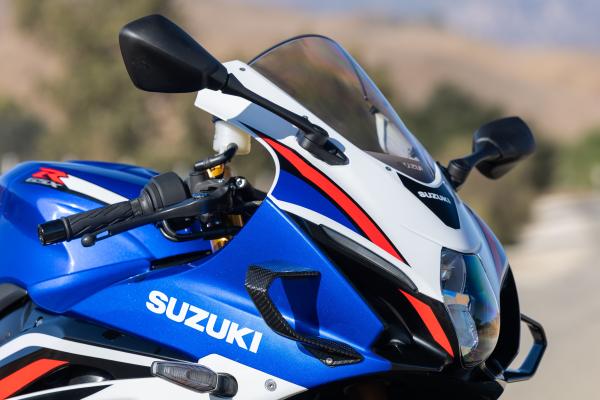
Ergonomically, this is where the reunion feels most effortless. The riding position never once felt cramped the way nearly all of its now ultra-racetrack-focused rivals do, and despite low clip-ons and rearsets that look set on forcing a racy position, the actual experience isn’t nearly as demanding. The superbike-styled bark is far worse than its bite.
The reach to the bars isn’t extreme, and there’s enough room down at the pegs to survive a real highway stretch. In fact, while returning the GSX-R1000RS, a nearly 200-mile straight-line slog was on the menu, and my biggest battle wasn’t sore wrists or an achy back, but boredom.

That’s the throughline across the GSX-R: an engine that never demands you manage it, electronics that stay out of the way until needed, a chassis that meets you halfway, and a cockpit that never turns a long ride into a chore. Nothing about the GSX-R1000R … err … GSX-R1000RS asks you to be a different rider than the one who climbed on. It simply lets you be a better version of that rider, which is the best thing any fast friend can impart to us.
Twenty-five years is a long time between any two friends, let alone a rider reconnecting with a motorcycle. Throwing a leg over the Suzuki’s superbike sparked memories of a friend’s K5 GSX-R that I was entrusted with long ago. The reunion didn’t skip a beat, and the current-generation GSX-R still delivers all the aspects we want in a sportbike. I’ve grown up. We’ve grown up. We still get along just fine.
Gear Check:

Helmet: Shoei RF-SR2
Gloves: Alpinestars GP Pro R4
Jacket: Alpinestars GP Force V2 Air
Pants: Alpinestars Cooper V3
Boots: Alpinestars Superfaster
2027 Suzuki GSX-R1000RS Review Photo Gallery:
2027 Suzuki GSX-R1000RS Specifications:
Engine:
|
Type |
Four-stroke inline four-cylinder, liquid-cooled, DOHC |
|
Displacement |
999.8cc |
|
Bore x stroke |
76.0mm x 55.1mm (2.992 in x 2.169 in) |
|
Maximum horsepower |
192.4 horsepower @ 13,200 rpm (claimed) |
|
Maximum torque |
81.13 lb-ft @ 11,000 rpm (claimed) |
|
Compression ratio |
13.8:1 |
|
Valvetrain |
DOHC; 4 valves per cylinder; titanium valves, 31.5mm intake, 25mm exhaust |
|
Fueling |
Ride-by-wire electronic fuel injection |
|
Exhaust |
Titanium system |
|
Cooling |
Liquid |
|
Transmission |
6-speed constant-mesh w/ bi-directional Quick Shift System |
|
Clutch |
Wet multi-plate w/ slipper and assist functions |
|
Final drive |
Chain, DID 525HV3, 120 links. |
Chassis:
|
Frame |
Aluminum twin-spar type; GSX-R1000R and GSX-R1000RS accept adjustable swingarm pivot parts (not offered on base GSX-R1000) |
|
Front suspension; travel |
Showa Balance Free Front Fork (BFF), fully adjustable, gold-anodized. 5.1 inches of travel |
|
Rear suspension; travel |
Showa Balance Free Rear Cushion Light (BFRC-lite) shock, fully adjustable, linkage-assisted to a braced swingarm. 4.7 inches of travel |
|
Wheels |
Cast aluminum, 6-spoke |
|
Front wheel |
17 in. diameter |
|
Rear wheel |
17 in. diameter |
|
Tires |
Bridgestone Battlax Racing Street RS11 |
|
Front tire |
120/70ZR17M/C (58W) |
|
Rear tire |
190/55ZR17M/C (75W) |
|
Front brake |
Dual Brembo Monobloc calipers, 4 opposed 32mm pistons per caliper, on a 320mm (12.6 in.) floating-mount disc; stainless steel brake lines; ABS-equipped |
|
Rear brake |
Nissin, 1-piston, single 220mm disc, ABS-equipped |
|
ABS |
Standard, front and rear; Motion Track Anti-Lock Brake System (lean-sensitive/cornering ABS), updated for 2027 w/ a new, more compact and precise Bosch IMU |
|
Electronic rider aids |
Full Suzuki Intelligent Ride System (S.I.R.S.) suite: Suzuki Drive Mode Selector (updated); Smart TLR Control (new), integrating Suzuki Traction Control System (updated), Lift Limiter (new), and Roll Torque Control (new); Launch Control (updated); Motion Track Brake System (updated); Slope Dependent Control System (updated); Suzuki Easy Start System; Low RPM Assist; six-axis Bosch IMU |
Dimensions & Capacities:
|
Wheelbase |
55.9 inches (1420mm) |
|
Rake |
23 degrees |
|
Trail |
3.7 inches (95mm) |
|
Seat height |
32.5 inches (825mm) |
|
Ground clearance |
5.1 inches (130mm), static |
|
Fuel capacity |
4.2 gallons (16 L) |
|
Estimated fuel consumption |
34.6 mpg (14.7 km/L), claimed |
|
Curb weight |
448 pounds (203 kg) |
Pricing & Warranty:
|
Website |
suzukicycles.com |
|
Price |
$18,639 Base MSRP |
|
Warranty |
Twelve-month unlimited-mileage limited warranty; longer coverage available through Suzuki Extended Protection (SEP) |
|
Service interval |
Oil and filter change every 3,500 miles (6,000 km) or 6 months, whichever comes first; valve clearance inspection every 14,500 miles (24,000 km) or 48 months, whichever comes first. |
|
Color |
Pearl Vigor Blue / Pearl Tech White (C6F); Candy Daring Red / Pearl Tech White (C7Q) |

Related posts

Latest Post


No Comments