
Toyota Supra 3.0GT Turbo A: The Only Homologation Supra
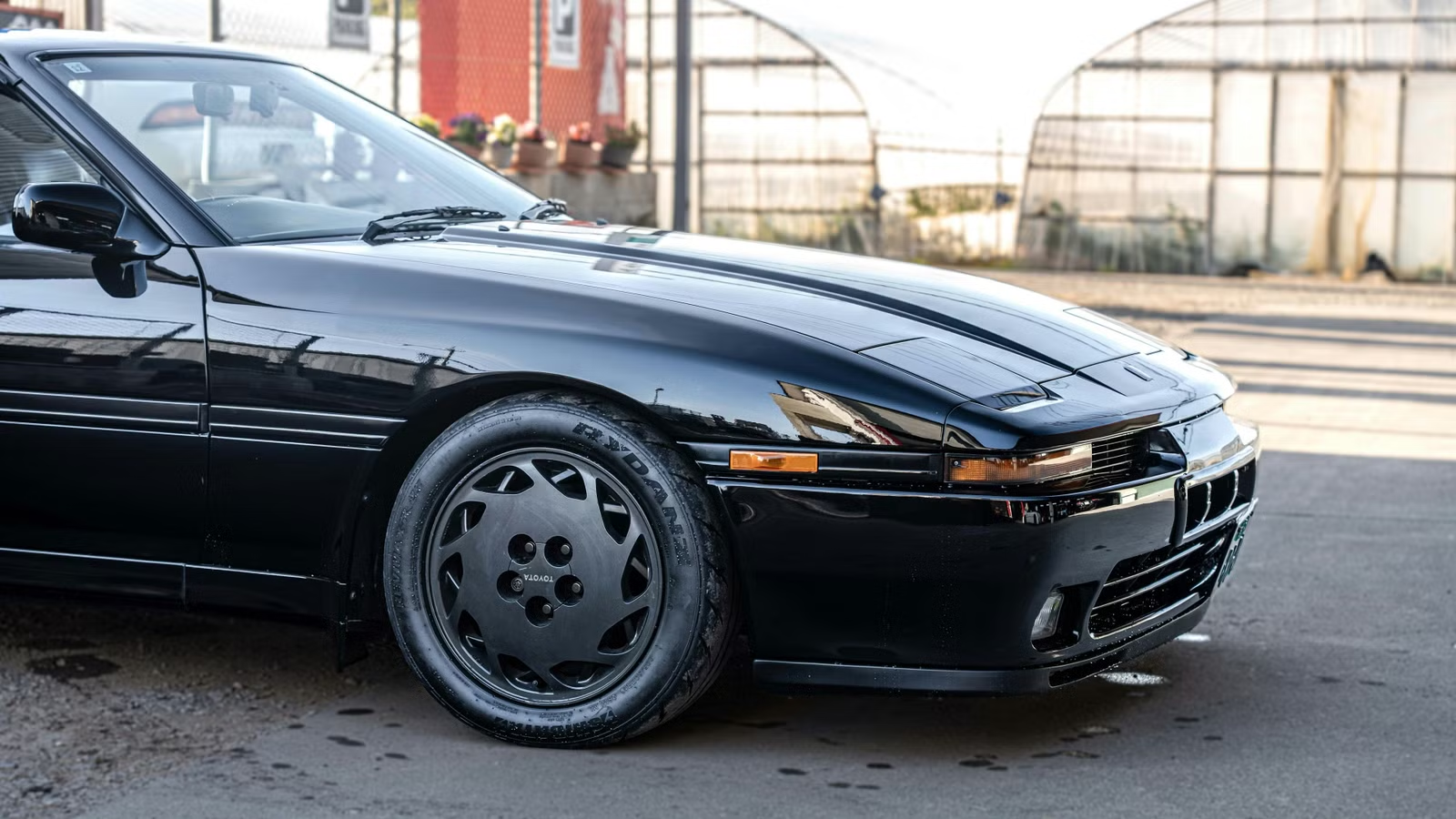
Late ’80s touring car racing came with a brutal entry fee. If an automaker wanted a faster car on the grid, it first had to sell that faster car to the public, in numbers the rulebook could count. Toyota understood this better than most, because its big turbocharged coupe was already racing and already struggling against lighter, nimbler opposition. The fix it came up with never officially left Japan, wore only one paint color, and stayed so obscure that plenty of Supra fans still have no idea it exists.
The Group A Rules That Forced Toyota’s Hand

The FIA introduced Group A in 1982 as a production-based touring car formula, and within a few years it was the class that mattered from Japan to Australia to Europe. Its central idea was homologation. A car could only race in a form that customers could actually buy, so every meaningful mechanical upgrade had to exist on a showroom model before a team could bolt it onto a race car. Teams could only modify that homologated hardware within strict limits, so a stronger road car translated directly into a faster race car.
That rule created a whole genre of strange, limited-run road cars. Automakers could legalize an upgraded version, usually called an evolution model, by building a short run of 500 street-legal examples. It’s why so many late ’80s performance specials arrived in tiny batches with odd names, and why their specs often read like a race engineer’s wish list rather than a marketing department’s.
For buyers, these cars were an odd proposition. They were tuned around a race team’s needs first, yet they still had to be registered, insured, and driven on public roads by whoever paid for them.

Why Toyota Needed A Faster Mk3 Supra

The third-generation Supra was Toyota’s flagship sports car by the late ’80s, a long, wide coupe with a turbocharged 3.0-liter inline-six and rear-wheel drive. Toyota put it into Group A, and its long-standing racing partner TOM’S campaigned the car in Japanese touring car racing.
Engine size was the Supra’s biggest handicap. Group A sorted cars into classes by displacement, and The Drive notes that the 3.0-liter Supra was classed punitively as a result, forcing it to carry more ballast than the 2.0-liter Ford Sierra Cosworth. The Sierra already dominated the series, so a heavy Toyota with less power had little chance of beating it on raw pace.
Weight compounded everything else. A Group A car kept the basic shell of its road-going twin, so the Supra’s size as a comfortable grand tourer followed it straight onto the track, where every extra pound cost time under braking and through corners.
Driver talent couldn’t close a gap that size. Toyota needed a better-equipped road car it could legally race, and the rules meant it had to build hundreds of them to get one onto the grid.
The 1988 Toyota Supra 3.0GT Turbo A Explained

Toyota’s answer arrived on August 2, 1988, when it announced a minor change to the Supra range alongside a new model called the 3.0GT Turbo A. The official 1988 announcement limited sales to 500 units and stated plainly that the car existed to make the Supra more competitive in motorsport at home and abroad.
The hardware matched that purpose. Toyota gave the 7M-GTEU inline-six more turbocharger and intercooler capacity, lifting output to 266 hp, which made it the most powerful Japanese car yet. Power reached the rear wheels through a five-speed manual, and every example was sold in Japan only.
Why Every Turbo A Left The Factory In Black

Here is the strange part. Every Turbo A was black, wheels included, yet Toyota never published a reason, and no period source explains whether it was a styling call, a cost decision on a short run, or a nod to the race program. That silence suits the car. A homologation special sold without fanfare, in one color, only in its home market, was always going to collect a little mythology.
For anyone inspecting a car at auction or in a barn, the paint is only the first test. Genuine cars should wear Toyota’s black paint code 202, “3.0GT Turbo A” decals on the doors and rear badging, and an extra duct in the front bumper that feeds air to the intercooler. Supra owner documentation also points to engine bay giveaways that are far harder to fake than stickers, including the larger turbocharger and a speed-density fuel system that replaces the regular car’s airflow meter. With only 500 built, a black 3.0GT Turbo wearing borrowed badges is much easier to find than the real thing.
The Turbo A On Track In Group A Racing

The Turbo A’s timing was terrible. It arrived just as the Sierra Cosworth handed its crown to the Nissan Skyline GT-R (R32), which joined Group A in 1989 and proved so dominant that rivals barely bothered entering. Toyota had built a sharper Supra right as the class turned into one of the toughest touring car fields in history.
Australia showed the problem clearly. Toyota Team Australia switched to a Group A Supra in 1989, but even the series organizer’s own history calls it too heavy and too underpowered to beat the Sierras, the Holden Commodores, and the Skylines. The car failed to finish the Bathurst 1000 that year, and the factory team folded at the end of the season.
The Race Cars Built From The Turbo A

Sources disagree on exactly who built the Turbo A’s racing versions. The Drive reports that Toyota Racing Development built 11 race variants for factory-backed efforts in Japan and Australia, while Australian accounts credit TOM’S with building the car Toyota Team Australia raced, and no source fully settles how the work was divided.
Privateers kept the Supra going after the factory left. John Bourke raced his own Group A Supra from 1989 through 1992, and its 1992 start made it the last Bathurst 1000 Supra for more than three decades. The homologation also opened the door to rallying, where the Supra had a brief World Rally Championship career before the Celica GT-Four arrived.
What A Supra Turbo A Is Worth Today
Every Turbo A has been legal to import under the 25-year rule since 2013, but most of the 500 cars never left Japan. Genuine examples rarely come up for public sale anywhere, and confirmed US sales are almost nonexistent.
The clearest recent reference is a Japan-based car with roughly 57,000 miles that reached a $24,000 high bid in an online auction and didn’t sell, which suggests its owner expected more. That already puts a Turbo A well above the regular third-gen Supra Turbo, which sits at a market average around $15,000. A cleaner, lower-mileage example with documentation would reasonably push higher still, though with so few changing hands, there’s no firm ceiling yet.
That scarcity is the whole story. No later Supra needed a homologation version, which leaves the Turbo A as the only one Toyota ever built to satisfy a racing rulebook. It lost the Group A war it was created to fight, but its 500-car run and single black paint job made it one of the rarest Supras Toyota ever sold.
Sources: Toyota, The Drive, Supercars, V8 Sleuth, Collecting Cars, Classic.com.

Related posts




Latest Post


No Comments