
The Forgotten Lexus Wagon Hiding A Toyota Supra’s Inline-Six
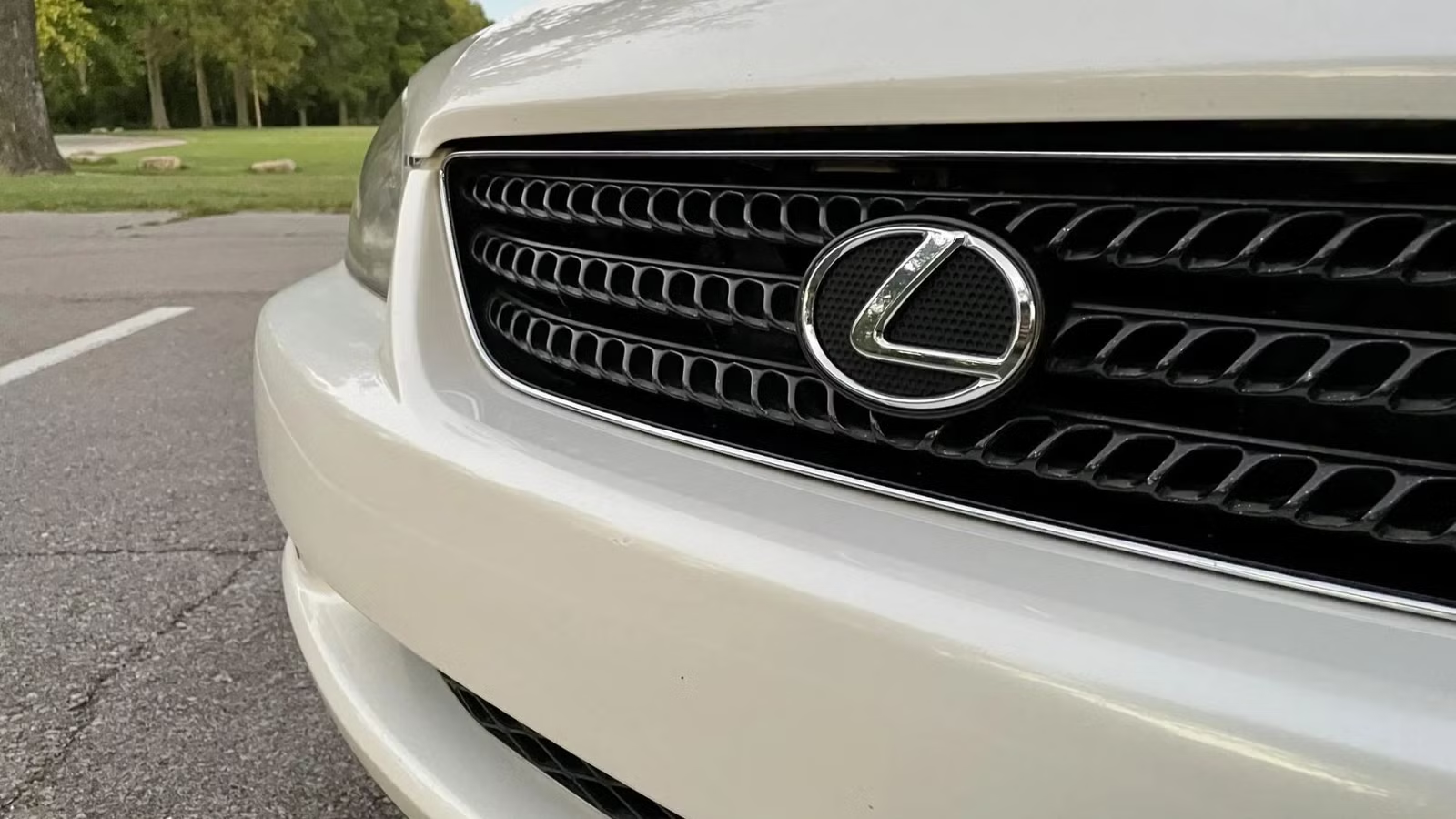
The MkIV Toyota Supra Turbo has long dominated the tuning spotlight with its twin-turbocharged inline-six, which has proven to unlock otherworldly levels of power with the correct upgrades without touching the bottom end. But with Supra prices skyrocketing while enthusiasts sing its praises, few are aware that the Japanese sports car happens to share its basic engine architecture with a sprightly wagon from Lexus. It may not have the looks, but it has all the same potential.
The Lexus for The Young Professional

During the 1990s, the fledgling Lexus brand built a reputation for crafting cushy land yachts that resonated deeply with older professionals and retirees. The brand’s serene North American showrooms displayed a trio of large sedans, the SC400 grand tourer, and the imposing LX 470 SUV. While this lineup was enough to firmly place Lexus on the map in its first decade in existence, the automaker’s focus on an older crowd left a noticeable gap.
In the summer of 2000, the IS300 sedan broke cover with its eyes on a younger demographic. It rejected the floaty disposition of its lineup stablemates, instead flaunting tighter dimensions and driving dynamics as sharp and youthful as its styling. With its name standing for “Intelligent Sports,” the IS300 featured a balanced, rear-wheel drive architecture, aiming it squarely at the benchmark BMW 3-Series.

The IS300 was heavily derived from the Toyota Altezza, which was already available exclusively in Japan, and served as a fitting basis for Lexus’s driver-focused compact sedan. While the two models shared an identical chassis, the IS300 underwent heavy upgrades beneath the sheet metal to ensure that it would rightfully earn its Lexus badge. The Altezza’s high-strung 2.0-liter four-cylinder was swapped out for a silkier inline-six, and the cabin was wrapped in standard leather upholstery rather than fabric.

The IS300 sedan proved to be immensely popular in the United States, and nearly 90,000 units were sold before a redesigned model was introduced in 2005. However, few are aware that Lexus also attached its badge to a rather elusive wagon variant during the IS300’s first-generation run.
The IS300 SportCross is a Wagon with a 2JZ Heart

The Lexus IS300 SportCross is the obscure long-roofed counterpart of the highly popular sedan. It appealed to a select group of North American buyers who defiantly preferred wagons, a niche that few automakers are gracious enough to acknowledge stateside. Its wagon layout provided a spacious cargo area without sacrificing the agility of a sedan, an appealing combination that was being actively ignored during the early 2000s SUV boom. Unlike the standard IS300 sedan, which was limited to fixed rear seats, the SportCross boasted flat-folding front passenger and rear seats, as well as a much larger hidden compartment beneath its loading floor.
Under the hood, the SportCross features the exact same 2JZ-GE powerplant as its sedan sibling. This means that its naturally-aspirated, 3.0-liter inline-six was directly related to the twin-turbocharged 2JZ-GTE unit found in Toyota’s highly revered MkIV Supra Turbo. Output for the wagon is rated at 215 horsepower and 218 lb-ft of torque, which are identical figures to its sedan counterpart. Power is sent to the rear wheels through a mandatory 5-speed automatic transmission. While the IS300 sedan offered a rather rare 5-speed manual from its second model year onward, the SportCross missed out on the third pedal option entirely. Lexus also decided to stick with a simpler rear-wheel drive layout for the wagon, even though the Toyota Altezza Gita offered all-wheel drive as an option in Japan.
A Rare Beast for North America

The IS300 SportCross entered the market at an unfortunate time. When it launched in late 2001, automakers were releasing car-based unibody SUVs left and right, with Lexus itself pioneering the luxury crossover segment with the massively popular RX300. North American buyers in particular were eager to sign on the dotted line, leaving the SportCross wagon moving against a strong SUV current. Those who sought a compact, driver-focused Lexus chose the sedan without hesitation, while those who desired space and utility fetched the keys to the RX. While the SportCross technically appealed to both demographics in one package, the SUV bandwagon effect was simply too strong.
As a result of this industry trend, only 3,078 units of the IS300 SportCross were allocated to the North American market. While it managed to hold on for four model years despite its extremely low popularity, the wagon ultimately met its demise in 2005, shortly before the second-generation IS reached dealers. The Toyota Altezza sedan and wagon promptly followed suit, as Lexus’s decision to expand beyond North America resulted in the sporty compact being replaced by the first ever Japan-bound IS.
A Wagon With Serious Tuning Potential

Even though the IS300 shares its engine architecture with the legendary MkIV Supra Turbo, it is not exactly a turnkey performance monster. However, like its sedan counterpart, the SportCross wagon does serve as a highly promising canvas for tuners. The sedan has already proved that its stock rear-wheel drive layout and remarkably balanced disposition provide an exceptional foundation for further performance upgrades, backed by massive aftermarket support, and the SportCross is no different.
A turbo conversion is widely considered to be an essential upgrade for this platform, as forced induction into the wagon’s naturally-aspirated 2JZ-GE bridges the gap to the twin-turbocharged 2JZ-GTE found in the Supra. Depending on the specific kit, the SportCross can reach anywhere from 300 to 400 hp, which is a noticeable boost from its factory 215-hp rating. As proven by the plentiful IS300 sedans with added turbochargers, the platform that underpins the SportCross is known to handle the extra output with relative ease, thanks to its rigid chassis and planted disposition from its double-wishbone suspension. A basic turbo conversion kit costs roughly $5,000 on average, but a proper setup with standalone fuel management, a heavy-duty torque converter, upgraded injectors, and a new exhaust system will set owners back at least $10,000.
Why The IS300 SportCross Is An Enthusiast Bargain

In the used market, the IS300 SportCross remains as obscure to buyers as it was when new, except for avid wagon enthusiasts. As a result, it remains highly attainable. Clean examples on Bring a Trailer with moderate mileage tend to sell for around $16,000 on average, though a few extremely pristine wagons have sold for as much as $26,000.
Sources: Bring a Trailer, Lexus

Related posts





Latest Post


No Comments